


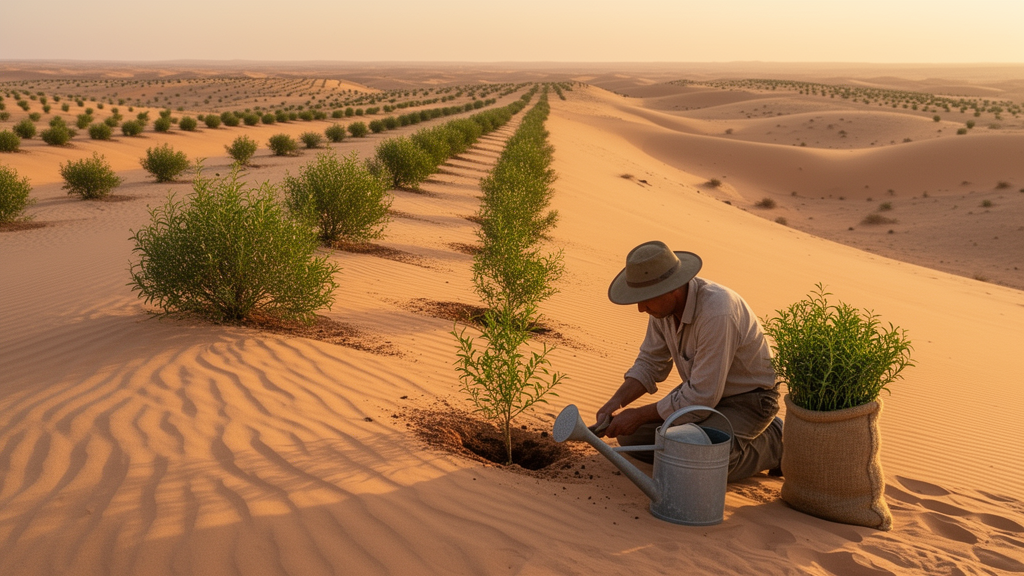
In the arid heart of Algeria, a decades-long experiment in stopping the sand has quietly delivered one of the clearest answers yet to a question that haunts drylands across North Africa: which plant should you choose when you try to pin a moving dune in place? A new study published in the Journal of Orthoptera Research examined three shrub plantations established 31 years earlier at El Mesrane, in the Djelfa Wilaya south of Algiers, and found that the choice of shrub leaves a lasting signature not only on the plants that colonize the dunes but also on the grasshopper communities that live among them. After more than three decades, the native retam bush, Retama raetam, emerged as the clear winner, hosting the richest flora and the most distinctive assemblage of Orthoptera, including a notable concentration of rare grasshopper species.
The El Mesrane dune fixation project was launched in 1982 by the National Institute of Forestry Research (INRF) with a practical goal: to stabilize drifting sand and slow its advance toward threatened cities and croplands in an arid zone that stretches northward from the Sahara. Algeria has pursued anti-desertification policies since 1962, including the famous Green Dam project, pastoral cooperatives, and a pastoral code, but these efforts have yielded limited results, partly because of difficulties motivating pastoralists to participate in rangeland management. Biological fixation, the planting of sand-binding vegetation, is one of two complementary tools used against moving sand, the other being mechanical stabilization. Several bush species have been tried over the years, including Retama raetam, Tamarix gallica, Tamarix aphylla, Elaeagnus angustifolia, Lycium shawii, and the prickly pear cactus Opuntia ficus-indica, with varied success. What had been missing, the researchers note, is knowledge of how these plantations affect the insects that form a crucial link in the food web.
Orthoptera, the order that includes grasshoppers and crickets, matter far beyond their chirping. They are major prey for vertebrates and are considered good indicators of ecosystem health, because when vegetation cover on a dune is scarce and the soil unstable, insect richness collapses. The research team, working at the Desertification Control Station of the INRF in Djelfa, set out with three objectives: to describe the plant and Orthoptera communities associated with the three main fixation shrubs and determine which produced the highest diversity; to test which grasshopper assemblage most resembled those of nearby steppe environments; and to identify which dune habitat hosted the most stable community by taking rare species into account.
The study site lies about 30 kilometers north of Djelfa city, between 860 and 880 meters above sea level, bounded by a sebkha, a vast salt flat, to the north and the Ouled Nail mountains to the south. The climate is harsh: over the 1984 to 2014 period, the dry season lasted ten months from February to November, with intense drought from June to September, and annual precipitation averaged roughly 249 millimeters. The Emberger pluvio-thermic quotient placed the area in the upper arid bioclimatic stage with fresh winters, a Mediterranean context at the edge of the Sahara. Before fixation, the dune soils were almost devoid of vegetation; after the shrubs were established, natural vegetation progressively colonized up to 65 percent of the dune surface.
Vegetation surveys were conducted in March and April of 2013 and 2014 across 30 plots, ten in each plantation, using a 10-meter rope to count individuals within uniform 100-square-meter areas. In total, the surveys recorded 46 plant species belonging to 22 families, with Asteraceae, Poaceae, Plantaginaceae, Brassicaceae, and Lamiaceae the most abundant. The team analyzed the flora through several complementary lenses: community indices, Raunkiaer’s system of life forms, phytosociological classification, and the plants’ resistance to moving sand, using psammophyte groups defined in earlier work at the same site. Soil samples taken beneath bush canopies in the retam and tamarix plantations showed remarkably similar chemistry, with low salt content around 0.3 to 0.4 mS/cm, organic matter between 1.54 and 1.85 percent, a pH near 7.9, and total calcium carbonate near 7.2 percent, which meant that differences between the plantations could not be attributed to soil chemistry.
The results revealed a clear gradient running from retam through opuntia to tamarix. The retam plantation hosted a significantly higher number of plant species with lower dominance than the other two, and its flora was enriched with therophytes, short-lived annual plants, making up more than two-thirds of its species, along with hemicryptophytes from the steppe group Stipetea and perennial xerophilous fallow lands. Across all three plantations, therophytes accounted for 48 percent of the flora, chamaephytes 22 percent, phanerophytes 13 percent, and hemicryptophytes 9 percent. In contrast, the tamarix plantation was dominated by vegetation of arid and Saharan dunes, the Calligono-Aristidetea alliance, and carried the highest proportion of plants linked to mobile or recently fixed sand. Mediterranean elements peaked in the retam plantation at 66.67 percent of the flora, while endemic elements prevailed under opuntia. Statistical comparisons using analysis of similarity confirmed that the plant compositions of all three plantations differed significantly.
The Orthoptera sampling, carried out monthly from March to December 2014 with sweep nets in randomly placed 3-by-3-meter quadrats, recorded 32 species. Only one, the bush-cricket Platycleis affinis, belonged to the Ensifera; the rest were Caelifera, dominated by the Acrididae with 24 species, followed by Pamphagidae with four, Pyrgomorphidae with two, and Dericorythidae with one. Within the Acrididae, the Oedipodinae were the richest subfamily with 15 species. Cumulative monthly richness averaged 20 species in the retam plantation, 19.6 in the opuntia plantation, and just 12 in the tamarix plantation, while abundance followed the same pattern at 86, 58, and 33 individuals respectively. Twelve species were shared by all three habitats, but seven were found only in the retam plantation, four only under opuntia, and a single one under tamarix.
One of the study’s most intriguing findings emerged when the researchers compared their dune samples with grasshopper surveys from three steppe sites in the same Wilaya: the well-preserved alpha steppe of Oued Sdar, dominated by Stipa tenacissima and protected from grazing; the degraded alpha steppe of Moudjbara, dotted with Aleppo pine; and the Lygeum spartum pasture of El Merdja on gypso-calcareous soils. A cluster analysis of 37 Orthoptera species across seven habitats showed that the retam plantation’s insect community stood apart as original, while the fauna of the tamarix and opuntia plantations clustered close to that of the degraded Moudjbara steppe. Although the compositions of the three dune assemblages were not statistically distinct overall, eight species differed significantly in abundance between habitats, with their highest values in the retam plantation, and none reached peak abundance under tamarix.
The pattern of rare and common species proved especially revealing. Using records from the Muséum National d’Histoire Naturelle in Paris to classify species by how many Algerian localities they occupy, the team found four rare species among the twelve associated with the retam plantation, but only one under opuntia and none under tamarix. Conversely, half of the species characteristic of the opuntia plantation were among the most common in the region. This suggests that specialist and generalist grasshoppers are not distributed randomly across the dunes but track habitat stability: rare, specialized species accumulate where the environment has settled, while common, disturbance-tolerant generalists dominate where sand remains mobile. The tamarix plantation, with the least stable soil, hosted precisely the kind of unspecialized species adapted to difficult conditions.
Why did retam outperform its rivals? The researchers propose a subtle mechanism rather than a chemical one. Although Retama raetum is a legume famous for fixing nitrogen through Rhizobium-associated roots, the proportion of nitrophilous species was actually lower in its plantation than under opuntia, likely because freely roaming sheep and goats enriched all three habitats equally with organic matter. Instead, the team hypothesizes that the benefit comes from a thin layer of fallen leaves beneath the retam canopy, which prevents the sand from shifting and thereby creates the stable seedbed that spring-flowering therophytes need to germinate. The finding carries a practical message for restoration programs across arid North Africa and beyond: the shrub you plant determines the ecosystem you get three decades later, and choosing a species that stabilizes the surface while nurturing a diverse herb layer can tip the balance from a depauperate dune toward a functioning steppe community, complete with the rare grasshoppers that signal a habitat on the mend.
Subject of Research: Long-term effects of three shrub species used for dune fixation on vegetation and Orthoptera communities in arid Algerian dunes
Article Title: Long term effect of dune fixation by three shrub species on vegetation and Orthoptera communities in arid dunes of Algeria
Article References: Sba, B. E. H., Djemai, I., Petit, D., & Guendouz Benrima, A. (2025). Long term effect of dune fixation by three shrub species on vegetation and Orthoptera communities in arid dunes of Algeria. Journal of Orthoptera Research, 34(2), 223-232. https://doi.org/10.3897/jor.34.137800
Image Credits: AI Generated
Keywords: dune fixation, desertification, Algeria, Retama raetam, Tamarix gallica, Opuntia ficus-indica, Orthoptera, grasshoppers, arid ecosystems, ecological restoration, biodiversity, psammophytes
Cite Scienmag News
Margaret Porter. (October 18, 2026). Thirty-One Years of Dune Planting in Algeria Reveals Which Shrub Best Restores Life to Shifting Sands. Scienmag. https://scienmag.com/thirty-one-years-of-dune-planting-in-algeria-reveals-which-shrub-best-restores-life-to-shifting-sands/
Margaret Porter. "Thirty-One Years of Dune Planting in Algeria Reveals Which Shrub Best Restores Life to Shifting Sands." Scienmag, 18 October 2026, https://scienmag.com/thirty-one-years-of-dune-planting-in-algeria-reveals-which-shrub-best-restores-life-to-shifting-sands/. Accessed 18 October 2026.
Margaret Porter. "Thirty-One Years of Dune Planting in Algeria Reveals Which Shrub Best Restores Life to Shifting Sands." Scienmag. October 18, 2026. https://scienmag.com/thirty-one-years-of-dune-planting-in-algeria-reveals-which-shrub-best-restores-life-to-shifting-sands/


