


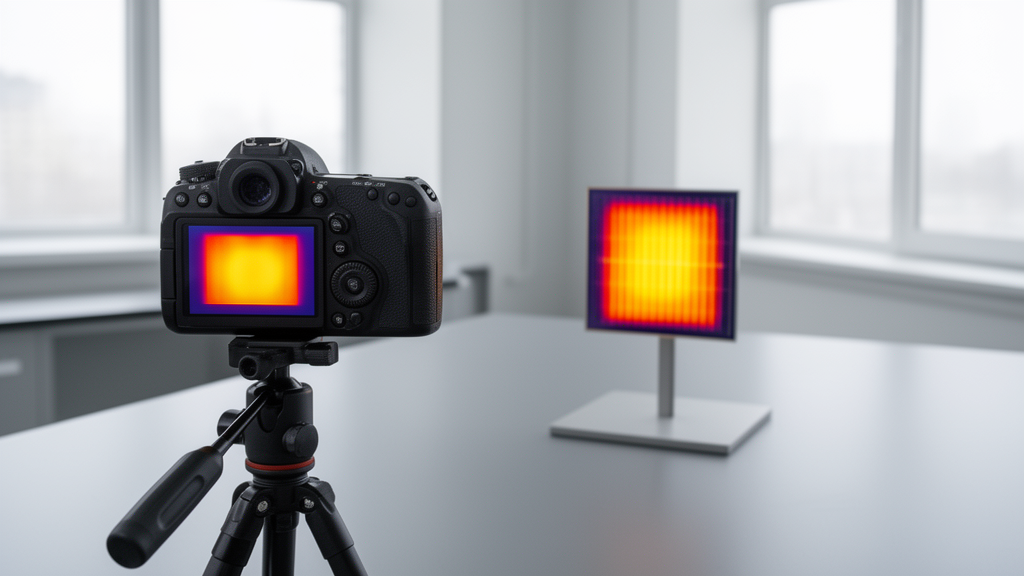
Commercial cameras can be remarkably powerful instruments, producing images with exquisite detail that mimic real life, and in laboratory settings, specially designed cameras can photograph objects in the infrared region of the spectrum, invisible to the naked eye. Now, researchers from the University of Stuttgart, the Research Center Jülich, and the German company Solarzentrum Stuttgart have shown that a camera most people could buy at an electronics store can be transformed, with only minor modifications, into a quantitative scientific instrument capable of measuring the efficiency of solar cells. The work, published in The Journal of Applied Physics by AIP Publishing, challenges the long-standing assumption that this kind of measurement demands expensive, carefully calibrated industrial equipment.
The quantity at the heart of the study is electroluminescent quantum efficiency, a value commonly used to determine how well a solar cell converts light into electricity. When a solar cell is electrically biased, it emits a faint glow in the infrared, and the intensity of that luminescence is directly related to the cell’s voltage. Generally speaking, the higher the luminescent quantum efficiency, the better the solar cell, because a more efficient device radiates more light for a given electrical input. Measuring this value has traditionally required dedicated scientific cameras whose response to light must be precisely characterized, a process that adds significant cost and complexity to quality control in photovoltaics manufacturing and research.
Our approach shows that even a relatively inexpensive consumer camera can provide quantitative results when its physical response is properly modeled and calibrated, said author Jürgen Werner. The key insight of the team is that the camera does not need to be a purpose-built scientific detector as long as the way it responds to incoming photons is fully understood. By constructing a suitable physical camera model, the researchers could convert raw pixel brightness into absolute luminescent quantum efficiency, turning an ordinary photograph into a map of local solar cell quality.
The camera the team selected was already primed for the experiment because it lacked an internal infrared-blocking filter, a component that is normally present in most commercial cameras. Manufacturers install these filters so that consumer photographs look natural to the human eye, but their removal opens a window into the near-infrared, where solar cells emit their electroluminescence. Cameras with this filter removed are also popular for artistic infrared photography and for capturing images of the night sky, which means the hardware required for the measurement is accessible to hobbyists as well as laboratories.
To suppress unwanted visible light, the researchers added a long-pass filter in front of the camera lens. This optical component blocks shorter wavelengths, including the visible background light that would otherwise contaminate the signal, while allowing the longer infrared wavelengths of the electroluminescence to pass through to the sensor. The result is a clean infrared electroluminescence image that can later be analyzed based on brightness, with the pixel values encoding quantitative information about the emitting device rather than merely a pretty picture.
An electroluminescence image contains much more quantitative information than simply showing bright and dark regions, said Werner. With a suitable physical camera model and calibration, it can provide absolute luminescent quantum efficiency and, therefore, information about the local quality of a solar cell or module. This local dimension is particularly important in practical photovoltaics, where defects, cracks, or degraded regions within a single cell or module can drag down overall performance even when the rest of the device is healthy. A calibrated consumer camera can therefore reveal exactly where a solar module is losing efficiency, something that previously required laboratory-grade imaging systems.
The implications for the solar industry could be substantial. Quality assurance in photovoltaics manufacturing relies on electroluminescence imaging to spot defects on production lines, and field inspections of installed modules use the same technique to identify degradation caused by weathering, microcracks, or faulty connections. If the physical model developed by the Stuttgart and Jülich teams proves robust across different consumer cameras, the barrier to performing absolute quantum efficiency measurements could drop dramatically, allowing smaller companies, research groups in developing institutions, and even advanced inspection services to carry out measurements that were once the exclusive domain of well-funded laboratories.
The methodology also carries broader lessons for experimental physics. The study demonstrates that the limiting factor in many optical measurements is not the detector itself but the degree to which its response is understood. A consumer camera sensor, with its Bayer color filter array, its nonlinear response curve, and its manufacturer-specific processing, is a far messier detector than a scientific CCD, yet the researchers showed that all of these quirks can be folded into a physical model. Once calibrated, the messy detector becomes a quantitative one. This modeling philosophy could extend well beyond photovoltaics, wherever faint light emission carries information about the underlying device.
The researchers plan to expand the camera’s capabilities in future work, keeping an emphasis on using commercially available technology. Our next step is to use the calibrated camera to determine quantum efficiencies and open-circuit voltages of further, previously uncharacterized solar cells and modules, said Werner. The same model should also be applicable to photoluminescence measurements and potentially to measurements performed in daylight. Photoluminescence imaging, in which sunlight or a laser excites the solar cell and the emitted light is analyzed, is another cornerstone technique in photovoltaics characterization, and daylight operation would be transformative for field inspections, where modules currently must often be measured in darkness or under controlled conditions.
The article New Camera Model for Absolute Quantum Efficiency Measurements from Electroluminescence of Solar Cells or Modules is authored by Jürgen H. Werner, Georgette Udo, and Liviu Stoicescu, and it appears in The Journal of Applied Physics on Sept. 22, 2026. As solar energy continues its rapid global expansion, the demand for fast, affordable, and accurate efficiency measurements grows with it, and this study suggests that the tools required may already be sitting in camera shops around the world. With a removed infrared filter, a long-pass filter, and a well-built physical model, an ordinary camera becomes a window into the invisible light that reveals exactly how good a solar cell really is.
Subject of Research: Electroluminescence-based quantum efficiency measurement of solar cells using a calibrated consumer camera
Article Title: A normal camera that can detect solar cell efficiency
Article References: A normal camera that can detect solar cell efficiency. (n.d.). Original publication
Image Credits: AI Generated
DOI: Not provided
Keywords: solar cells, electroluminescence, quantum efficiency, consumer camera, photovoltaics, infrared imaging, camera calibration, The Journal of Applied Physics, solar cell efficiency, long-pass filter, open-circuit voltage, photoluminescence
Cite Scienmag News
Katie Riggs. (October 18, 2026). A Normal Camera That Can Detect Solar Cell Efficiency. Scienmag. https://scienmag.com/a-normal-camera-that-can-detect-solar-cell-efficiency/
Katie Riggs. "A Normal Camera That Can Detect Solar Cell Efficiency." Scienmag, 18 October 2026, https://scienmag.com/a-normal-camera-that-can-detect-solar-cell-efficiency/. Accessed 18 October 2026.
Katie Riggs. "A Normal Camera That Can Detect Solar Cell Efficiency." Scienmag. October 18, 2026. https://scienmag.com/a-normal-camera-that-can-detect-solar-cell-efficiency/


