


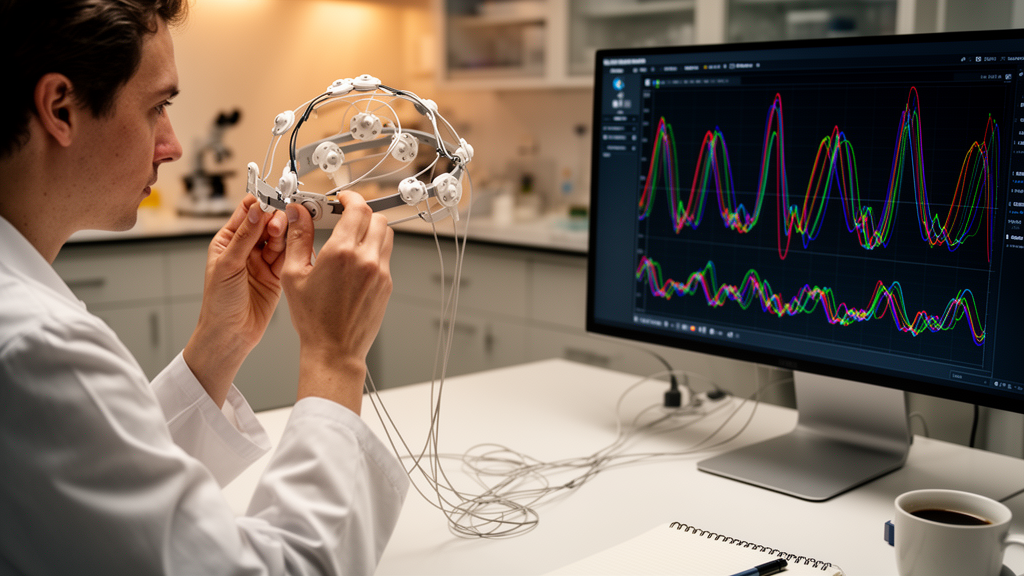
Epilepsy affects roughly 50 million people worldwide, and for many patients the unpredictable timing of seizures is what most seriously erodes quality of life. Electroencephalography, or EEG, records the brain’s electrical activity in real time and has long played a central role in epilepsy diagnosis and monitoring. Yet EEG signals are notoriously nonstationary, noisy and highly variable between individuals, which makes manual interpretation time-consuming and vulnerable to subjective bias. Deep learning has become increasingly important for seizure prediction, but its performance often depends strongly on network architecture, and designing an effective architecture by hand can demand substantial time and computing resources. A research team from Hefei University of Technology and the University of Science and Technology of China now reports a framework that lets an algorithm automatically search for suitable network structures for EEG-based seizure prediction, rather than relying on human trial and error.
The framework, called CMS-NAS, combines three distinct families of neural networks within a search space specifically designed for seizure prediction: convolutional neural networks, the Mamba architecture and spiking neural networks. Rather than simply connecting the three types of networks, the researchers designed two hybrid building blocks, called ConvSpike and MambaSpike, which weave the complementary strengths of the components into single units. The system first converts multichannel EEG signals into time-frequency representations using a short-time Fourier transform. It then generates a population of candidate network architectures, each of which is trained and evaluated. Better-performing architectures are selected for crossover and mutation to produce new generations, an evolutionary loop that iteratively refines the candidate pool.
Crucially, the search simultaneously considers prediction performance and model size, allowing the algorithm to seek architectures that balance accuracy and efficiency. The resulting search space contains about 1.74 × 10¹⁷ possible architectures, a number so vast that manual exploration would be hopeless. By constraining the space around seizure prediction tasks and the hybrid building blocks, the team reduced the structural redundancy, search cost and computational burden typically associated with manually designed or conventional neural architecture search models. The approach reflects a broader trend in biomedical AI: instead of asking human engineers to guess the best network topology, the search algorithm itself explores the design landscape and evolves solutions tuned to the data.
To evaluate seizure prediction rigorously, the researchers considered several measures. AUC reflects the model’s overall ability to distinguish different EEG states, with higher values generally indicating better discrimination. Sensitivity measures the proportion of actual seizures that are successfully predicted, while the study’s false-positive rate measures the number of false alarm events per hour of interictal EEG. Higher sensitivity and lower FPR are therefore desirable. The researchers also calculated P values against a random prediction baseline, with P < 0.05 considered statistically significant. To reduce isolated false alarms, they used a k-of-n strategy, in which at least 20 of 30 consecutive predictions had to be positive to count as a positive event. The prediction horizon was set to 1 minute, giving patients and caregivers a short but actionable warning window.
The team tested CMS-NAS on two public datasets, CHB-MIT and AES, and on a private clinical dataset. They used both patient-specific and patient-independent evaluation. In the patient-specific setting, data from other seizure events of the same patient were used for training and validation, while one seizure event was held out for testing. In the patient-independent setting, all data from one patient were held out for testing while the remaining patients were used for training, providing a more demanding test of generalization to previously unseen patients. This dual evaluation matters because real-world clinical deployment would require models that work for new patients, not only for those whose data the system has already seen.
On CHB-MIT, CMS-NAS achieved an AUC of 0.930, sensitivity of 88.5% and an FPR of 0.108 false alarms per hour in patient-specific testing. Seventeen of 18 subjects met the study’s statistical significance criterion. In patient-independent testing, the model achieved an AUC of 0.672 and sensitivity of 60.7%, remaining ahead of the compared methods on these two core measures. On the AES dataset, CMS-NAS achieved an AUC of 0.878, sensitivity of 87.3% and an FPR of 0.107 in patient-specific testing, while its patient-independent sensitivity reached 61.3%, the highest among the compared methods. On the private clinical dataset, the model achieved an AUC of 0.923, sensitivity of 84.4% and an FPR of 0.138 in patient-specific testing, and in patient-independent testing it achieved an AUC of 0.662, sensitivity of 51.6% and an FPR of 0.253.
The researchers also evaluated deployment efficiency, and the numbers are striking for a field often dominated by heavyweight models. The architecture search took 11 hours, while the final model had only 0.034 million parameters, a model size of 0.131 MB, 0.293 million MACs, and an inference latency of 1.308 milliseconds. Such a footprint opens the door to running seizure prediction directly on lightweight wearable or bedside hardware, where memory, energy and latency budgets are tight. For patients, that could eventually translate into continuous, low-power monitoring outside the hospital rather than prediction confined to specialized clinical equipment.
Ablation experiments showed why the hybrid design works. CNN, Mamba and SNN were not simply stacked together but played complementary roles: the CNN extracted local time-frequency features, Mamba modeled long-range temporal dependencies, and the SNN used sparse spike-based processing to enhance transient abnormal signals. Removing any core component reduced overall prediction performance, confirming that the search algorithm had good reason to favor architectures containing all three. The result suggests that biologically inspired spiking computation, efficient sequence modeling and classical convolutional feature extraction each contribute something the others cannot replace when the task is spotting the fleeting electrical signatures of an impending seizure.
The researchers conclude that CMS-NAS can reduce some of the structural redundancy, search cost and computational burden associated with manually designed or conventional NAS-based seizure prediction models, while balancing prediction performance and lightweight deployment. However, the current framework is designed for fixed tasks and uses only single-modal EEG data. Future work will explore multimodal seizure prediction and architectures that can adapt to a wider range of tasks, further testing the framework’s generality and practical value. The paper, A Hybrid Convolutional, Mamba and Spiking Neural Network Architecture Search for Seizure Prediction, was published in the journal Cyborg and Bionic Systems on Sep 30, 2026, by authors including Bo Yu, Chang Li, Rencheng Song, Xiang Liu, Ruobing Qian and Xun Chen, with support from the National Key Research and Development Program of China, the National Natural Science Foundation of China and other Chinese funding agencies.
Subject of Research: Neural architecture search for EEG-based epileptic seizure prediction
Article Title: AI searches for a better, lightweight network to predict epileptic seizures
Article References: AI searches for a better, lightweight network to predict epileptic seizures. (n.d.). Original publication
Image Credits: AI Generated
DOI: Not provided
Keywords: epilepsy, seizure prediction, EEG, neural architecture search, deep learning, spiking neural networks, Mamba, convolutional neural networks, CHB-MIT, lightweight AI, Cyborg and Bionic Systems, biomedical engineering
Cite Scienmag News
Denise Maddox. (October 18, 2026). AI searches for a better, lightweight network to predict epileptic seizures. Scienmag. https://scienmag.com/ai-searches-for-a-better-lightweight-network-to-predict-epileptic-seizures/
Denise Maddox. "AI searches for a better, lightweight network to predict epileptic seizures." Scienmag, 18 October 2026, https://scienmag.com/ai-searches-for-a-better-lightweight-network-to-predict-epileptic-seizures/. Accessed 18 October 2026.
Denise Maddox. "AI searches for a better, lightweight network to predict epileptic seizures." Scienmag. October 18, 2026. https://scienmag.com/ai-searches-for-a-better-lightweight-network-to-predict-epileptic-seizures/


