


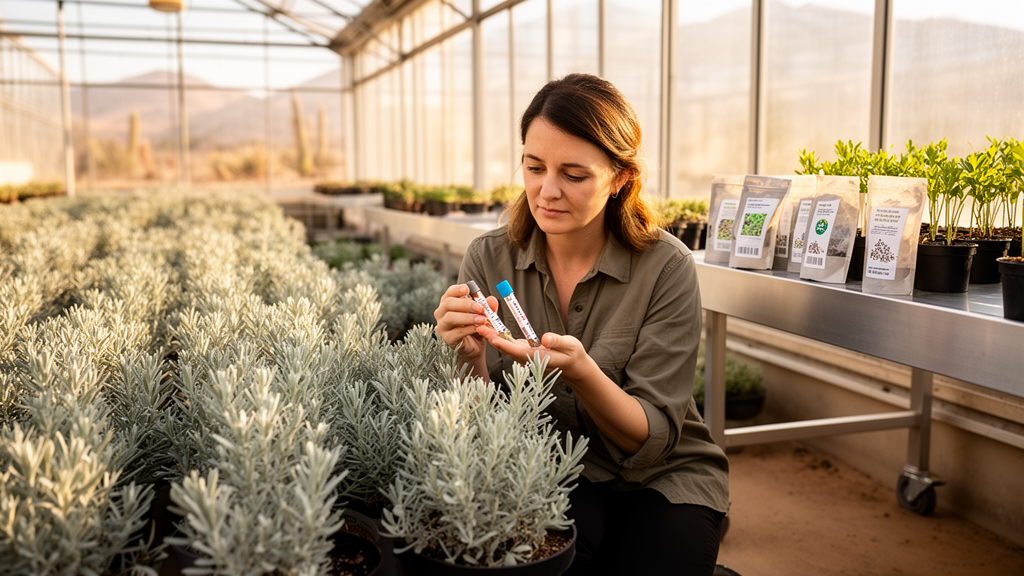
Deep in the deserts of Xinjiang, China, a small evergreen shrub is quietly testing the limits of modern conservation science. Ammopiptanthus nanus, a relict legume endemic to Central Asian deserts, is one of only two evergreen broad-leaved shrubs that survive in the Asian temperate desert, and it is under siege. Habitat fragmentation, intrinsically low reproductive rates and a demographic profile dominated by aging adults with few seedlings have pushed the species to the edge, earning it dual protection as a National Category II and Xinjiang Category I protected plant. A new study published in Nature Conservation has now performed the first integrated genetic audit of the ex situ conservation populations established across China to save it, and the results carry a warning that resonates far beyond this single species: not all rescue programs are created equal.
The research team, led by scientists working with four independently managed ex situ populations, sampled 114 individuals and subjected them to a battery of molecular markers rarely combined in a single conservation assessment. The toolkit included expressed sequence tag–simple sequence repeats, or EST-SSRs, which offer high-resolution snapshots of biparentally inherited nuclear diversity; three chloroplast DNA fragments, psbA–trnH, trnL–trnF and trnS–trnG, which trace maternal lineages through seeds; and the nuclear ribosomal internal transcribed spacer region, amplified with universal ITS1/ITS4 primers. Because each marker system reports on a different slice of the genome, with different inheritance modes and different sensitivities to recent demographic events, the combined data allowed the researchers to disentangle what each conservation strategy had actually preserved.
The four populations were as different in management history as they were in geography. Tazhong Botanical Garden, at roughly 1,100 meters altitude, was founded about 22 years ago and has been maintained through large-scale, multigenerational cultivation with intermittent wild genetic supplementation. The Forestry Academy of Sciences population, at about 2,180 meters, was established roughly 8 years ago from just 3 to 5 wild founders and has received no subsequent management. A near-site fenced conservation area at about 2,500 meters relies on natural regeneration within a semi-natural setting. Finally, a Forestry and Grassland Administration–managed zone, also near 2,180 meters, was established less than 4 years ago from 2 to 3 wild founders and receives only basic horticultural care. None of these programs followed standardized protocols for founder sampling or genetic management, making a comparative evaluation both timely and revealing.
The nuclear marker data told a clear story of genetic erosion. The wild reference population possessed the highest allelic diversity, with a mean of 8.733 alleles per locus and rarefied allelic richness of 8.462, but it also showed severe heterozygote deficiency, with an observed heterozygosity of just 0.230 and a fixation index of 0.685. Among the ex situ populations, Tazhong Botanical Garden retained the most nuclear diversity, posting the highest Shannon’s Information Index at 1.523, expected heterozygosity of 0.675, observed heterozygosity of 0.398 and the lowest fixation index among all sites at 0.404. The gradient of declining allelic richness, running from the wild population through Tazhong, then the Administration zone, the near-site area and finally the Forestry Academy population, confirms that the botanical garden most effectively captured the wild gene pool, while the Forestry Academy site, with allelic richness of only 5.000, epitomizes an extreme founder bottleneck followed by unmanaged drift.
Yet the chloroplast and ITS sequences flipped the script in a way that initially looked contradictory. The Forestry Academy population, despite its impoverished nuclear diversity, harbored the greatest number of haplotypes, with four detected through ITS and five through cpDNA, alongside the highest haplotype diversity of any ex site. Tazhong, by contrast, contained only a single chloroplast haplotype despite its rich nuclear variation. The researchers interpret this cytonuclear discordance not as a failure of any single dataset but as an informative outcome of differential evolutionary pressures. EST-SSRs, being biparentally inherited and recombining, are highly sensitive to recent bottlenecks and inbreeding, while the haploid, maternally inherited cpDNA is not diluted through pollen flow and therefore preserves a strong signal of historical maternal lineage diversity. In other words, the Forestry Academy founders were derived from multiple distinct maternal lines, preserving ancient polymorphisms, whereas Tazhong’s seeds likely all originated from one or a few maternal sources even as a genetically diverse pollen pool introduced nuclear variation through recombination.
Population structure analyses reinforced the distinctiveness of the Forestry Academy site. STRUCTURE Bayesian clustering identified an optimal K of 5, principal coordinate analysis separated all individuals into two primary groups, one exclusively containing Forestry Academy individuals, and neighbor-joining trees based on Nei’s genetic distance produced subgroups consistent with these results. Pairwise differentiation statistics showed the Forestry Academy population diverging from all others with FST values between 0.283 and 0.363, while the wild, Administration and Tazhong populations displayed low differentiation, with FST values between 0.047 and 0.089. Analysis of molecular variance revealed that roughly 90 percent of nuclear variation resided within populations rather than among them, and cpDNA and ITS AMOVA results pointed the same direction, with 71 and 68 percent of variation within populations respectively.
Perhaps the most sobering finding was universal: every population, including the wild source, displayed high inbreeding coefficients, with fixation indices ranging from 0.404 to 0.685. The researchers attribute this not primarily to ex situ management but to the species’ intrinsic reproductive ecology. As a self-compatible, long-lived perennial shrub in fragmented habitats, A. nanus likely experiences prevalent geitonogamous selfing, in which insect-mediated pollination delivers substantial within-plant fertilization, an effect amplified in sparse populations where pollinator movements are restricted. Limited seed dispersal also produces fine-scale spatial genetic structure, meaning local mating occurs among relatives and generates excess homozygosity. Because all ex situ populations were established from seed, clonal propagation is definitively excluded as a contributing factor, underscoring that mating system dynamics are the principal driver of the observed heterozygosity deficit.
The study’s authors propose a threefold strategy to secure the species’ evolutionary resilience. First, they recommend diversifying genetic foundations by introducing founders from multiple genetically distinct wild sources and expanding population sizes to mitigate drift. Second, they call for enhancing gene flow among ex situ sites through periodic interpopulation transplants and facilitated distant cross-pollination, integrated with coordinated breeding programs. Third, they urge the establishment of long-term genetic monitoring, incorporating periodic assessment of both nuclear and chloroplast genomic diversity, supported by a centralized germplasm registry. The contrasting profiles of Tazhong and the Forestry Academy population demonstrate why founder sampling strategy is so critical: capturing multiple maternal lineages preserves organellar history, while ensuring a diverse pool of paternal contributors is essential for maintaining nuclear variation.
For conservation practitioners worldwide, the message is unambiguous. Ex situ programs can indeed serve as vital genetic reservoirs for endangered species, enabling future reintroduction and mitigating extinction risk, but their long-term success hinges on the genetic representativeness of founder stocks and subsequent management practices. When these are left to chance, as they were for A. nanus, the result is a patchwork of conservation outcomes, each preserving a different and incomplete slice of the species’ evolutionary legacy. Multi-molecular marker audits, combining nuclear SSRs with organellar DNA, offer a rigorous way to measure what has actually been saved and to design interventions before genetic erosion becomes irreversible. For this remarkable desert relict, the clock is ticking, but the roadmap for saving its full genetic heritage now exists.
Subject of Research: Evaluating the conservation effectiveness of Ammopiptanthus nanus (Fabaceae) under different ex situ strategies through multi-molecular marker analysis
Article Title: Evaluating the conservation effectiveness of Ammopiptanthus nanus ( Fabaceae ) under different ex situ strategies through multi-molecular marker analysis
Article References: Ma, L., Liu, J., Lu, Z., Wang, X., Zhang, D. Y., Wang, J., & Shi, W. (2026). Evaluating the conservation effectiveness of Ammopiptanthus nanus (Fabaceae) under different ex situ strategies through multi-molecular marker analysis. Nature Conservation, 63, 17-35. https://doi.org/10.3897/natureconservation.63.169174
Image Credits: AI Generated
DOI: 10.3897/natureconservation.63.169174
Keywords: Evaluating, conservation, effectiveness, Ammopiptanthus, nanus, Fabaceae, under, different, situ, strategies, multi-molecular, marker
Cite Scienmag News
Juliet Wilcox. (October 18, 2026). Genetic audit reveals which ex situ strategies best protect a rare desert shrub. Scienmag. https://scienmag.com/genetic-audit-reveals-which-ex-situ-strategies-best-protect-a-rare-desert-shrub/
Juliet Wilcox. "Genetic audit reveals which ex situ strategies best protect a rare desert shrub." Scienmag, 18 October 2026, https://scienmag.com/genetic-audit-reveals-which-ex-situ-strategies-best-protect-a-rare-desert-shrub/. Accessed 18 October 2026.
Juliet Wilcox. "Genetic audit reveals which ex situ strategies best protect a rare desert shrub." Scienmag. October 18, 2026. https://scienmag.com/genetic-audit-reveals-which-ex-situ-strategies-best-protect-a-rare-desert-shrub/


