


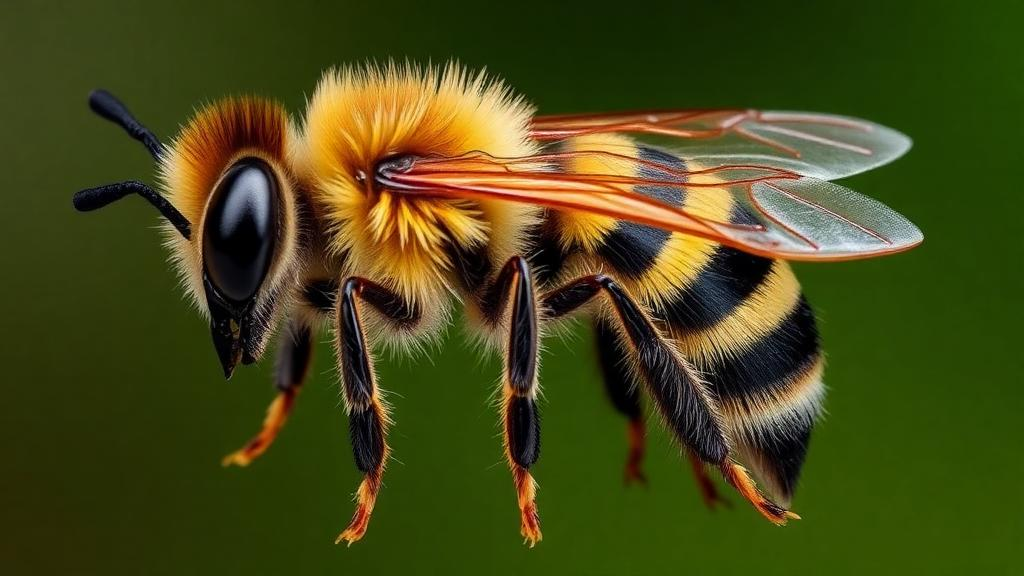
Deep in the mountains of Kyrgyzstan, two bees have been hiding in plain sight. They look so much like their closest relatives that for decades they were filed away under the wrong names, their true identities masked by the notoriously uniform body plan of the cuckoo bees. Now, a sweeping revision of the genus Thyreus in the West and Central Palaearctic, published in the Deutsche Entomologische Zeitschrift, has finally pulled them into the light, describing two new species, resolving long-standing puzzles about missing sexes and host relationships, and delivering a completely rebuilt identification key to the twelve European members of this challenging group.
Thyreus is the largest genus of the obligately parasitic bee tribe Melectini, with roughly 115 species spread across the Old World. These are the brood parasites of the bee world: rather than provisioning their own nests, females of Thyreus lay their eggs in the nests of other bees, principally the blue-banded relatives of the genus Amegilla and, in some cases, bees of the genus Anthophora. Because they never build nests, carry pollen, or perform any of the tasks that drive morphological divergence in their hosts, melectine bees have evolved a largely conserved and homogeneous appearance. That uniformity is precisely what makes species recognition so difficult, and it is why the genus remained in a largely chaotic state until the landmark revisions of M.A. Lieftinck in the mid-twentieth century.
The new study, led by Thomas J. Wood, combined fresh field collections, the examination of museum specimens across Europe and beyond, and DNA barcoding of the mitochondrial COI gene to re-examine the Palaearctic fauna. Specimens were sequenced using standardised high-throughput protocols at the Canadian Centre for DNA Barcoding in Guelph, Canada, targeting the COI-5P region with bee-specific primers. Aligned sequences were analysed with maximum-likelihood methods run with 1,000 bootstrap replicates, and intra- and interspecific genetic distances were calculated to test whether barcode clusters corresponded to morphologically coherent species. The results broadly vindicated Lieftinck’s framework, but they also exposed genuine complexity that had been invisible to earlier workers relying on external morphology alone.
The phylogenetic tree revealed two main clades. The first, with bootstrap support of 97, contained the most commonly collected West and Central Palaearctic species such as T. histrionicus and T. ramosus. The second, with support of 87, united T. affinis, T. elegans sensu lato, T. scutellaris, and a newly described species, and is best referred to as the scutellaris-group. Within this group, the new species Thyreus impressus Wood, sp. nov., from Kyrgyzstan, was separated from its nearest neighbour T. scutellaris by an average genetic distance of 8.05%, and from T. elegans sensu lato by 10.63%. These are substantial distances for COI in this genus, and they were matched by clear morphological differences: T. impressus has a medially impressed and sulcate scutellum with slightly diverging axillae, four distinct white hair patches at the base and on the marginal area of the first metasomal tergum, and strongly produced individual rhinaria on the posterior faces of the antennal segments, characters that reliably distinguish it from T. scutellaris, in which the rhinaria are weakly produced and the scutellum is evenly flattened.
The second new species emerged from a different kind of detective work. Specimens from Kyrgyzstan and Afghanistan that had been referred to as T. picaron turned out to be genetically distinct, differing from true T. picaron sequences from Spain, Italy, Albania, and Iran by an average of 6.58%. Morphologically, the new species Thyreus jansseni Wood, sp. nov., is smaller at 10 mm body length compared with 12–13 mm in T. picaron, has a scutellum 1.5 times wider than long with a barely indicated median notch, a strong division between the shining anterior and dull posterior faces of the antennal segments, very weakly impressed paired rhinaria, and a hind basitarsus with only a small white hair fringe dorsally. The name honours Kobe Janssen of Belgium, who generously shared large numbers of bee specimens with the lead author over many years. Intriguingly, the female of T. jansseni may already have been described: Marikovskaya in 1992 described the female of what she called T. picaron from the Alai Mountains of Kyrgyzstan, but her collection appears to have been destroyed, and the host she recorded, the rare boreal bee Anthophora borealis, is simply too small to host the much larger true T. picaron, making it far more plausible that she was dealing with T. jansseni all along.
DNA barcoding also clarified the identities of previously unknown sexes. The female of T. parthenope, described by Lieftinck in 1968 from southern Yemen, was identified from specimens captured alongside males in the United Arab Emirates, and the species is now known to range across the southern half of the Arabian Peninsula into Saudi Arabia, Oman, and the Emirates, with additional records from Sudan and Egypt. The female of T. priesneri, known only from a single male from southern Egypt, was recognised from specimens in the Natural History Museum in London that had been identified by Donald Baker in the 1980s but never published. The female of T. picaron, identified through DNA barcoding from Iran, proved to be completely identical in barcode to T. histrionicus, meaning that future records of T. histrionicus within the expanded range of T. picaron must be treated with caution.
One of the most striking results concerns host relationships. On the Greek island of Amorgos in June 2023, Vincent Leclercq observed three females of T. hellenicus flying in and out of ground nests simultaneously visited by females of a large Anthophora species. Through careful examination of type material, including specimens collected by Francis Walker in 1871 from Mount Sinai and Eritrea, the authors established that this host is Anthophora (Paramegilla) superans Walker, 1871, with the name An. inclyta Walker, 1871, now synonymised under it. The lectotype of An. superans, a male from the Convent Garden on Mount Sinai, was finally validly published in this study, as earlier designations by Baker in 1979 and 1983 failed to meet the criteria of the International Code of Zoological Nomenclature. The revised distribution of An. superans now covers Italy, Greece, Turkey, Armenia, Israel and the West Bank, and Egypt, and the same association was supported by historical specimens collected alongside T. hellenicus paratypes at Corinth and Gytheio.
For T. truncatus, the picture was more complex. DNA barcoding revealed three mitochondrial lineages within this widespread species: an Iberian lineage, a French lineage, and a Euro-Siberian lineage extending east to Kyrgyzstan. These lineages were separated by genetic distances of between 1.53 and 4.16%, and two of them occur in close proximity in southern France, just 35 kilometres apart along the Rhône corridor. Morphologically, specimens from the Iberian and Euro-Siberian lineages can provisionally be separated by characters of the male genitalia and the density of punctation on the outer face of the apex of the gonostylus, but specimens from France display intermediate morphology. Given the inability to recognise three consistently distinct forms, the presence of at least two mitochondrial lineages in close proximity in the terra typica, and the lack of genetic data from Egypt and Morocco where the names with next oldest priority arise, the authors took the conservative decision to maintain a broad concept of T. truncatus, pending further study. A lectotype was designated from a male syntype in the Muséum national d’Histoire naturelle in Paris, bearing Pérez catalogue number 980 from Montpellier, confirming the current interpretation of the species in a general sense.
The ecological association between T. truncatus and its host, the long-horned bee Tetralonia dentata, was examined by overlaying distributional data from GBIF. There is broad correspondence in central Spain, southern France, south-western Switzerland, eastern Austria, and eastern Germany, and one female of T. truncatus was collected flying over a nesting site of Te. dentata in southern France. Interestingly, Te. dentata itself shows considerable COI variation, with sequences from Spain, France and Switzerland, Germany and Hungary, and Kyrgyzstan assigned to four separate Barcode Index Numbers, suggesting that genetic variation in this nominally widespread host species may be as complex as that of its parasite.
New distributional records resolved the ranges of several poorly studied species. Thyreus praevalens is newly reported for Europe from Greece, where a female was collected at Stena Fourkas in 2005. Thyreus picaron is newly recorded for Ukraine and Georgia, and its expanded range in south-eastern Europe now includes Slovakia, Montenegro, Albania, and Romania. The suspected hosts of T. picaron are two of the larger Amegilla sensu stricto, either Am. garrula or Am. ochroleuca, and the parasite does not extend into North Africa, matching the distribution of these two bees. Thyreus hohmanni remains restricted to the island of Gran Canaria, where new records support its position as a single-island endemic, with the logical host being Amegilla canifrons, which also occurs on Tenerife but where no specimens of T. hohmanni have ever been found.
The study culminates in a modified and updated identification key to the twelve European members of the genus, designed to extract the most salient information from Lieftinck’s broader work within a narrower geographic scope. The key separates males and females into distinct sections, advises extraction of the genital capsule for all males, and uses characters of the scutellum, the white hair patches on the first metasomal tergum, and the structure of the gonostylus to guide users swiftly to species groups such as the scutellaris-group. The authors hope that this improved key will stimulate new work on this complex and challenging bee genus, and that the integration of genetic and morphological evidence will maintain the fundamentally robust species concepts established by Lieftinck for current and future species monitoring.
Subject of Research: Taxonomy and DNA barcoding reveal two new cuckoo bee species and clarify host relationships in the West and Central Palaearctic genus Thyreus
Article Title: A contribution to the knowledge of the genus Thyreus Panzer in the West and Central Palaearctic ( Hymenoptera , Apidae ), with two new species, taxonomic updates, host relationships, and a key to European species
Article References: Wood, T., Leclercq, V., Schmid-Egger, C., & Praz, C. (2025). A contribution to the knowledge of the genus Thyreus Panzer in the West and Central Palaearctic (Hymenoptera, Apidae), with two new species, taxonomic updates, host relationships, and a key to European species. Deutsche Entomologische Zeitschrift, 72(2), 259-302. https://doi.org/10.3897/dez.72.164496
Image Credits: AI Generated
Keywords: Thyreus, cuckoo bees, new species, DNA barcoding, taxonomy, host relationships, Palaearctic, identification key, contribution, knowledge, genus, Panzer
Cite Scienmag News
Gavin Prescott. (October 18, 2026). Two new cuckoo bee species revealed as DNA barcodes untangle a parasitic bee genus in the West and Central Palaearctic. Scienmag. https://scienmag.com/two-new-cuckoo-bee-species-revealed-as-dna-barcodes-untangle-a-parasitic-bee-genus-in-the-west-and-central-palaearctic/
Gavin Prescott. "Two new cuckoo bee species revealed as DNA barcodes untangle a parasitic bee genus in the West and Central Palaearctic." Scienmag, 18 October 2026, https://scienmag.com/two-new-cuckoo-bee-species-revealed-as-dna-barcodes-untangle-a-parasitic-bee-genus-in-the-west-and-central-palaearctic/. Accessed 18 October 2026.
Gavin Prescott. "Two new cuckoo bee species revealed as DNA barcodes untangle a parasitic bee genus in the West and Central Palaearctic." Scienmag. October 18, 2026. https://scienmag.com/two-new-cuckoo-bee-species-revealed-as-dna-barcodes-untangle-a-parasitic-bee-genus-in-the-west-and-central-palaearctic/


