


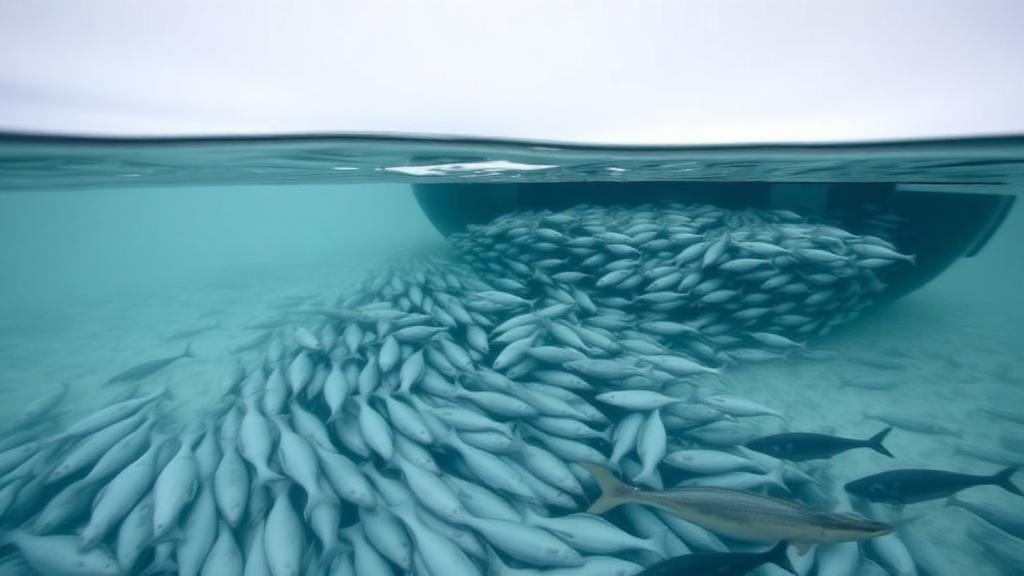
Deep in the Joides Basin of the Ross Sea, a piece of oceanographic equipment designed to catch falling particles has quietly assembled one of the most detailed records of mid-depth Antarctic marine life ever compiled. An automatic sediment trap moored at roughly 500 metres below the surface, part of Italy’s long-running monitoring programme in the Ross Sea, captured more than 210,000 individual organisms across three separate year-round deployments spanning 1995 to 2016. The resulting checklist, published in the Biodiversity Data Journal, documents 68 genera and 68 species of pelagic animals that researchers call swimmers, offering an unprecedented window into a layer of the Southern Ocean that remains stubbornly undersampled.
Sediment traps are conical devices moored on the seafloor with their mouths pointed upward, built to intercept the steady rain of organic and inorganic particles sinking from the sunlit surface waters toward the deep ocean. Their cups rotate on a timed schedule, filling one by one with preserved samples that allow scientists to reconstruct how the export of carbon and other materials varies through the seasons. But the traps have a well-known side effect. Motile animals, from tiny crustaceans to gelatinous predators, swim into the collection area either deliberately, attracted perhaps by the structure or the shelter it offers, or accidentally, swept in by currents. These unintended captures, the swimmers, are usually treated as contamination in flux calculations. In this study, they became the primary data.
The trap sat on Mooring B at approximately 74 degrees south latitude and 175 degrees east longitude, within what is now the Ross Sea Marine Protected Area, in a sector designated as a General Protection Zone. The seafloor at the site lies at about 560 metres, meaning the trap hovered in the mesopelagic layer, the twilight zone between the well-lit surface and the lightless deep. Depending on the deployment year, the instrument was positioned at 530 metres in 1995, 515 metres in 2005 and 470 metres in the 2014 to 2016 series. Each time series covered roughly a full year, with the mooring deployed during one Italian Antarctic expedition and recovered during the next, allowing the trap cups to rotate continuously through the Antarctic winter, a season when ship-based sampling is essentially impossible.
The technical setup varied slightly across the three periods. For the 1995 to 1996 series, researchers used a McLane Parflux Mark 7G-21 trap with 21 rotating cups and a 0.5 square metre collection area. The 2005 and 2014 to 2016 deployments used a McLane 78HW-13 model with the same mouth size. The cups were prefilled with a buffered 5 percent formaldehyde solution to preserve whatever fell or swam in, and the rotation intervals ranged from as short as seven days to as long as three months, depending on the expected flux. Once recovered, the samples were kept cold and transported to laboratories at the National Research Council’s Institute of Polar Sciences in Bologna, where technicians painstakingly picked swimmers out from the passive sinking particles under a stereomicroscope, separating each animal by hand from the surrounding detritus.
The sorting and identification work continued at the Italian National Antarctic Museum in Genoa, where the previously unsorted specimens were catalogued, counted and assigned to 905 occurrence records backed by physical vouchers. In total, the collection spans two kingdoms, 11 phyla, 17 classes, 26 orders, 53 families, 68 genera and 68 species, with six additional morphotypes that could not be fully resolved. Every scientific name was checked against the World Register of Marine Species, and event dates were converted to ISO 8601 format and verified against field reports, giving the dataset a level of quality control suitable for feeding directly into species distribution models.
Copepods dominated the catch, making up 43.54 percent of all individuals. These small crustaceans are among the most abundant animals on Earth and form a critical link between phytoplankton and higher trophic levels, from fish to seabirds to whales. Polychaete worms came second at 17.13 percent, followed by hydrozoans at 10.17 percent, malacostracan crustaceans at 8.29 percent and gastropod molluscs at 6.85 percent. Among the orders, calanoid copepods alone accounted for 36.69 percent of the total, with well-known Antarctic species such as Calanoides acutus, Calanus propinquus and Metridia gerlachei appearing throughout the record. Pteropods, the shelled and unshelled swimming snails of the open ocean, contributed nearly 6 percent, while euphausiids, the krill that anchor the Antarctic food web, appeared at just over 1 percent.
The life-stage composition tells its own story. Adults made up 73.48 percent of the identified specimens, but the traps also captured a rich array of larvae and juveniles, including copepodite stages of copepods at nearly 10 percent, nauplius larvae, cypris larvae of barnacles, polychaete nectochaete larvae, echinoderm bipinnaria and brachiolaria larvae, and even fragments of siphonophoran colonies at almost 4 percent. Ecologically, 75.36 percent of the swimmers were holoplanktonic, meaning they spend their entire lives in the water column, while 17.57 percent were meroplanktonic, larval stages of organisms that will eventually settle to the seafloor. Benthic organisms, which must have been swept up or migrated from below, accounted for nearly 6 percent, and a small fraction of nektonic fish larvae completed the picture.
What makes this dataset particularly valuable is that the biological records come bundled with a continuous stream of environmental measurements collected by sensors on the same mooring. Temperature, salinity and density data gathered throughout each deployment allow researchers to correlate exactly which organisms appeared at which times with the physical conditions of the water column. This pairing of occurrence records with matched environmental time series is rare for the mesopelagic zone and could significantly refine predictive models of how Antarctic zooplankton and micronekton respond to warming, acidification and changes in sea ice cover. Zooplankton communities are widely recognized as sensitive indicators of environmental variability, and shifts in their abundance, distribution and life cycles have been documented across the Southern Ocean in response to climate-driven perturbations.
The Ross Sea itself is one of the most productive and dynamic regions of the Southern Ocean, supporting massive phytoplankton blooms each spring when sea ice retreats and polynyas, areas of persistent open water near the Ross Ice Shelf and Terra Nova Bay, allow light and nutrients to fuel primary production. These blooms cascade through the food web, and the zooplankton that graze on them play a dual role in the carbon cycle, both transferring energy upward to predators and packaging organic matter into faecal pellets that sink rapidly, contributing to the vertical export of carbon. Understanding which species inhabit the mesopelagic layer and when they are present is therefore essential for modelling how the Ross Sea contributes to global biogeochemical cycles and how those contributions might change as the climate warms.
The three time series also allow for comparison across two decades, from 1995 through 2016, a period during which the Ross Sea experienced measurable changes in sea ice dynamics, water mass properties and productivity patterns. While the published checklist primarily documents occurrence and abundance, the consistency of copepod dominance across all three periods, at roughly 40 to 44 percent in each series, suggests a degree of stability in the community structure of this mid-depth layer. At the same time, differences in the relative abundance of other groups, such as the higher proportion of gastropods and malacostracans in the 2005 series compared to the 1995 series, hint at shifts that warrant closer investigation. The full dataset, released under a Creative Commons licence and formatted in Darwin Core standard, is now openly available for researchers worldwide to mine for patterns in biodiversity, phenology and community composition across one of the most remote and rapidly changing marine environments on the planet.
Subject of Research: Antarctic mesopelagic biodiversity
Article Title: First year-round occurrence checklist of mesopelagic “swimmers” collected by an automatic sediment trap on Mooring B (Ross Sea, Antarctica) in years 1995-1996, 2004-2005 and 2014-2016
Article References: Grillo, M., Linciano, M., Balan, M., Guzzi, A., Noli, N., Cometti, V., Langone, L., Giordano, P., & Schiaparelli, S. (2026). First year-round occurrence checklist of mesopelagic “swimmers” collected by an automatic sediment trap on Mooring B (Ross Sea, Antarctica) in years 1995-1996, 2004-2005 and 2014-2016. Biodiversity Data Journal, 14, Article e197009. https://doi.org/10.3897/bdj.14.e197009
Image Credits: AI Generated
Keywords: First, year-round, occurrence, checklist, mesopelagic, swimmers, collected, automatic, sediment, trap, Mooring, Ross
Cite Scienmag News
Violet Maxwell. (October 18, 2026). Antarctic sediment trap reveals 210,000 hidden swimmers from three decades of Ross Sea monitoring. Scienmag. https://scienmag.com/antarctic-sediment-trap-reveals-210000-hidden-swimmers-from-three-decades-of-ross-sea-monitoring/
Violet Maxwell. "Antarctic sediment trap reveals 210,000 hidden swimmers from three decades of Ross Sea monitoring." Scienmag, 18 October 2026, https://scienmag.com/antarctic-sediment-trap-reveals-210000-hidden-swimmers-from-three-decades-of-ross-sea-monitoring/. Accessed 18 October 2026.
Violet Maxwell. "Antarctic sediment trap reveals 210,000 hidden swimmers from three decades of Ross Sea monitoring." Scienmag. October 18, 2026. https://scienmag.com/antarctic-sediment-trap-reveals-210000-hidden-swimmers-from-three-decades-of-ross-sea-monitoring/


