


Botanists surveying the grassy hillsides around Anning City in China’s Yunnan Province have described a previously unknown species of flowering shrub, and the way they confirmed it marks a quiet revolution in how new life is catalogued. The plant, a member of the legume family named Campylotropis anningensis, had been standing in plain sight on forest margins and mountain ridges for years, collected repeatedly since 2014 and mistaken for close relatives with silvery-haired leaves. Only when researchers combined meticulous anatomy with a phylogenomic analysis of 1,233 single-copy nuclear genes did the shrub reveal itself as a species entirely its own, formally described in the journal PhytoKeys.
The genus Campylotropis is a group of roughly 40 species of shrubs and subshrubs spread across temperate and subtropical East Asia, with its evolutionary center of gravity in the Hengduan Mountains and southern China. China alone harbors 35 species, 20 of which grow nowhere else on Earth. The plants belong to the vast legume family, Fabaceae, within the subfamily Papilionoideae, the same branch that gives humanity peas, beans, and soybeans. Like many rapidly radiating lineages, Campylotropis species are notoriously plastic in form, and botanists have long relied on a constellation of traits — branchlet shape, the presence of stipels and glandular hairs, inflorescence architecture, and pod morphology — to tell one species from another.
What makes the new species distinctive is a suite of characters that individually seem subtle but together form an unmistakable signature. Its young branchlets carry ascending white hairs rather than the flattened, silky white hairs of its closest look-alike, C. argentea. Its stipules — small leaf-like appendages at the base of each leaf stalk — range from ovate to linear-lanceolate, a different geometry from its relatives. The undersides of its leaflets are densely clothed in appressed, white, silky hairs, and its flower clusters, which appear both in leaf axils and at branch tips, bear a mix of white pubescence and glandular hairs that secrete sticky exudates. Even its reproductive anatomy differs: the tenth, uppermost stamen, the vexillary one, is fused to the staminal tube only at its base, whereas in C. argentea the fusion extends along the basal third.
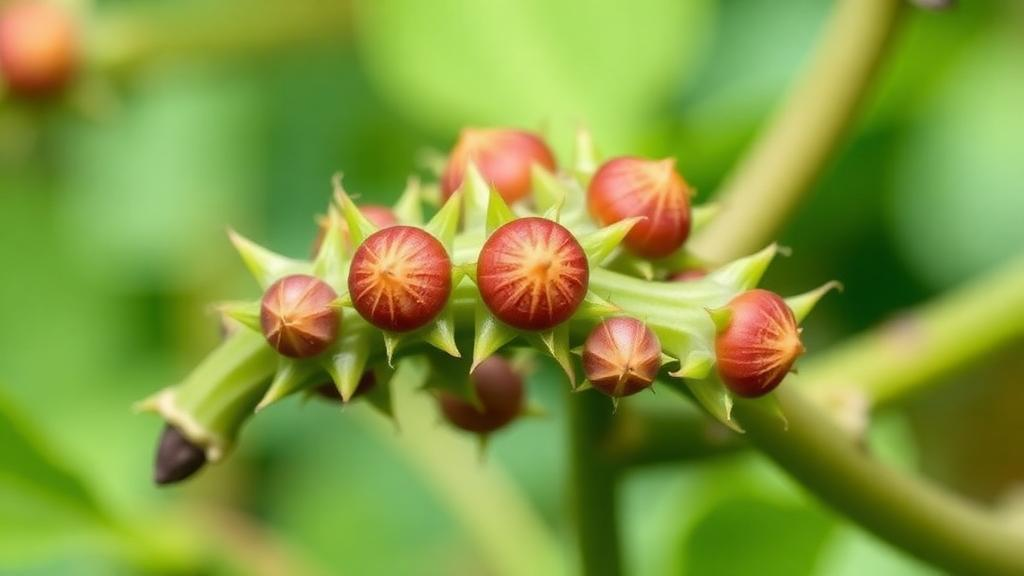
The flowers themselves are reddish purple, with a broad standard petal measuring 10.7 to 13 millimeters long — noticeably longer than the 9 to 10 millimeter standard of C. argentea — and wings of 10 to 12 millimeters. The keel, the boat-shaped petal pair that encloses the reproductive organs, is white with a purple tip and bent at an obtuse angle, a hallmark of the genus. The fruits are one-seeded pods, obliquely ovate rather than obliquely oblong, densely covered in ascending hairs, and marked with brown reticulate veins. The shrub stands 0.8 to 1.5 meters tall, flowers from September through December, and sets fruit from December into February.
Morphology alone, however, was never going to settle the question, because rapid radiation and convergent hair patterns have made Campylotropis one of the most taxonomically treacherous genera in the region. The researchers therefore turned to phylogenomics, sequencing and analyzing 1,233 single-copy nuclear genes — loci present exactly once in the genome, which makes them exceptionally reliable markers for reconstructing evolutionary relationships. Using both maximum likelihood and Bayesian inference, two independent statistical frameworks for building evolutionary trees, they recovered identical topologies with high support values across every branch that mattered.
The genomic verdict was unambiguous. The new species, sampled under the code C. sp._S1119, falls squarely within what the researchers call Clade E, a group of taxa sharing dense white or tawny hairs on the undersides of their leaflets. It is most closely allied with C. pinetorum and C. sulcata, and the analyses recovered it as the sister lineage to the C. pinetorum clade — meaning it shares a more recent common ancestor with C. pinetorum than either does with any other sampled species. Strikingly, although it looks most like C. argentea, it does not sit beside C. argentea in the tree at all. Convergent evolution had dressed two distantly related shrubs in nearly identical silvery foliage, a trap that only genomics could expose.
This is the deeper story of the discovery. For centuries, species were defined primarily by what they looked like, and in groups with few distinguishing features, that approach bred both duplication and oversight. Single-copy nuclear genes sidestep the problems that plague older molecular markers such as chloroplast DNA, which is inherited as a single linkage block and can fail to capture the branching history of recently diverged lineages. Sampling more than a thousand independent nuclear loci provides a genome-wide consensus that is far harder to distort by incomplete lineage sorting or hybridization, the two processes that most often scramble relationships in rapidly radiating plant groups like the ones crowding the Hengduan Mountains.
The fieldwork behind the description reads like a decade-long treasure hunt. Specimens of the unfamiliar shrub first surfaced in 2014 in the Qinglongxia gorge, and between April 2021 and March 2026 researchers documented it at more than two dozen localities across Anning City, from the Chinese Douglas Fir Protected Plot at Zhongyuanliang to the ridges of Heifengshan and the shores of the Sancha and Monande reservoirs. The type specimen was gathered on 28 September 2021 at 2,035 meters in hillside grasslands in Xianjie Subdistrict, and duplicates now rest in herbaria in Chengdu, Kunming, Xishuangbanna, and Ningbo. The species grows in thickets at the edges of valley forests and on grassy slopes between 1,900 and 2,500 meters.
Unlike many newly described plants emerging from biodiversity hotspots, C. anningensis is not in immediate peril. Field surveys found it frequent along mountain ridges, forest margins, valleys, and slopes throughout Anning City, and it has been assessed as Least Concern under the criteria of the IUCN Red List. The authors note it is likely to turn up in neighboring counties as survey work continues. The species carries the vernacular Chinese name ān níng háng zǐ shāo, and its epithet honors the city where it grows — a fitting tribute, since Anning’s hillsides proved to hold a lineage that had been hiding behind a familiar face.
The discovery also carries a broader warning for conservation science. If a conspicuous, flowering shrub, common enough to be assessed as Least Concern, could evade formal recognition for more than a decade while botanists walked past it collecting specimens, then the true diversity of less visible organisms — insects, fungi, soil microbes — is almost certainly far greater than current inventories suggest. Yunnan Province sits at the heart of one of the planet’s richest temperate floras, a landscape of deep river gorges and compressed elevation gradients where isolation on mountaintops drives speciation at remarkable pace. Each genome-scale analysis of a problematic group there has tended to split old entities and reveal new ones, and C. anningensis, distinguished by ascending white hairs, gland-dotted flower stalks, and a thousand-gene consensus, is the latest proof that the frontier of botanical discovery runs not through remote wilderness but through well-trodden hillsides a short drive from a provincial city.
Subject of Research: Description of a new legume species, Campylotropis anningensis, from Yunnan, China, using morphology and phylogenomics
Article Title: Campylotropis anningensis ( Fabaceae , Papilionoideae ), a new species from Yunnan, China
Article References: Jiang, L.-S., Pan, B., Zhu, J.-Y., Li, X., Jiang, K.-W., Yan, L.-C., Liu, C.-W., Liu, E.-D., & Xu, B. (2026). Campylotropis anningensis (Fabaceae, Papilionoideae), a new species from Yunnan, China. PhytoKeys, 277, 269-278. https://doi.org/10.3897/phytokeys.277.199754
Image Credits: AI Generated
DOI: 10.3897/phytokeys.277.199754
Keywords: Campylotropis anningensis, Fabaceae, new species, Yunnan, phylogenomics, single-copy nuclear genes, taxonomy, Hengduan Mountains, IUCN Least Concern, plant diversity, China, PhytoKeys
Cite Scienmag News
Juliet Wilcox. (October 18, 2026). New Legume Species From Yunnan Revealed by 1,233 Nuclear Genes. Scienmag. https://scienmag.com/new-legume-species-from-yunnan-revealed-by-1233-nuclear-genes/
Juliet Wilcox. "New Legume Species From Yunnan Revealed by 1,233 Nuclear Genes." Scienmag, 18 October 2026, https://scienmag.com/new-legume-species-from-yunnan-revealed-by-1233-nuclear-genes/. Accessed 18 October 2026.
Juliet Wilcox. "New Legume Species From Yunnan Revealed by 1,233 Nuclear Genes." Scienmag. October 18, 2026. https://scienmag.com/new-legume-species-from-yunnan-revealed-by-1233-nuclear-genes/


