


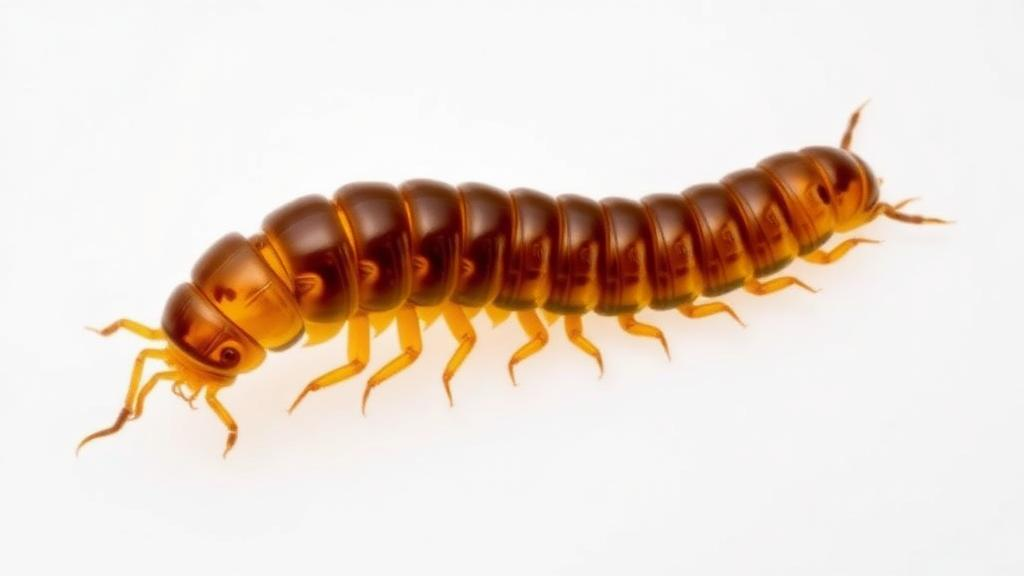
Deep in a small piece of amber from northern Myanmar, a millipede has been waiting for roughly 98 million years. Now, thanks to cutting-edge imaging technology, it has finally told its story. Scientists have described Protosiphonorhinus patrickmuelleri, the first unambiguous fossil member of the millipede family Siphonorhinidae, from Cretaceous Myanmar amber. This tiny creature, measuring just under 7 millimeters long, offers a rare glimpse into an ancient lineage of sucking millipedes that today survives in scattered pockets across the globe. The discovery, published in the journal Evolutionary Systematics, not only adds a new branch to the tree of life but also rewrites what we thought we knew about the family’s evolutionary pace.
Myanmar amber, also known as burmite, comes from the Hukawng Valley in Kachin State and has been dated to the Upper Cretaceous Period, around 98 million years ago. It is by far the richest source of Cretaceous terrestrial fossils known to science, preserving an astonishing diversity of arthropods trapped in tree resin during a time when flowering plants and insects were radiating across the planet. Millipedes, among the first animals to fully conquer land, are well represented in this amber, yet the Mesozoic fossil record of the group remains remarkably sparse, with only slightly more than a dozen fossils known from the entire era before more recent Cenozoic amber deposits filled in some of the gaps.
The Siphonophorida, the order to which the new species belongs, is often called a taxonomist’s nightmare. These elongated, worm-like millipedes lack many of the well-defined characters that typically help scientists distinguish species. Around 120 of the more than 12,000 known millipede species belong to this order, representing only about 1 percent of millipede diversity. Within Siphonophorida, two families are recognized: Siphonophoridae and Siphonorhinidae. The latter is especially mysterious, comprising just six extant genera and 16 species, disjunctly distributed in Southeast Asia, South Africa, Madagascar, Chile, and California. This bizarre distribution pattern has long puzzled biogeographers, and fossils might hold the key to explaining how such an unusual arrangement came to be.
The holotype specimen, a single male, is preserved in a small round piece of amber measuring 10.02 by 12.25 by 2.42 millimeters. It was legally collected before February 2021 and donated from the vast amber collection of Patrick Müller of Käshofen, Germany, after whom the species is named. The piece is now housed in the collections of the Koenig Museum in Bonn. Alongside the millipede, the amber contains an insect leg, a mite, and vegetal fragments, painting a miniature portrait of a Cretaceous forest floor ecosystem. Authenticity was confirmed under ultraviolet light, under which Myanmar amber fluoresces blue.
What makes this description truly remarkable is the technology behind it. The researchers employed both conventional micro-computed tomography and synchrotron micro-CT at the German Electron Synchrotron DESY in Hamburg, using the PETRA III storage ring. The synchrotron scans achieved an effective pixel size of just 0.458 micrometers, using 3,501 projections with a 20-megapixel camera system. These techniques allowed the team to virtually dissect the specimen in three dimensions, revealing essential anatomical structures including the tergites, legs, head, antenna, and, most importantly, the gonopods, the specialized reproductive appendages that often carry species-specific characters in millipedes.
The new genus shares some characteristics with the extant genus Siphonorhinus, such as the pear-shaped head and elbowed antennae, but differs mainly in the shape of the antenna, tergites, and anterior gonopods. The antenna features a massively swollen, lemon-shaped sixth antennomere, reaching its greatest width about one-third of its length, with deep sensory pits on antennomeres 5 and 6. The body consists of 38 body rings plus a telson, notably fewer than the 60 or more segments found in mature specimens of the closest extant genera. The anterior gonopod consists of seven podomeres, a character shared with the American genera Illacme and Notiorhinus and the Madagascan Madagascarhinus, but differing from the six-podomere condition in Kleruchus, Nematozonium, and Siphonorhinus.
Perhaps the most consequential finding of the study is the reinterpretation of two recently described fossil species from Myanmar amber that had been assigned to Siphonorhinidae. Su, Cai, and Huang described two species in 2024, Siphonorhinus globosus and Siphonorhinus peculiaris, and used them to argue for extreme bradytely, or exceptionally slow evolution, within the family from the mid-Cretaceous to the present day. However, the new analysis shows that S. globosus is clearly a member of the family Siphonophoridae, evident from its short but pronounced beak and its straight, stout antennae with uniform antennomeres, characters typical of Siphonophoridae and absent in the elbowed, slender-antennomered Siphonorhinidae. The species has therefore been transferred to the genus Siphonophora as Siphonophora globosa comb. nov.
The generic placement of Siphonorhinus peculiaris is also questionable at best. The characters used to support its placement in Siphonorhinus are not specific to that genus, and its sensilla basiconica are arranged in rows rather than sunken into sensory pits as in true Siphonorhinus. The specimens might represent an extinct, highly derived lineage or a stem lineage within Siphonorhinidae, but they do not represent a species of the extant genus. With these corrections in place, the hypothesis of bradytely within Siphonorhinidae from the mid-Cretaceous to the present day must be rejected. The Cretaceous members of the family differ in their character combination from extant genera, showing that evolution within the group has not been frozen in time.
Members of Siphonorhinidae are not rare in Myanmar amber. At least 12 specimens were reported as of 2018, and an additional 11 have since been sent for determination, bringing the total to five males and 18 females. All five available males clearly do not belong to Protosiphonorhinus, as they have differently shaped antennae or strongly developed paranota, suggesting further diversity within the Cretaceous family awaits description. The millipede fauna of Myanmar amber is considered rich, with most species still undescribed, and the oldest known fossils of many millipede taxa, including Siphonophorida, were found in these deposits.
The description of Protosiphonorhinus patrickmuelleri marks a milestone in the study of an ancient and enigmatic lineage. By combining synchrotron imaging, micro-CT, and light microscopy, the researchers have reconstructed a creature that lived among the roots of Cretaceous forests, feeding on decaying matter as its descendants do today. The fossil record of millipedes remains full of gaps, but each new specimen from Myanmar amber adds another piece to the puzzle of how these soil-forming detritivores diversified across the planet. As more specimens emerge from the amber collections of the world, the evolutionary history of the sucking millipedes promises to become clearer, one tiny, resin-entombed arthropod at a time.
Subject of Research: Discovery of the first fossil sucking millipede from Cretaceous Myanmar amber
Article Title: Protosiphonorhinus patrickmuelleri gen. et sp. nov., the first fossil member of the sucking millipede family Siphonorhinidae ( Colobognatha , Siphonophorida ) described from Cretaceous Myanmar amber
Article References: Moritz, L., Wipfler, B., & Wesener, T. (2025). Protosiphonorhinus patrickmuelleri gen. et sp. nov., the first fossil member of the sucking millipede family Siphonorhinidae (Colobognatha, Siphonophorida) described from Cretaceous Myanmar amber. Evolutionary Systematics, 9(1), 77-86. https://doi.org/10.3897/evolsyst.9.147291
Image Credits: AI Generated
DOI: 10.3897/evolsyst.9.147291
Keywords: paleontology, millipedes, Myanmar amber, Cretaceous, Siphonorhinidae, synchrotron imaging, evolution, fossils, Protosiphonorhinus, patrickmuelleri, first, fossil
Cite Scienmag News
Gavin Prescott. (October 18, 2026). Cretaceous Amber Reveals First Fossil of the Sucking Millipede Family Siphonorhinidae. Scienmag. https://scienmag.com/cretaceous-amber-reveals-first-fossil-of-the-sucking-millipede-family-siphonorhinidae/
Gavin Prescott. "Cretaceous Amber Reveals First Fossil of the Sucking Millipede Family Siphonorhinidae." Scienmag, 18 October 2026, https://scienmag.com/cretaceous-amber-reveals-first-fossil-of-the-sucking-millipede-family-siphonorhinidae/. Accessed 18 October 2026.
Gavin Prescott. "Cretaceous Amber Reveals First Fossil of the Sucking Millipede Family Siphonorhinidae." Scienmag. October 18, 2026. https://scienmag.com/cretaceous-amber-reveals-first-fossil-of-the-sucking-millipede-family-siphonorhinidae/


