


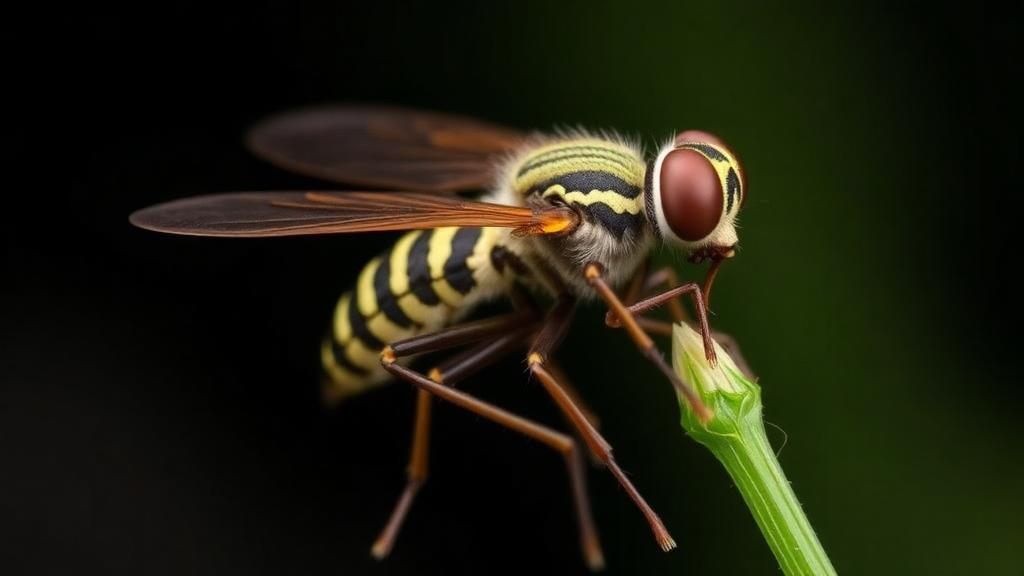
Deep in the high-altitude grasslands of southeastern Lesotho, entomologists have pulled back the curtain on a genus of flies that, remarkably, had never been documented in the mountain kingdom before. A new study published in African Invertebrates records eight species of Atherigona from Lesotho for the first time, including one species entirely new to science, named Atherigona jordaensi sp. nov. The finding is more than a taxonomic curiosity: Atherigona is a genus of muscid flies with real agricultural weight, containing some of the most notorious cereal pests in Africa, and knowing which species occur in Lesotho is the first step toward understanding whether the country’s subsistence farmers face hidden threats in their fields.
Atherigona Rondani, 1856 is one of the most speciose genera within the family Muscidae, the house fly relatives. Roughly 260 species have been described worldwide, of which approximately 168 are known from the Afrotropical region. The genus is divided into two subgenera: Atherigona sensu stricto and Atherigona (Acritochaeta) Grimshaw, 1901. The split matters enormously for agriculture. Larvae of Atherigona sensu stricto feed mostly on plants of the grass family, Poaceae, which includes several cereal crops, and several species have been reported to cause harm to cultivated cereals. Atherigona tritici Pont & Deeming, 2001, for example, has been linked to about 10 percent wheat yield loss. Even more dramatic is Atherigona soccata Rondani, 1871, better known as the sorghum shoot fly, one of the most damaging pest species in Africa. Its larvae tunnel into the growing shoots of sorghum, millet and maize, producing the characteristic dead heart symptom in which the central shoot withers and dies. Infestations have resulted in yield losses of up to 90 percent across Africa, Asia and Latin America.
The larvae of the subgenus Atherigona (Acritochaeta), by contrast, are typically considered saprophages or facultative predators living in decaying organic matter. Recent discoveries have added surprising ecological twists to this picture. In 2023, scientists described Atherigona (Acritochaeta) culicivora Kovac, Pont & Deeming, 2023 from Thailand, a subaquatic species that preys on mosquito larvae. Yet even within Acritochaeta, agricultural pests lurk: Atherigona (Acritochaeta) orientalis Schiner, 1868 attacks crops such as peppers, tomatoes and sorghum. This dual identity, decomposer and pest, predator and crop destroyer, makes Atherigona a genus that demands careful attention wherever it occurs.
Why, then, had Lesotho gone unrecorded? The Diptera of Lesotho are generally poorly studied, and the genus Atherigona is abundant and well documented in neighboring South Africa. The pattern is not unique to this genus. A recent paper by Muller and Midgley reported the first record of Coenosia Meigen, 1826, another speciose muscid genus, from Lesotho, despite Coenosia being quite well known from the surrounding South African landscape. Lesotho shares much of its vegetation and geology with South Africa, but it sits on average 900 metres higher above sea level. This difference in elevation may shape insect diversity in ways that only rigorous sampling can reveal, and until recently, that sampling simply had not happened.
The new records come from a combination of fresh fieldwork and reexamination of historical museum specimens. Researchers collected flies by hand using sweep nets and through Malaise trapping at eight sites across the country: five Lesotho Highland Basalt Grassland sites and one Western Lesotho Basalt Shrubland site within the Drakensberg Grassland Bioregion, and two Basotho Montane Shrubland sites within the Mesic Highveld Grassland Bioregion. Intriguingly, several of the newly recorded species, including Atherigona angulata, Atherigona chrysohypene, Atherigona laevigata, Atherigona lineata ugandae and Atherigona rubricornis, were actually collected in Lesotho as long ago as 1948 and 1949 by C. Jacot Guillarmod, during the era when the country was known as Basutoland. Those specimens sat in the Albany Museum in Makhanda, South Africa, waiting three quarters of a century for someone to identify them.
Identifying Atherigona species is a delicate technical business that hinges on male terminalia. The researchers macerated the male genitalia in 10 percent heated potassium hydroxide for approximately 10 minutes to expose the trifoliate process, a three-part structure of the phallus whose shape, in posterior view and in profile, is often the decisive character separating closely related species. The hypopygial prominence, a knob-shaped or lobed structure on the fifth abdominal segment, provides additional diagnostic signals. Specimens were identified using a combination of identification keys by Dike and by Muller, and measurements were made using a Nikon SMZ745T stereomicroscope with attached Motic camera and Motic Images Plus 3 software. The habitus photograph of the new species was captured with a Canon 850D camera, and illustrations of the terminalia were prepared using Adobe Illustrator and Photoshop CC 2024.
The new species, Atherigona jordaensi sp. nov., was named after Dr Kurt Jordaens of the Royal Museum for Central Africa in Tervuren, in recognition of his contribution to the study of Diptera in Lesotho. The holotype, a male in good condition measuring 3.84 millimetres in body length with a 3.66 millimetre wing, was collected on 30 November 2022 at a roadside swamp near Quting, Mphaki, in Lesotho Highland Basalt Grassland, at coordinates 30°13.690’S, 28°8.445’E. Seven paratype males were dissected to confirm the species’ diagnostic features. The species is most similar to Atherigona decempilosa Dike, 1989, but can be separated from it by the shape of the trifoliate process: the median piece is medially dilated in profile rather than apically dilated and bifid, and the basal lateral area of the lateral plates curves upward without appearing angular. The hood of the trifoliate process is also less well developed than in A. decempilosa, and while A. decempilosa shows some degree of infuscation on all of its legs, A. jordaensi has only the foreleg somewhat infuscated.
The description of A. jordaensi is characteristically thorough. The male has a dark ground colour with golden-grey dusting on the scutum, faint dorsocentral vittae that do not extend to the scutellum, and katepisternal setae in a 1:1:1 arrangement. All legs are yellow except for the apical half of the fore femur, the apical two thirds of the fore tibia and the fore tarsi, which are infuscated. The wings are hyaline with light-brown veins, white-knobbed halteres and somewhat light-brown calypters. The abdomen bears tergites that are yellow and without dorsal median vittae, with tergite 3 carrying two small spots roughly twice the size of those on tergite 4, while tergites 1+2 and 5 are immaculate. The hypopygial prominence is knob-shaped with two anteriorly projecting tubercles. Notably, the female remains unknown, a gap that future collectors may hope to fill. Beyond Lesotho, the species has also been recorded from Harrismith in South Africa’s Free State, collected in Malaise traps in dense Leucosidea-dominated scrub, suggesting it may be a highland specialist of the greater Drakensberg region.
The other seven newly recorded species each carry their own biogeographic stories. Atherigona angulata, with its golden yellow vibrissae and right-angled median piece of the trifoliate process, is known from Botswana, Namibia, Nigeria, South Africa and Saudi Arabia. Atherigona chrysohypene, distinguished by its bilobate hypopygial prominence, was previously known only from South Africa. Atherigona laevigata is the widest traveler of the group, recorded across much of the Afrotropical region from Angola to the Seychelles and Madagascar, and also across the Palaearctic from Cyprus to Yemen. Atherigona kirkspriggsi, with its tridentate hypopygial prominence, and Atherigona londti, with its yellow-tipped scutellum, were both previously known only from South Africa. Atherigona lineata ugandae, a subspecies with an entirely yellow fore femur and a deeply bifurcated hypopygial prominence, ranges from Chad to Uganda. Atherigona rubricornis, with its partially yellow frontal vitta, occurs from Botswana to Zimbabwe.
Crucially, neither of the two most feared pest species, the sorghum shoot fly Atherigona soccata nor the polyphagous Atherigona orientalis, has yet been recorded from Lesotho. But the researchers caution that this absence may be an artifact of sampling focus rather than a true biological absence. The recent expeditions to Lesotho concentrated on Alpine areas and less disturbed natural regions, and only 8 out of 30 collecting sites yielded Atherigona at all. To truly capture the diversity of the genus in Lesotho, future surveys will need to expand to more Atherigona-focused sampling sites, especially disturbed areas near farmland, and will need to involve local authorities and collaborate with local commercial and subsistence farmers. As insect pests, Atherigona species may potentially contribute to agricultural challenges in Lesotho, and more information on the diversity and distribution of the genus is needed before any management practices can be implemented. The new checklist and species description should be seen as a springboard for future study of the group in the country, potentially allowing local farmers and land managers to better manage pest species if they are present. In a nation where agriculture underpins rural livelihoods, the humble shoot flies of the high basalt grasslands may prove to matter far more than their small size suggests.
Subject of Research: First record of the shoot fly genus Atherigona from Lesotho, with description of the new species Atherigona jordaensi sp. nov.
Article Title: The first record of Atherigona from Lesotho ( Diptera , Muscidae ), with description of a new species
Article References: Magoai, M. M. J., & Muller, B. S. (2024). The first record of Atherigona from Lesotho (Diptera, Muscidae), with description of a new species. African Invertebrates, 65(2), 49-60. https://doi.org/10.3897/afrinvertebr.65.131744
Image Credits: AI Generated
DOI: 10.3897/afrinvertebr.65.131744
Keywords: Atherigona, Lesotho, Diptera, Muscidae, new species, shoot fly, entomology, African Invertebrates, first, record, description, species
Cite Scienmag News
Gavin Prescott. (October 18, 2026). Shoot fly genus Atherigona recorded in Lesotho for first time with new species. Scienmag. https://scienmag.com/shoot-fly-genus-atherigona-recorded-in-lesotho-for-first-time-with-new-species/
Gavin Prescott. "Shoot fly genus Atherigona recorded in Lesotho for first time with new species." Scienmag, 18 October 2026, https://scienmag.com/shoot-fly-genus-atherigona-recorded-in-lesotho-for-first-time-with-new-species/. Accessed 18 October 2026.
Gavin Prescott. "Shoot fly genus Atherigona recorded in Lesotho for first time with new species." Scienmag. October 18, 2026. https://scienmag.com/shoot-fly-genus-atherigona-recorded-in-lesotho-for-first-time-with-new-species/


