


A randomized trial of 307 second-year undergraduates found that real-time AI pose feedback improved competence, autonomy, and motor skill in traditional PE, with the competence pathway explaining the gains. The study, published in Frontiers in Psychology, is among the first to test the motivational mechanisms behind AI feedback in traditional health-focused PE.
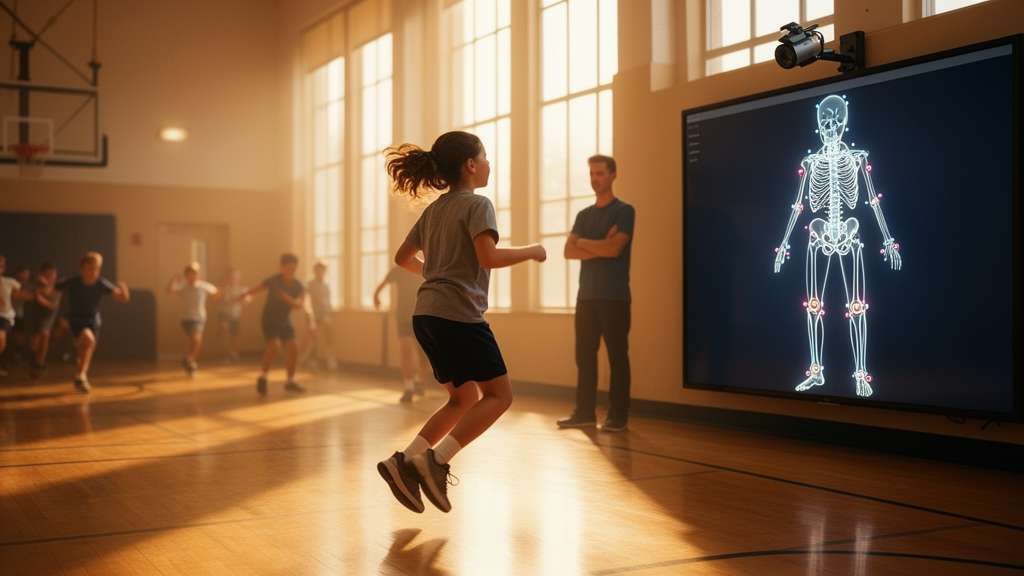
Participants were second-year undergraduates enrolled in a traditional PE elective. The trial compared real-time AI pose feedback with conventional instruction over 12 weeks. Students in the AI condition received a superimposed skeleton on a screen, with deviation cues drawn at key joints, while the control group practiced the same movements with instructor feedback alone.
The AI system processed each frame in roughly 120 milliseconds, drawing deviation vectors at the shoulders, hips, and knees. Students saw their own skeleton overlaid on an expert template, with red lines marking where their pose diverged. The system updated on every frame, so students could adjust their posture in real time rather than waiting for instructor correction.
The trial measured competence, autonomy, and motor skill at baseline and after 12 weeks. Students in the AI condition showed significantly greater gains in all three measures. The competence pathway—students’ sense that they could master the movements—explained a substantial share of the motor skill improvement. Autonomy gains, students’ sense that they could direct their own practice, also contributed.
The findings suggest that AI feedback works not by replacing instructors but by giving students a visible, immediate record of their own progress. The skeleton overlay turns an abstract instruction like “keep your back straight” into a concrete visual target. Students can see exactly where their pose diverges from the expert template, and they can adjust in the moment rather than waiting for the next correction.
The study also found that the AI condition did not reduce students’ sense of connection to their instructor. Students in both conditions reported similar levels of relatedness, suggesting that AI feedback can supplement rather than supplant the human relationship in PE.
The trial has implications for the design of AI feedback systems in PE and beyond. The competence pathway suggests that feedback should be visible, immediate, and specific. The autonomy pathway suggests that students should be able to direct their own practice, with the AI serving as a record of progress rather than a director of behavior. The relatedness finding suggests that AI feedback can supplement rather than supplant the human relationship.
The study is among the first to test the motivational mechanisms behind AI feedback in traditional PE. The findings suggest that AI feedback works by building students’ sense of competence and autonomy, with the competence pathway explaining a substantial share of the motor skill gains. The relatedness finding suggests that AI feedback can supplement rather than supplant the human relationship in PE.
The study’s design deserves closer attention because it addresses a common weakness in educational technology research. Rather than randomly assigning individual students, the researchers randomized twelve intact classes, which preserved the natural structure of real teaching. Three instructors each taught two classes per condition, meaning that any instructor-specific effects—teaching style, enthusiasm, or experience—were distributed across both groups. This cluster-level randomization, combined with negligible intraclass correlations reported in the analysis, strengthens the case that the observed differences in competence, autonomy, and motor skill reflect the feedback intervention itself rather than differences in who was teaching or how classes happened to be composed.
The choice of Zhuang Daoyin as the learning context is also scientifically meaningful. Traditional ethnic sports place unusual demands on learners because their movements coordinate posture, breathing, rhythm, and expressive qualities simultaneously. Unlike standardized exercises where a single biomechanical error may be obvious, these practices require learners to detect subtle discrepancies between a demonstrated form and their own execution. Conventional instruction handles this through a demonstration–imitation–correction cycle in which one teacher observes many students and comments after errors have already occurred. The AI system’s contribution was to compress that correction loop from minutes or entire sessions down to roughly a tenth of a second, allowing adjustment while the movement was still being performed.
The theoretical framing draws on self-determination theory, a widely tested account of motivation that distinguishes between controlled forms of regulation—acting from external pressure or internal guilt—and autonomous forms, in which behavior is self-endorsed and personally valued. The relative autonomy index used in the study summarizes a learner’s position along this continuum. Decades of research in physical education have shown that environments satisfying the basic psychological needs of autonomy, competence, and relatedness tend to foster autonomous motivation, which in turn predicts effort, engagement, and learning. What this study adds is a test of which specific need an AI feedback tool engages, rather than treating the technology as an undifferentiated intervention.
The mediation results are the study’s most distinctive contribution. The statistical model showed that the effect of AI feedback on motor skill traveled entirely through a two-step sequence: the tool first strengthened students’ sense of competence, and that competence gain in turn shifted motivational regulation toward more autonomous forms, which then predicted skill improvement. The direct path from the AI condition to motor skill, once this sequence was accounted for, was not statistically significant. This pattern matters because it rules out a simpler explanation—that the technology improved skill through some non-motivational channel such as merely increasing practice volume—and instead supports the claim that the psychological experience of visible progress is the active ingredient.
Equally informative is what did not change. Relatedness, the sense of mutual care and belonging with instructors and peers, showed no difference between conditions. From a measurement standpoint, this is discriminant evidence: if the AI condition had simply made students more enthusiastic about the course in general, one would expect ripples across all three psychological needs. Instead, the effects were confined to the needs most directly tied to the tool’s affordances—competence, because the feedback makes mastery visible, and autonomy, because students can self-correct without waiting for an authority. The untouched relatedness score suggests the effects are specific rather than diffuse.
The autonomy finding warrants some nuance. One might expect algorithmic feedback to feel like surveillance, undermining volition, yet students in the AI condition reported greater autonomy. A plausible reading is that the skeleton overlay functioned as an impersonal information source rather than a commanding one. When a visual display shows where a pose diverges from a template, the learner retains the decision about whether and how to adjust, whereas verbal correction from an instructor can carry implicit evaluative weight. This aligns with self-determination theory’s distinction between controlling and informational feedback, and suggests that the presentation format of automated guidance—not just its content—shapes motivational outcomes.
Several limitations frame how far these conclusions extend. The sample consisted of second-year undergraduates at a single institution taking an elective course, and the intervention lasted twelve weeks, so durability beyond a semester remains untested. The outcome measures relied on self-report for the psychological constructs, which are subject to demand characteristics even in cluster-randomized designs. The study also examined one specific system built on one pose-estimation architecture for one movement discipline; systems that score and rank performance, or that generate training plans between sessions, engage learners through different mechanisms and may produce different motivational profiles. Finally, the effect sizes, while statistically reliable, were modest in magnitude, which is typical for educational interventions delivered at the classroom level.
For practitioners, the human–AI division of labor implied by the results is perhaps the most actionable takeaway. Because relatedness was unaffected and teachers remained central to instruction in both conditions, the findings support a complementary model: automated systems handle the high-frequency, precision-oriented corrections during practice, while instructors concentrate on relational support, cultural context, and the motivational scaffolding that machines cannot provide. This division is especially relevant in settings where qualified instructors of traditional movement arts are scarce and transmission has historically depended on face-to-face apprenticeship. A tool that makes progress legible to learners—showing them, frame by frame, that their form is converging on a target—may allow scarce expert attention to be allocated where it matters most.
More broadly, the study illustrates a shift in how educational technology should be evaluated. Comparing post-intervention outcomes between a tool group and a control group answers whether a technology works, but not why it works, and the distinction has design consequences. A system that raises technical scores through external evaluation and social comparison might achieve short-term performance gains while eroding autonomous motivation once the novelty fades. Mechanism-level evidence of the kind reported here—specifying which psychological needs a tool satisfies and which it leaves untouched—offers a template for designing and auditing AI feedback features so that they improve both performance and the quality of the learning experience over time.
Subject of Research: AI Feedback Coach: How Real-Time Pose Detection Builds Motivation and Motor Skill in Traditional PE
Article Title: Effects of AI-mediated real-time feedback on motivation and motor skill learning in traditional ethnic sports education: testing self-determination theory mechanisms
Article References: Qin, Y., Yang, Y., Chen, G., Huang, H., & Wei, D. (2026). Effects of AI-mediated real-time feedback on motivation and motor skill learning in traditional ethnic sports education: testing self-determination theory mechanisms. Frontiers in Psychology, 17, Article 1958348. https://doi.org/10.3389/fpsyg.2026.1958348
Image Credits: AI Generated
DOI: 10.3389/fpsyg.2026.1958348
Keywords: artificial intelligence, real-time feedback, motor skill, motivation, traditional PE, competence, autonomy, Effects, AI-mediated, real-time, feedback, motor
Cite Scienmag News
Blake Davidson. (October 18, 2026). AI Feedback Coach: How Real-Time Pose Detection Builds Motivation and Motor Skill in Traditional PE. Scienmag. https://scienmag.com/ai-feedback-coach-how-real-time-pose-detection-builds-motivation-and-motor-skill-in-traditional-pe/
Blake Davidson. "AI Feedback Coach: How Real-Time Pose Detection Builds Motivation and Motor Skill in Traditional PE." Scienmag, 18 October 2026, https://scienmag.com/ai-feedback-coach-how-real-time-pose-detection-builds-motivation-and-motor-skill-in-traditional-pe/. Accessed 18 October 2026.
Blake Davidson. "AI Feedback Coach: How Real-Time Pose Detection Builds Motivation and Motor Skill in Traditional PE." Scienmag. October 18, 2026. https://scienmag.com/ai-feedback-coach-how-real-time-pose-detection-builds-motivation-and-motor-skill-in-traditional-pe/


