


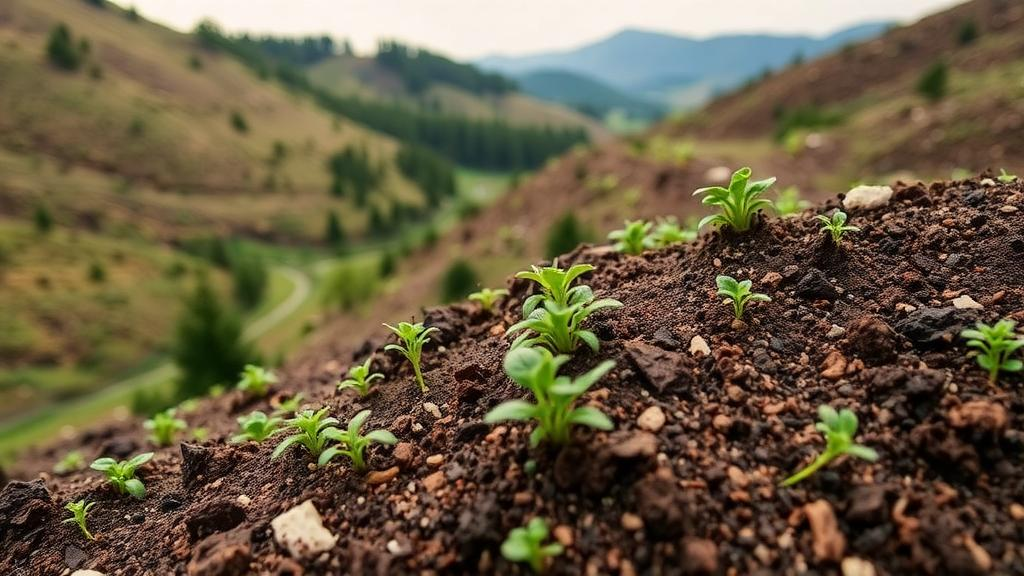
In the Topolnitsa-Pirdop valley of southern Bulgaria, the land carries the chemical signature of more than a century of copper mining and smelting. A new study published in the journal BioRisk has now measured, with unusual precision, how the microscopic communities living in these soils respond to that long-term contamination. The findings reveal a subtle but consequential shift: as soil copper rises, fungal populations fall while bacteria hold their ground, tilting the entire microbial balance of the ecosystem toward bacterial dominance. That tilt, the researchers argue, is a warning sign for soil quality and, ultimately, for the productivity of the plants that depend on it.
The valley is one of the most industrialized zones in Bulgaria. Three large metal mining and processing enterprises operate there, including Elatsite Med, Dundee Precious Metals and Aurubis, and the open-pit Medet mine, although closed in 1992, is still considered the main source of pollution in the area. The Topolnitsa River and its tributaries, the Medetska, Zlatishka, Pirdopska and Bunovska Rivers, have absorbed the combined pressures of the ore industry, agriculture and domestic wastewater, leading to a deterioration of their ecological status under the national River Basin Management Plan for 2016 to 2021. Soils in the region, all classified as Fluvisols under the FAO system, therefore offer a natural laboratory for studying how microbial life copes with decades of heavy metal exposure.
To probe that question, the research team collected topsoil samples from a depth of 0 to 20 centimeters at five sites in May 2021, selected from a monitoring map with the sources of copper pollution in mind. Site S1 lay in the valley of the Medetska River, 710 meters from the Medet mine tailing; S2 sat 250 meters from the same tailing in the Topolnitsa valley; S3 was 750 meters from the tailing in the Pirdopska valley; S4 was 2,200 meters from the tailings of Elatsite-Med in the Bunovska valley; and S5, next to the village of Muhovo, lay 25 to 30 kilometers from the other sites and served as a reference location. Each sample was taken in three replicates, and copper concentrations across the five soils ranged from 28.05 to 198.9 milligrams per kilogram.
The physicochemical analysis showed moderately acidic soils, with pH values between 5.57 and 5.76, and soil organic carbon levels ranging from 1.22 to 2.67 grams per kilogram, relatively low values that matter because organic matter can bind heavy metals and reduce their toxicity. Copper concentrations in sites S1 and S3 exceeded the maximum permissible concentration of 80 milligrams per kilogram set by Bulgarian Regulation 3/2008, and the study’s discussion noted that three of the five tested soils, S1, S3 and S4, were above that threshold. A Pearson correlation analysis confirmed a linear relationship between the level of copper contamination and the distance to the pollution source, and a hierarchical cluster analysis of the abiotic soil factors split the sites into two main groups: one containing the least contaminated reference soil S5, and the other grouping the remaining soils according to a copper threshold of about 100 milligrams per kilogram. The pattern identified copper as the major factor structuring the soil environments.
The heart of the study, however, lay in the molecular measurements. Rather than counting cells under a microscope, the team used quantitative PCR, a technique that amplifies and quantifies specific genetic markers, to estimate microbial abundance as gene copy numbers per gram of dry soil. Bacterial abundance was measured as copies of the 16S rRNA gene, the standard bacterial taxonomic marker, using the primer pair Eub338f and Eub518r, while fungal abundance was estimated from copies of the ITS rRNA region, amplified with the primers ITS1 and ITS4. Genomic DNA was extracted from half a gram of soil with a commercial soil DNA kit, and every measurement was run in triplicate, with amplification efficiencies of 109 percent for bacteria and 92 percent for fungi, both with R-squared values of 0.99, indicating highly reliable calibration curves built from serial dilutions of plasmid DNA standards.
The results painted a picture of two microbial kingdoms with very different sensitivities. Bacterial abundance varied in a relatively narrow range, from 1.68 × 10^11 gene copies in the reference soil S5 to 3.24 × 10^11 in site S4, and statistical analysis found no significant correlation between bacterial numbers and soil copper concentration. Fungal abundance, by contrast, spanned a wider range, from 1.95 × 10^8 ITS gene copies in the highly contaminated S3 to 6.71 × 10^8 in the uncontaminated S5, and here the correlation with copper was strongly and significantly negative. The coefficient of variance among soils was 40.48 for fungi but only 25.07 for bacteria, a difference the researchers interpreted as evidence of possible bacterial resistance to copper toxicity.
When the team calculated the ratio of fungal to bacterial abundance, the ecological meaning of the imbalance became explicit. The highest relative fungal-to-bacterial ratio, 3.98 × 10^-3, was recorded in the uncontaminated reference soil S5, while the lowest, 6.80 × 10^-4, appeared in the heavily contaminated S3. The ratio related negatively with soil copper, and the researchers suggested this resulted from the higher impact of copper on fungal abundance. Because the balance between bacteria and fungi is vital in explaining many soil functions, the calculated changes in this ratio indicated a deterioration in soil quality, being of primary importance for plant production. A declining fungal share is widely regarded as a sensitive indicator of stressed soil, and its decrease under heavy metal contamination has been reported in other studies.
Why would fungi suffer more than bacteria from the same metal? The researchers point to the spatial architecture of soil itself. Several studies have shown that bacteria tend to dominate in silt and clay fractions, whereas fungi inhabit mainly the coarse sand fraction. Meanwhile, work using the Nemerow pollution index concluded that heavy metals including copper, lead and zinc, and their bioavailable forms, are distributed among soil fractions in the order coarse sand, then clay, then silt, then fine sand. The similar mode of distribution between fungi and copper among soil fractions may thus be a prerequisite for the higher copper toxicity that fungi experience compared with bacteria. The acidic pH of the valley soils may compound the problem, since acidity increases the mobility and toxicity of heavy metals and can suppress bacterial diversity as well.
The ordination analysis, a non-metric multidimensional scaling procedure applied to the abundance-weighted microbial communities, separated the five soils into four distinct groups. Sites S2 and S4 grouped closely, indicating similar microbial abundances, while the other soils were placed individually. The analysis showed that the important factors influencing soil microbial abundance were soil copper concentration and water content in S1, and soil organic carbon and phosphate concentrations in S2 and S4. Only the highest soil copper concentration, about 190 milligrams per kilogram at S1, appeared to influence the microbial communities significantly; at the other sampling sites, local abiotic factors held sway. The bacterial abundances recorded were also about one-fold higher than those estimated in previous studies on mining activities in the area, where soil copper concentrations ranged from 53 to 860 milligrams per kilogram, a difference the researchers attributed to the lower copper ranges in the present soils, but also to the dependence of microbial abundance on edaphic and climatic conditions.
The broader lesson is that microbial responses to contamination are not uniform, and that the fungal-to-bacterial ratio can serve as an early-warning gauge of soil health in industrialized landscapes. The study concluded that microbial abundance, especially fungal, was significantly affected by long-term copper contamination of Fluvisols, and that copper shifted the structure of microbial communities toward bacteria, suggesting that in these soils bacteria are better at developing copper resistance than fungi. The researchers also noted that relatively low copper concentrations can even stimulate bacterial proliferation, and that bacteria appear to have developed adaptation mechanisms to the altered soil environments created by decades of mining. Understanding these responses, the team argues, is essential to counteract the negative effects of copper on ecosystem functions and services, and further studies should be implemented to clarify the functional responses of soil microbes to copper contamination, moving beyond abundance to measure what these resilient communities are actually doing in the dirt.
Subject of Research: Distribution of microbial abundance in long-term copper contaminated soils from Topolnitsa-Pirdop valley, Southern Bulgaria
Article Title: Distribution of microbial abundance in long-term copper contaminated soils from Topolnitsa-Pirdop valley, Southern Bulgaria
Article References: Petkova, M., Nankova, N., Kancheva, V., Boteva, S., Kenarova, A., & Radeva, G. (2023). Distribution of microbial abundance in long-term copper contaminated soils from Topolnitsa-Pirdop valley, Southern Bulgaria. BioRisk, 20, 23-35. https://doi.org/10.3897/biorisk.20.97795
Image Credits: AI Generated
Keywords: Distribution, microbial, abundance, long-term, copper, contaminated, soils, Topolnitsa-Pirdop, valley, Southern, Bulgaria, scientific research
Cite Scienmag News
Morgan Morrow. (October 18, 2026). Copper pollution quietly rewires soil microbes in Bulgarian valley. Scienmag. https://scienmag.com/copper-pollution-quietly-rewires-soil-microbes-in-bulgarian-valley/
Morgan Morrow. "Copper pollution quietly rewires soil microbes in Bulgarian valley." Scienmag, 18 October 2026, https://scienmag.com/copper-pollution-quietly-rewires-soil-microbes-in-bulgarian-valley/. Accessed 18 October 2026.
Morgan Morrow. "Copper pollution quietly rewires soil microbes in Bulgarian valley." Scienmag. October 18, 2026. https://scienmag.com/copper-pollution-quietly-rewires-soil-microbes-in-bulgarian-valley/


