


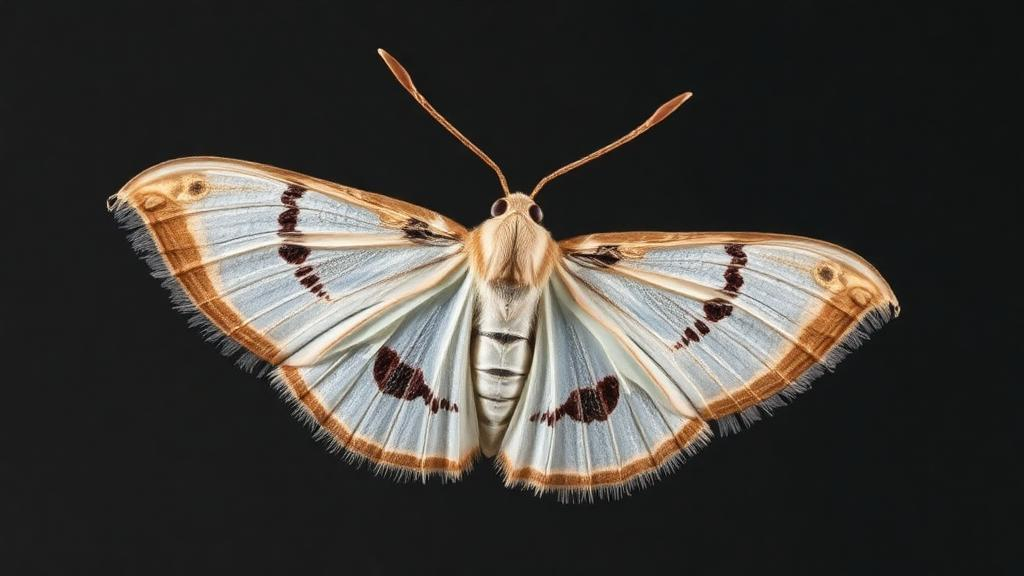
For decades, two of the strangest moth families on Earth have sat awkwardly inside one of Lepidoptera’s most species-rich superfamilies. Now, a multigene phylogenetic study published in ZooKeys has formally tested that arrangement and found it wanting. The ectoparasitic families Cyclotornidae and Epipyropidae, whose larvae are the only moths known to live as obligate external parasites, do not belong to Zygaenoidea at all. Instead, the DNA evidence places them near the base of Apoditrysia, a vast ditrysian clade, far from the chemically defended burnet moths, slug caterpillars, and venomous flannel moths they were long thought to call relatives.
Zygaenoidea as traditionally defined contains roughly 3,550 described species distributed across eleven extant families, with its greatest diversity in tropical and subtropical regions. The two giants, Limacodidae with about 1,880 species and Zygaenidae with about 1,142, together account for approximately 85 percent of all described zygaenoid species. The remaining families are small: Aididae (7 species), Cyclotornidae (5), Epipyropidae (32), Heterogynidae (10), Himantopteridae (around 80), Lacturidae (around 140), Megalopygidae (around 230), Phaudidae (15), and Somabrachyidae (8). Previous family-level phylogenetic work had repeatedly shown that nine of these families form a well-supported monophyletic group, the so-called core Zygaenoidea, but none of those studies had ever included all eleven families, and Cyclotornidae and Epipyropidae had never been sampled in any of them.
The two excluded lineages are biologically extraordinary. First instars of both families use piercing mandibles to attack and cling to auchenorrhynchan hemipteran hosts. Epipyropidae is cosmopolitan, absent only from Antarctica, and its larvae ectoparasitize cicadas as well as plant- and leafhoppers, including members of Cicadellidae, Delphacidae, and Fulgoridae. Cyclotornidae, endemic to Australia, runs an even more complex life history: larvae begin as external parasites of leafhoppers and scale insects, then abandon their hemipteran hosts to become obligate predators of ant brood inside ant nests. This dual parasitism-predation strategy is unique among Lepidoptera and has long fueled speculation about where these moths fit on the moth tree of life.
Earlier comprehensive phylogenetic studies covering all of Lepidoptera had placed Cyclotornidae and Epipyropidae in wildly unstable positions. Both lineages typically exhibit long branches, and crucially, they almost never cluster with the core Zygaenoidea. They do not even consistently form a sister-group relationship with each other across studies. In several analyses, one or both were recovered within Cossoidea, arguably the closest relative of Zygaenoidea, but always with weak nodal support. In the most recent phylogenomic investigation to include Epipyropidae, the family clustered with neither the core Zygaenoidea nor Cossoidea but instead appeared as sister to Schreckensteinioidea. No study had ever been specifically designed to test the monophyly of Zygaenoidea as a whole.
To close that gap, the research team assembled phylogenetic datasets comprising 22 genes: 13 full-length mitochondrial protein-coding genes, two full-length mitochondrial rRNA genes, and seven nuclear protein-coding gene fragments. The nuclear markers included CAD, two fragments of EF-1α, GAPDH, IDH, MDH, RpS5, and wingless, the most commonly amplified markers in lepidopteran molecular systematics. The ingroup covered all 29 currently recognized ditrysian superfamilies plus two ditrysian families of uncertain placement, Heliocosmidae and Millieriidae, while three glossatan superfamilies served as outgroup. In total, 75 lepidopteran species were merged into 62 final samples, with all eleven zygaenoid families represented for the first time in a single phylogenetic analysis.
The laboratory and computational pipeline was substantial. For 16 representative species lacking public mitochondrial genomes but with available whole-genome sequencing or transcriptomic SRA data, the team attempted mitogenome assembly using ARC, GetOrganelle, MitoZ, NOVOPlasty, and SPAdes, with gap filling and polishing performed using Pilon and annotation conducted with MitoZ and the MITOS2 online server. Three nuclear gene fragments of Epipomponia nawai, a focal epipyropid species, were sequenced for the first time from a final-instar larva collected from the body surface of its cicada host in Longli County, Guizhou, China, in July 2025. Protein-coding genes were aligned as codons using MACSE, poorly aligned regions removed with Gblocks, rRNA genes aligned with MAFFT and trimmed with trimAl, and individual gene alignments concatenated in MEGA to construct five datasets ranging from 5,088 amino acid sites to 17,507 DNA sites.
Eleven phylogenetic trees were reconstructed using maximum likelihood and Bayesian inference. The primary tree was a Bayesian inference tree based on the amino acid dataset under the site-heterogeneous CAT-GTR model, a model shown to significantly improve model fit and reduce long-branch attraction artifacts, making it more suitable for resolving deep and rapid phylogenetic radiations despite its higher computational demand. Maximum likelihood analyses were performed with RAxML-NG under partitioned substitution models selected by ModelFinder, with branch support estimated from 1,000 bootstrap replicates. Bayesian analyses were conducted with MrBayes, running eight or 16 independent Markov chains for 11 to 35 million generations, with convergence assessed in Tracer to ensure effective sample sizes above 200. An additional Bayesian analysis of the amino acid dataset was performed with PhyloBayes-MPI under the CAT-GTR model.
The results were unambiguous on the central question. Zygaenoidea sensu lato, as traditionally defined, never formed a monophylum in any of the 11 trees. Cyclotornidae and Epipyropidae were recovered together as sisters in most analyses, often with moderate to strong support, but were placed near the base of Apoditrysia, distantly from the core Zygaenoidea, possibly as sister to Douglasioidea. In the sole exception, the two families appeared in the same clade but separated by Douglasioidea and Schreckensteinioidea. The analyses consistently rejected a close relationship between the ectoparasitic pair and either core Zygaenoidea or Cossoidea. Meanwhile, the remaining nine families constituted a well-supported monophyletic group across all trees, with particularly strong support in the Bayesian trees, posterior probabilities ranging from 0.729 to 0.998.
The authors propose that Zygaenoidea sensu stricto should include only the nine core families and exclude Cyclotornidae and Epipyropidae, regardless of whether the two form a sister pair or represent independent lineages. The study also delivered unexpected dividends for ditrysian systematics. Simaethistoidea, sampled for the first time in any phylogenetic study, consistently clustered with Alucitoidea, the many-plumed moths, within Obtectomera with high support, suggesting this obscure superfamily may be an obtectomeran member. Heliocosmidae and Millieriidae, two families that could not be confidently assigned to any superfamily, clustered together into a monophyletic group in half of the trees, sometimes with very high nodal support, though their positions remained formally unresolved.
Important caveats temper the headline conclusion. Nodal support values were only moderate despite the large number of genes analyzed, largely because about two-thirds of the loci were mitochondrial. Unlike nuclear genes, mitochondrial sequences evolve rapidly and tend to reach saturation over time, which may weaken their ability to recover deep evolutionary nodes. This is particularly relevant for Cyclotornidae and Epipyropidae, both of which exhibited relatively long branches, a pattern often associated with accelerated substitution rates in ectoparasitic lineages. Long-branch attraction may therefore have contributed to the recovery of these two families as sisters in some analyses, and the proposed sister-group relationship with Douglasioidea should be interpreted with caution pending further evidence. Future phylogenomic studies incorporating denser taxon sampling and increased nuclear gene representation will be essential to test these relationships. For now, the message is clear: the parasitic moth families have been evicted from Zygaenoidea, and the nine core families stand as the true, monophyletic heart of the superfamily.
Subject of Research: Phylogenetics
Article Title: Investigating the phylogenetic placement of ectoparasitic families Cyclotornidae and Epipyropidae : Multigene insights into Zygaenoidea systematics ( Lepidoptera )
Article References: Cai, Y., & Yin, A. (2026). Investigating the phylogenetic placement of ectoparasitic families Cyclotornidae and Epipyropidae: Multigene insights into Zygaenoidea systematics (Lepidoptera). ZooKeys, 1291, 283-301. https://doi.org/10.3897/zookeys.1291.204651
Image Credits: AI Generated
DOI: 10.3897/zookeys.1291.204651
Keywords: Phylogenetics, Lepidoptera, Zygaenoidea, Ectoparasitism, Systematics, ZooKeys, Investigating, phylogenetic, placement, ectoparasitic, families, Cyclotornidae
Cite Scienmag News
Gavin Prescott. (October 18, 2026). Parasitic Moths Evicted From Their Own Superfamily After DNA Study. Scienmag. https://scienmag.com/parasitic-moths-evicted-from-their-own-superfamily-after-dna-study/
Gavin Prescott. "Parasitic Moths Evicted From Their Own Superfamily After DNA Study." Scienmag, 18 October 2026, https://scienmag.com/parasitic-moths-evicted-from-their-own-superfamily-after-dna-study/. Accessed 18 October 2026.
Gavin Prescott. "Parasitic Moths Evicted From Their Own Superfamily After DNA Study." Scienmag. October 18, 2026. https://scienmag.com/parasitic-moths-evicted-from-their-own-superfamily-after-dna-study/


