


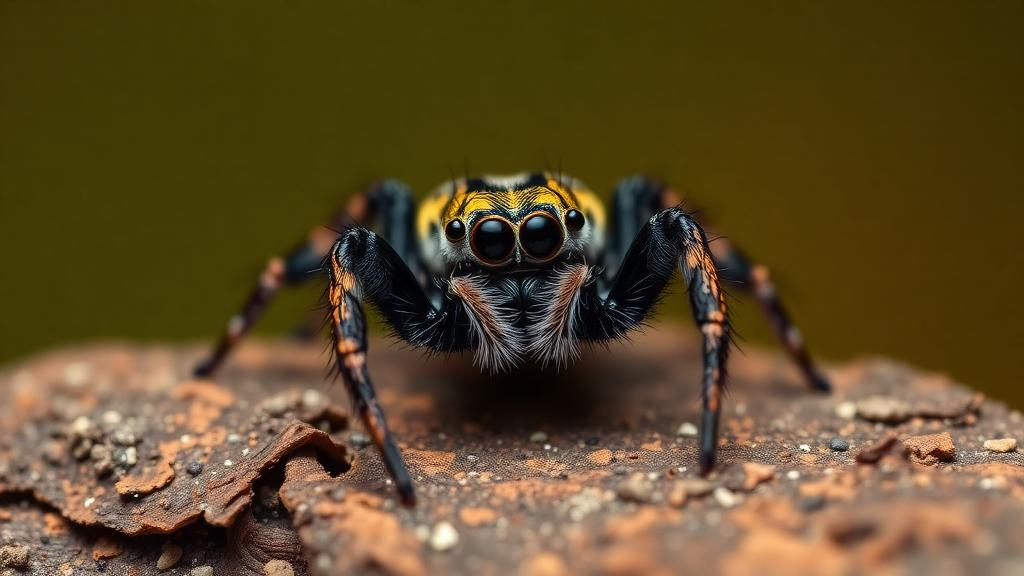
A spider small enough to sit comfortably on a pencil eraser has turned out to belong to an entirely new genus, according to a study published in the journal African Invertebrates. The miniature arachnid, collected decades ago in a celebrated South African game reserve, has been formally named Foordus stefani, and with it comes a brand-new genus, Foordus, that expands our picture of one of the most species-rich branches of the jumping spider family tree. The discovery, made by arachnologist Galina N. Azarkina of the Institute of Systematics and Ecology of Animals in Novosibirsk, Russia, raises the count of euophryine jumping spider genera in South Africa from six to seven and the species tally from fifty to fifty-one. That may sound like a modest bookkeeping adjustment, but in taxonomy every new genus represents a genuinely distinct branch of life, one that scientists had somehow overlooked despite decades of collecting in one of the best-studied corners of the Afrotropics.
The specimens that led to the discovery have a surprisingly long history. The male holotype, the single individual upon which the species description is officially anchored, was collected on 18 November 1992 in the Hluhluwe Imfolozi Game Reserve in KwaZulu-Natal Province by S. Endrödy-Younga. The reserve, one of the oldest protected areas in Africa, is famous as the last stronghold of the white rhinoceros, yet its tiny invertebrate inhabitants continue to yield surprises. Additional males and a single female, designated as paratypes, came from the same locality and are now distributed among museum collections in Pretoria, Novosibirsk, Manchester, Frankfurt and Saint Petersburg. The fact that the spiders sat in museum drawers for more than thirty years before anyone recognized them as something new is a familiar story in taxonomy, and it underscores how much undiscovered biodiversity may already be preserved on shelves around the world.
Foordus stefani is a genuinely tiny animal. The male holotype measures just 2.05 millimetres in total body length, while the female paratype reaches about 2.10 millimetres, with the genus definition allowing females up to 2.40 millimetres. The carapace of the male is a mere 1.05 millimetres long. Like all jumping spiders, the species belongs to the family Salticidae, a group renowned for their acute vision, stalk-and-pounce hunting style and, in many species, elaborate courtship displays. Within Salticidae, the subfamily Salticinae and the tribe Euophryini contain some of the most diverse jumping spiders on Earth, reported from every continent except Antarctica. In South Africa alone, euophryines had previously been represented by six genera and fifty species, four of those genera confined to Southern Africa, making the region a recognized hotspot for this lineage.
What convinced the author that these specimens deserved not just a new species but a new genus? The answer lies in the fine architecture of the spiders’ genitalia, the standard currency of spider taxonomy. In male jumping spiders, the copulatory organ, or palp, is a complex miniature apparatus whose shape is typically unique to each genus and species. In Foordus, the male palp features a retrolateral outgrowth of the tegulum near the embolic coil, a configuration that immediately recalls the South Asian genus Cytaea. However, several consistent differences set the new spider apart. The embolic division of Foordus bears an outgrowth at its base that is absent in Cytaea alburna, the comparative species examined. The females differ too: Foordus has a wider epigynal septum, whereas Cytaea possesses a thin median guide. On top of these anatomical distinctions, all known Cytaea species are larger and possess fissidentate chelicerae, meaning their jaws carry a comb-like row of teeth, while Foordus has unidentate chelicerae with two teeth on the front margin and one on the rear.
The formal definition of the genus reads like a portrait in miniature. Foordus spiders are tiny, with the sexes similar in general body shape, though males carry a shiny scutum, a hardened plate that covers the entire dorsal surface of the abdomen. The carapace is rather low, with a very low clypeus, the area between the eyes and the front edge of the head. The legs are subequal in size and length, with males showing a leg formula of I–IV/III/II and females IV/I/III/II, meaning the first and fourth pairs are longest. The male palp has a more or less round cymbium of the usual euophryine form, a short tibia bearing a small ventral bump, and a retrolateral tibial apophysis bent ventrally at almost ninety degrees. The embolic division forms a round coil prolatero-ventrally, with the salticid radix positioned prolaterally, and the coil carries a triangular outgrowth at its base, forming a single circle. The tegulum and salticid radix are separated by the basal haematodocha, while the embolic coil is separated from the radix by the distal haematodocha, elastic sacs that inflate during mating.
The female copulatory organs are equally diagnostic. The median septum of the epigyne is narrow, with two round windows flanked by wings on their outer rim, and the openings to the copulatory ducts sit close to the anterior end, supported by stiffeners. Internally, the vulva features long copulatory ducts and tube-shaped spermathecae, with fertilization ducts located in the middle part near the septum. Such characters, invisible to the naked eye, were revealed through meticulous laboratory work. Specimens preserved in seventy percent ethanol were examined under a stereomicroscope, and the epigyne was detached and macerated in ten percent potassium hydroxide overnight to clear the soft tissues. Drawings were made with a reticular eyepiece attached to an MBS-10 stereomicroscope, while photographs were taken with a Canon EOS 550D camera mounted on a Zeiss Stemi-2000 microscope, with stacked images combined using Helicon Focus software and edited in Adobe Photoshop and Corel Draw.
Both sexes were described in exhaustive detail, down to the pattern of bristles on each leg segment. The male is brown with a dark brown eye field and dark rings around the eyes, a dark brown shiny scutum covering the abdomen, and yellow legs whose femora are darkened on the sides and tips. The female shows a grey-brown abdomen with two thin yellow longitudinal bands, a yellow-brown longitudinal band on the thoracic part of the carapace, and dark yellow legs tinged with brown. Measurements of every segment, from the diameter of the anterior median eyes, a substantial 0.25 millimetres, to the length of each tarsus, were recorded for both the holotype and the paratype female, providing a permanent anatomical benchmark against which future specimens can be compared.
The name Foordus is a patronym honouring the late Professor Stefan Hendrik Foord, a South African arachnologist celebrated for his contributions to African arachnology, and the species epithet stefani carries the same dedication. The choice is fitting, because the study sits squarely within the research tradition Foord helped build. South Africa’s euophryine fauna was comprehensively revised only a decade ago, in 2014, when that work described two new genera and thirty-three new species, establishing Thyenula with twenty species as the largest genus and Euophrys with sixteen as the runner-up, alongside the South African endemics Rumburak and the monotypic Yimbulunga. That Foordus, a second monotypic genus, emerged barely ten years later suggests the inventory is still far from complete.
Beyond the description itself, the paper contributes to a broader biogeographical puzzle: the disjunct distributions that link Afrotropical spiders with relatives in South and Southeast Asia. Cytaea, the genus Foordus most resembles, ranges from India to Australia and eastward to Samoa. A few other salticid genera show a similar split, including Chinophrys, with one South African species and the rest in Southeast Asia, and Orsima, with one West African species and two in Southeast Asia. Intriguingly, several apparently shared species have been reexamined in recent years and found to be impostors. Two species of Afromarengo were first described in the Asian genus Marengo before being moved to a purely Afrotropical genus, and both Ballagascar insularis and Wandawe benjamini were originally placed in the Asian genus Colaxes before being reassigned. These corrections suggest that the apparent Africa-Asia connections may often reflect convergent anatomy rather than true close kinship.
For now, Foordus is known only from its type locality in KwaZulu-Natal, and the author has chosen a deliberately cautious course. Despite the considerable similarity to Cytaea, the new genus is described separately until further material is found and a full detailed diagnosis of Cytaea itself becomes available, since that genus appears to be polyphyletic, meaning its members may not all descend from a single common ancestor. Molecular methods, the study notes, may help resolve the question in the future, and DNA sequencing has already transformed jumping spider systematics elsewhere. Meanwhile, the genus Euophrys is itself suspected of being polyphyletic, and some of its African members will likely be moved to new, still-undescribed genera. In other words, the seven genera and fifty-one species now recorded from South Africa are probably a floor rather than a ceiling, and the smallest spiders in the bushveld may hold many more surprises for anyone patient enough to look.
Subject of Research: Taxonomic description of a new genus and species of euophryine jumping spider from South Africa
Article Title: Foordus gen. nov., a new genus of euophryine jumping spider from South Africa ( Salticidae , Araneae )
Article References: Azarkina, G. N. (2024). Foordus gen. nov., a new genus of euophryine jumping spider from South Africa (Salticidae, Araneae). African Invertebrates, 65(2), 75-83. https://doi.org/10.3897/afrinvertebr.65.137760
Image Credits: AI Generated
DOI: 10.3897/afrinvertebr.65.137760
Keywords: jumping spiders, Salticidae, taxonomy, new genus, South Africa, KwaZulu-Natal, Euophryini, arachnology, biodiversity, biogeography, Cytaea, African Invertebrates
Cite Scienmag News
Margaret Porter. (October 18, 2026). Tiny New Jumping Spider Genus Foordus Discovered in South Africa. Scienmag. https://scienmag.com/tiny-new-jumping-spider-genus-foordus-discovered-in-south-africa/
Margaret Porter. "Tiny New Jumping Spider Genus Foordus Discovered in South Africa." Scienmag, 18 October 2026, https://scienmag.com/tiny-new-jumping-spider-genus-foordus-discovered-in-south-africa/. Accessed 18 October 2026.
Margaret Porter. "Tiny New Jumping Spider Genus Foordus Discovered in South Africa." Scienmag. October 18, 2026. https://scienmag.com/tiny-new-jumping-spider-genus-foordus-discovered-in-south-africa/


