


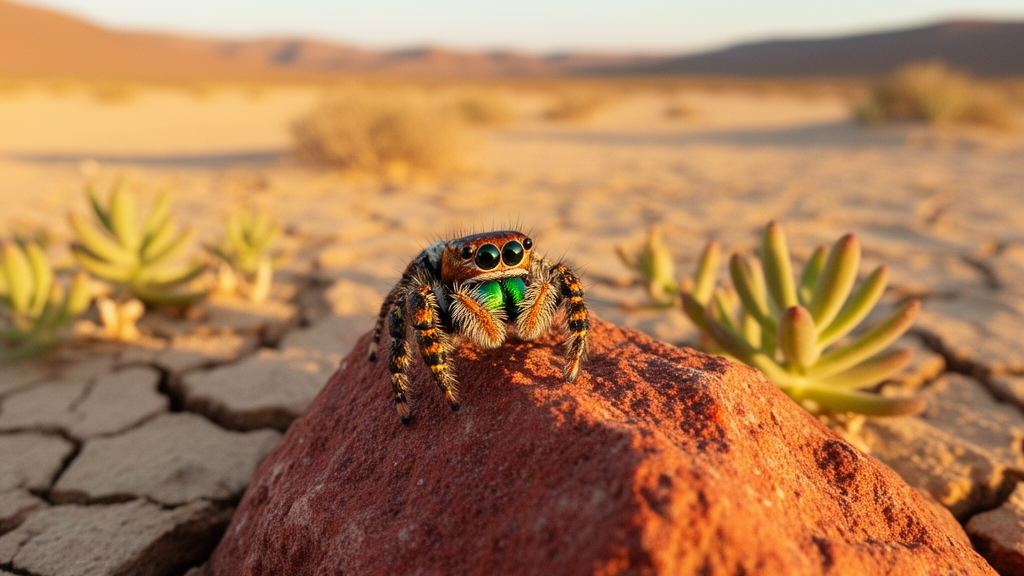
Deep in the arid western interior of South Africa, where the Succulent Karoo and Nama Karoo biomes stretch across some of the most underexplored terrain on the continent, a team of arachnologists has uncovered a hidden diversity of jumping spiders that has somehow evaded scientific attention for more than a century. A new study published in African Invertebrates reports three species new to science, describes previously unknown sexes of several poorly known spiders, and documents new provincial and country records for a tribe of salticids called the Chrysillini. The work represents the first focused taxonomic treatment of any spider group from this region, and it suggests that the arid west may be far richer in spider diversity than anyone expected.
The research emerged from a rapid biodiversity assessment conducted during 2021 and 2022 along a north–south transect through five historically undersampled degree squares in the arid western interior. The team, led by Charles Haddad of the University of the Free State and co-author Wanda Wesołowska, sampled sites ranging from the Desert Biome of Richtersveld National Park in the far northwest to the Succulent Karoo further south. The region includes the globally recognised Succulent Karoo biodiversity hotspot, famed for its extraordinary richness and endemism of dwarf succulents, yet its invertebrate fauna remains poorly documented for most orders. Most spiders recorded from the area were described by William Purcell in 1908 and Eugène Simon in 1910, meaning the bulk of the region’s spider fauna has gone essentially untouched by taxonomists for over a hundred years.
Jumping spiders of the family Salticidae are among the most charismatic arachnids on Earth, renowned for their exceptional vision, complex courtship displays and remarkable cognitive abilities. The Chrysillini, the tribe at the centre of this study, includes genera such as Heliophanus, Icius, Menemerus and Natta, many of which are adorned with iridescent scales that shimmer in the harsh African sunlight. Despite their visual appeal, the chrysilline fauna of South Africa’s arid west was known almost exclusively from scattered historical specimens held in natural history collections, with many quarter-degree cells in the region either severely undersampled or never sampled at all.
The survey yielded three new species. Icius jacksoni sp. nov., a diminutive male spider with a carapace length of just 1.7 millimetres, was collected at Sendelingsdrift camp in Richtersveld National Park and is named for Robert Jackson in recognition of his unparalleled contribution to jumping spider biology over five decades. Menemerus foordi sp. nov., a larger species with a carapace length of 2.8 millimetres, was found on grass at Kokerboomkloof in the same park and honours the late Stefan Hendrik Foord for his distinguished career in African arachnology. The most spectacular of the three, Natta triguttata sp. nov., is the first new species of Natta to be described in more than 120 years. Both its male and female were collected from leaf litter in a dry river bed at Akkedis Pass, and the species name derives from the Latin tri- and guttatus, referring to the three distinct white spots on the abdomen of both sexes. Unlike its congeners, which bear many orange or yellow spots, N. triguttata displays a pair of round white spots near the middle of the abdominal dorsum and a single white spot above the spinnerets.
Beyond the new species, the study filled critical gaps in the knowledge of several poorly known spiders. The hitherto unknown females of Heliocapensis mirabilis and Icius pulchellus were described for the first time, as was the male of Menemerus lesserti. The female of H. mirabilis can be distinguished from its congeners by the course of the seminal ducts, which initially run anteriorly from the epigynal depressions rather than posteriorly as in other species. Heliocapensis maluti, previously known only from the montane enclave of Lesotho, and Heliophanus deformis, previously known only from Angola, were both recorded from South Africa for the first time, both from the Northern Cape Province. Helafricanus patellaris, Heliocapensis capensis, H. mirabilis and Menemerus lesserti were all recorded from the Northern Cape for the first time. Heliocapensis redimitus, previously known only from its type locality at Komaggas, was collected approximately 45 kilometres west of that site, representing only the second record of the species since Simon described it in 1910.
The taxonomic work was underpinned by the first comprehensive molecular analysis of South African Chrysillini jumping spiders, based on the cytochrome oxidase I gene. The team sequenced 68 terminals, using the Kimura 2 Parameter distance model and the Neighbour-joining algorithm to construct a phylogenetic tree rooted with Massagris honesta, a member of the subfamily Hisponinae. The analysis found all South African Chrysillini genera monophyletic with two exceptions. Heliophanus sensu stricto was polyphyletic, with two specimens of H. deformis forming a clade sister to Mexcala and one specimen as sister to a clade containing Afraflacilla and H. pygmaeus. Helafricanus itself was represented by two clades separated by Trapezocephalus orchestra, a result the authors suggest may reflect the fact that the first clade contains considerably larger species with modified embolus and epigyne structures, possibly representing another genus altogether. The authors caution that decisions on the systematics of these genera should await more comprehensive molecular datasets.
The molecular data also resolved a long-standing taxonomic puzzle. Pseudicius matabelensis, originally described from Zimbabwe, was shown to nest within a clade containing two Afraflacilla species, prompting the authors to propose a new combination, Afraflacilla matabelensis comb. nov. When Prószyński partially revised Pseudicius in 2017, he transferred numerous African species to Afraflacilla and Psenuc, but a considerable proportion remained unresolved and were retained in Pseudicius. The proposed transfer here represents one step in resolving the placement of many untreated species. Crucially, the tree also confirmed the placement of all three new species within their respective genera, demonstrating that even a single gene can provide valuable information regarding the monophyly of genera and the placement of new species described therein.
The morphological methodology behind the study was equally meticulous. All specimens were preserved in 70 percent ethanol and deposited in the National Collection of Arachnida in Pretoria, the National Museum in Bloemfontein and the KwaZulu-Natal Museum in Pietermaritzburg. Digital microscope photographs of the habitus and genitalic morphology were taken with extended focal range imaging and stacked using Helicon Focus software to increase depth of field. Genitalic structures were illustrated with the aid of a reticular eyepiece on a binocular microscope, with male pedipalps and female epigynes dissected, cleared in hot potassium hydroxide solution, dehydrated in ethanol and drawn in temporary eugenol mounts. Measurements were determined with an eyepiece micrometer, with carapace length measured along the mid-line from the base of the anterior median eyes to the posterior margin.
The implications of the study extend well beyond taxonomy. Of the eight species of Euophryini collected along the transect, only one, Euophrys leipoldti, is described, suggesting that taxonomic studies of other salticid clades will reveal similarly poor knowledge of the region’s fauna. The authors argue that only through a concerted taxonomic effort on Salticidae and other families can the fauna of the arid zone be properly documented, and that there remains great potential for intensive sampling to address the massive geographical gaps that persist. The arid western interior of South Africa, long dismissed as species-poor relative to the mesic east, is now emerging as a frontier of arachnological discovery, where every expedition into its rocky plains and dry river beds has the potential to yield species that have never before been seen by human eyes.
Subject of Research: On some new and poorly-known Chrysillini from arid western South Africa (Araneae, Salticidae)
Article Title: On some new and poorly-known Chrysillini from arid western South Africa ( Araneae , Salticidae )
Article References: Haddad, C. R., & Wesołowska, W. (2024). On some new and poorly-known Chrysillini from arid western South Africa (Araneae, Salticidae). African Invertebrates, 65(2), 127-159. https://doi.org/10.3897/afrinvertebr.65.136083
Image Credits: AI Generated
DOI: 10.3897/AfrInvertebr.65.136083
Keywords: some, poorly-known, Chrysillini, arid, western, South, Africa, Araneae, Salticidae, scientific research
Cite Scienmag News
Margaret Porter. (October 17, 2026). New Jumping Spider Species Emerge From Arid Western South Africa. Scienmag. https://scienmag.com/new-jumping-spider-species-emerge-from-arid-western-south-africa/
Margaret Porter. "New Jumping Spider Species Emerge From Arid Western South Africa." Scienmag, 17 October 2026, https://scienmag.com/new-jumping-spider-species-emerge-from-arid-western-south-africa/. Accessed 17 October 2026.
Margaret Porter. "New Jumping Spider Species Emerge From Arid Western South Africa." Scienmag. October 17, 2026. https://scienmag.com/new-jumping-spider-species-emerge-from-arid-western-south-africa/


