


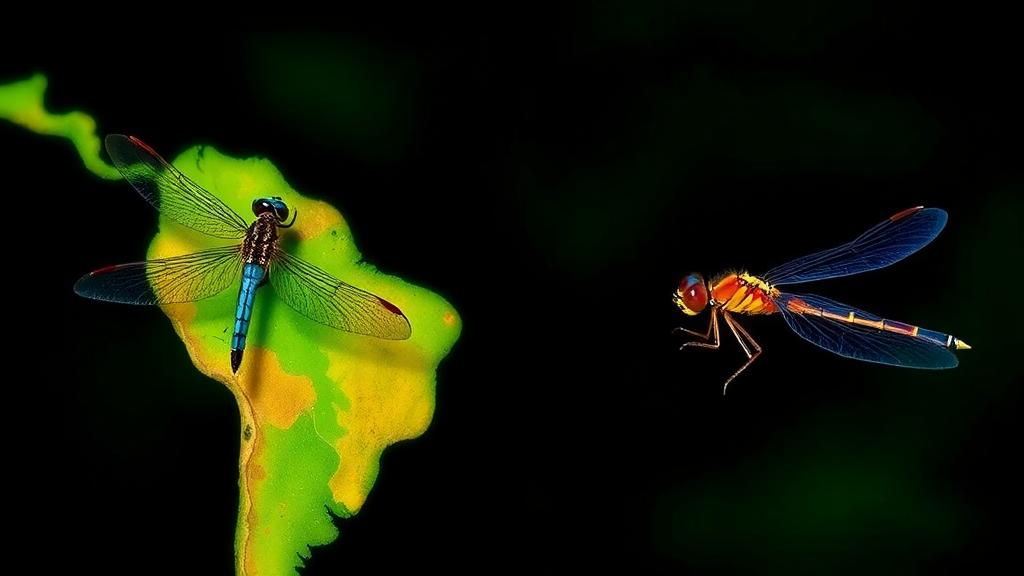
The Neotropics hold roughly 2,000 described species of dragonflies and damselflies, nearly 30 percent of global odonate diversity, yet until now the region had never been formally partitioned into biogeographic units for the entire order. A new study published in Frontiers of Biogeography has filled that gap, and its results reveal something unexpected: the two suborders that make up the order Odonata draw fundamentally different maps of the same landscape. Dragonflies, the strong fliers of the suborder Anisoptera, trace broad, cohesive regions that align closely with the overall odonate pattern. Damselflies, the delicate Zygoptera, fragment the Neotropics into a finer mosaic of smaller, more endemic-rich units. The difference, the authors argue, comes down to one biological trait: dispersal capacity.
The research team, led by P. L. Nunes and P. E. Cardoso, compiled geographic distribution data for 1,533 Neotropical odonate species from the IUCN Red List spatial data download, comprising 666 Anisoptera and 867 Zygoptera species. Two cosmopolitan wanderers, Tramea basilaris and Pantala flavescens, were excluded from the dataset because their ranges extend far beyond the study region. The remaining polygons were analyzed using the Infomap Bioregion application, an adaptive-resolution network method that constructs a bipartite graph linking grid cells to species and then clusters that network using the Map Equation algorithm. Cell sizes shrink where species distributions densely overlap, capturing fine compositional turnover, and expand in data-sparse areas to avoid spurious fragmentation.
The analysis successfully delineated 13 distinct bioregions for the entire order Odonata across the Neotropical realm. Species richness varied dramatically among these units: the Pan-Amazon Complex bioregion supported the highest diversity with 972 species, followed by the Atlantic Forests bioregion with 428 species and the Tropical Andes bioregion with 418 species. Endemism proved remarkably high. Of the 1,533 species analyzed, 834 were exclusive to a single bioregion and another 330 occupied only two. When the suborders were analyzed separately, Anisoptera yielded 14 bioregions while Zygoptera produced 19, with 444 damselfly species confined to a single unit, a pronounced degree of regional confinement that exceeded even the dragonfly pattern.
To test whether the suborders shared the same biogeographic architecture, the researchers quantified spatial association between the odonate bioregions and those of each suborder using the V-measure, an information-theoretic metric that is the harmonic mean of homogeneity and completeness, ranging from 0 for no correspondence to 1 for perfect alignment. The results were statistically significant against 1,000 randomized regionalizations. Anisoptera bioregions showed a stronger association with the overall odonate pattern (V = 0.638) than Zygoptera (V = 0.481). Homogeneity values were similar for both comparisons, but completeness dropped substantially for Zygoptera (c = 0.41 versus c = 0.69 for Anisoptera), indicating that damselfly bioregions more frequently intersected multiple odonate units and exhibited greater spatial fragmentation.
Local correspondence was mapped using the relative inhomogeneity index, which quantifies the internal compositional variance of each spatial unit on a scale from 0 for perfect homogeneity to 1 for maximal heterogeneity. For Anisoptera, zones of high inhomogeneity clustered in Mesoamerica, the Greater and Lesser Antilles, and along the southern Atlantic coast of Brazil, while low values dominated Central America and southern South America. The reciprocal map revealed that the vast Amazon region and western southern South America showed the tightest congruence between odonate and dragonfly boundaries. For Zygoptera, high inhomogeneity spanned Central America, the Lesser Antilles, extensive portions of northern South America, the Atlantic coast of Brazil, Andean regions, and the Southern Cone, while the western Amazon and northeastern Atlantic coast displayed the strongest alignment with the overall odonate pattern.
The researchers then overlaid their taxonomic bioregions with nine thematic regionalizations, including terrestrial ecoregions, biomes, climatic types, climatic zones, hydrobasins at two levels, simplified terrestrial biomes, biogeographical provinces, and biogeographical subregions. The results overturned a common assumption. Watersheds at levels 2 and 3 of the HydroBASINS hierarchy consistently produced the highest V-measure values across Odonata and both suborders, reaching 0.496 for the full order at level 2 and 0.525 for Zygoptera at level 3. In contrast, climate-based partitions showed the weakest association, with V-measures as low as 0.179 for Zygoptera against climatic types. For obligate aquatic insects whose larvae develop in freshwater, the finding reinforces that hydrological structure, not broad climatic zones, exerts the primary filter on community composition at Neotropical extents.
Local inhomogeneity maps between bioregions and watershed partitions highlighted zones of transition and mixing. The highest values for the full odonate pattern concentrated in the central and northern Amazon Basin, central Brazil, and the Andean foothills, while the lowest values appeared along the western slopes of the Andes in Peru and across the vast Amazon Basin itself. For Anisoptera, the interior of South America, especially the Amazon Basin, showed overwhelmingly low inhomogeneity in the reciprocal map, implying that dragonfly bioregions and watershed boundaries are tightly correlated in core regions of major biomes. For Zygoptera, a large contiguous block of low inhomogeneity in northwestern South America, coinciding with the western Amazon, emerged as a potential stronghold of bioregional congruence.
The divergence between suborders is consistent with a mechanism in which contrasting dispersal capabilities shape macro-scale biogeographic patterns. Previous Amazonian studies found that Zygoptera, with lower vagility, exhibited higher endemism and clearer separation of interfluvial areas, supporting the hypothesis that major rivers acted as effective barriers. Anisoptera, by contrast, showed broader distributions extending across multiple interfluves, with large rivers posing little impediment. The new Neotropical-wide analysis extends this pattern to the entire realm. Damselflies, more tightly bound to local hydroscapes, fragment into finer units that reflect basin-specific environmental regimes and dispersal limitation across drainage divides. Dragonflies, tracking broader hydrological connectivity, produce more geographically cohesive regions that align with large continuous areas like the Amazon Basin.
The authors acknowledge a potential caveat: IUCN range polygons may have been delineated with reference to hydrological boundaries, which could introduce a degree of circularity given that hydrological units emerged as the strongest correlates. However, IUCN expert maps have been empirically shown to yield environmental estimates highly correlated with occurrence data, and they provide a comprehensive alternative where raw occurrence records are geographically incomplete and unevenly sampled. The team also notes that zones of incongruence between suborders coincided with areas of geological complexity, including mountain uplift, glacial dynamics, and river dynamics in Mesoamerica, the Antilles, the Andes, and the southern Brazilian coast, suggesting these regions function as transitions of biotas where historical processes interact with contemporary hydrography.
The study establishes the first spatially explicit biogeographic framework for Neotropical Odonata and offers a theory-informed baseline for freshwater conservation. By linking suborder-specific dispersal traits with hydrographic structure, the results provide information for targeted strategies in freshwater and riparian conservation planning. The bioregion shapefiles are freely available, and the framework can guide spatially explicit protection of aquatic habitats across a region where watershed integrity increasingly determines the survival of endemic freshwater biodiversity.
Subject of Research: Biogeographic regionalization of Odonata (Insecta) in the Neotropics: contrasting Anisoptera and Zygoptera spatial patterns
Article Title: Biogeographic regionalization of Odonata ( Insecta ) in the Neotropics: contrasting Anisoptera and Zygoptera spatial patterns
Article References: Löwenberg-Neto, P., & Coelho, P. E. (2025). Biogeographic regionalization of Odonata (Insecta) in the Neotropics: contrasting Anisoptera and Zygoptera spatial patterns. Frontiers of Biogeography, 18, Article e175261. https://doi.org/10.21425/fob.18.175261
Image Credits: AI Generated
Keywords: Biogeographic, regionalization, Odonata, Insecta, Neotropics, contrasting, Anisoptera, Zygoptera, spatial, patterns, scientific research
Cite Scienmag News
Gavin Prescott. (October 17, 2026). Dragonflies and Damselflies Draw Contrasting Maps of the Neotropics. Scienmag. https://scienmag.com/dragonflies-and-damselflies-draw-contrasting-maps-of-the-neotropics/
Gavin Prescott. "Dragonflies and Damselflies Draw Contrasting Maps of the Neotropics." Scienmag, 17 October 2026, https://scienmag.com/dragonflies-and-damselflies-draw-contrasting-maps-of-the-neotropics/. Accessed 17 October 2026.
Gavin Prescott. "Dragonflies and Damselflies Draw Contrasting Maps of the Neotropics." Scienmag. October 17, 2026. https://scienmag.com/dragonflies-and-damselflies-draw-contrasting-maps-of-the-neotropics/


