


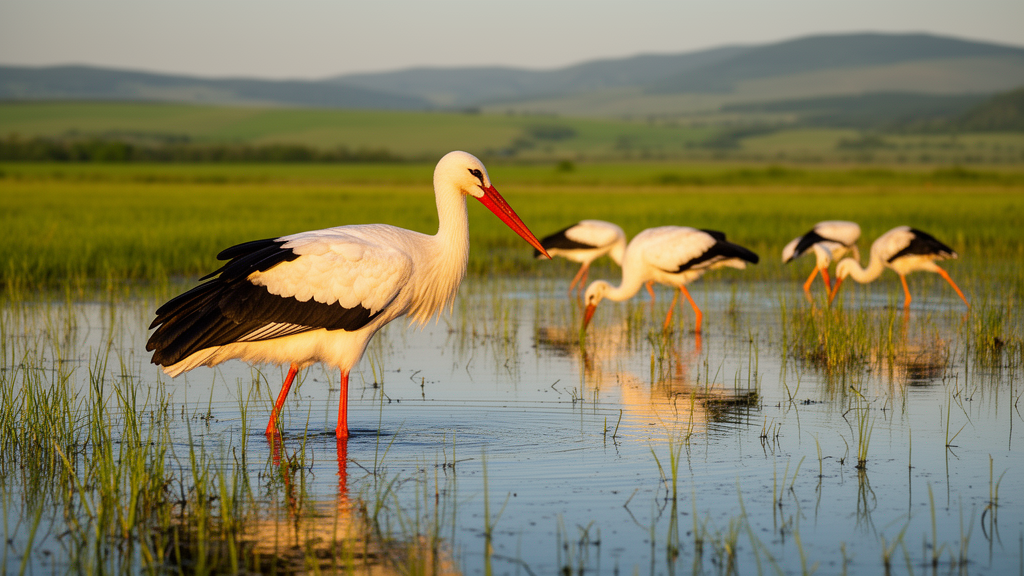
In the mountain grasslands and wetland-fringed settlements of southern Georgia, one of Europe’s most iconic birds is quietly making a comeback. A new census of the White Stork (Ciconia ciconia), published in the journal Caucasiana, documents 202 nesting pairs or occupied nests across the species’ limited local range in the Republic of Georgia, a substantial rise from the 105 pairs recorded during the most recent previous survey in 2018-2020. The findings point to a stable local population with an increasing trend, even though the change within settlements censused in both periods was not statistically significant.
The White Stork is among the easiest bird species to monitor anywhere in the world. It nests close to human settlements, often colonially, on rooftops and electricity pylons, and its large stick nests are highly detectable from the ground. That visibility makes the species an excellent indicator of wetland health, since storks depend on open, wet environments with sparse vegetation where they can forage for everything from large insects to small vertebrates. Historically, human settlements clustered near the same wetlands that storks favor, creating a natural overlap between the bird’s habitat and the villages where researchers can count its nests street by street.
Despite this ease of monitoring, published data on White Storks in Georgia has been scarce, with long gaps between population censuses. The first nationwide census with numbers dates to 1984, when researchers documented 85 nests, 74 of them occupied. Surveys in 1994-1995 mentioned roughly 60 nesting pairs, while by 2013-2014 the count had grown to 104 occupied nests. The 2018-2020 census detected 105 nesting pairs. Against this backdrop, the new 2024 survey represents the most comprehensive recent assessment of the species in the country.
In 2024, researchers revisited all 23 settlements where breeding pairs had been recorded in 2018-2020 and expanded the census to additional settlements within the stork’s range, which is concentrated in the southern Samtskhe-Javakheti and Kvemo Kartli regions. The team systematically inspected every street in each settlement by car and used binoculars to count nestlings in active nests. In total, 59 settlements were surveyed, with breeding pairs detected in 43 of them. All nests recorded in both census periods were located within settlements, underscoring the species’ close association with human habitation in Georgia.
Among the 23 settlements censused in both 2018-2020 and 2024, the number of nesting pairs increased by 40 percent, though a Wilcoxon signed-rank test applied to log-transformed count data found this change was not statistically significant (p = 0.299). Fluctuations were observed in 14 of these settlements, with most showing increases and four showing slight declines, while the remaining nine held steady. Because no data exists on previously surveyed settlements that had no breeding pairs, it is not possible to determine whether previously unoccupied villages have gained nesting storks since the last census.
The 2024 survey also broadened its scope to 36 additional settlements that had never been surveyed or reported in prior assessments. In 22 of these, researchers documented 55 new nesting pairs. This expansion of known range and abundance, combined with the growth in previously censused villages, suggests the local population is not merely holding steady but actively spreading across its southern Georgian stronghold.
Nesting success in 2024 appeared healthy. Of the 202 nests documented, 11.39 percent showed no visible fledglings or eggs, even if they may have been present. Most nests contained multiple young: 40.59 percent held at least two nestlings, 36.63 percent at least three, and 5.94 percent at least one. Only 5.45 percent of nests contained four nestlings, the highest count recorded. The researchers note, however, that they lacked published comparative data on hatchling success from previous monitoring years, limiting their ability to fully interpret these figures.
The study’s authors emphasize that while the observed pattern indicates a stable population with increasing trends, the factors driving growth remain unclear. More comprehensive studies are needed, alongside systematic monitoring using consistent methodologies and the collection of ecological and environmental variables. Such data would allow researchers to move beyond descriptive statistics and begin identifying the underlying causes of population change, whether related to wetland availability, agricultural practices, climate, or other factors shaping the stork’s mountain habitat.
A growing concern is Georgia’s expanding commitment to green energy infrastructure, including wind farms, which pose significant risks to large soaring birds. The Samtskhe-Javakheti region, identified as a potential windy area, overlaps directly with the White Stork’s habitat range in Georgia. The authors warn that careful planning and environmental assessment are essential before development proceeds, noting that the region also supports other vulnerable species such as Velvet Scoters, Common Pochards, and Dalmatian Pelicans.
To reconcile conservation with development, the researchers propose sensitivity mapping of the stork’s local range as a strategic tool for identifying critical habitats and movement corridors. Such maps would guide developers toward sites with minimal wildlife impact, reduce the likelihood of collisions and habitat fragmentation, and help conservation organizations prioritize monitoring in high-risk areas. Satellite tracking of the local population would further illuminate habitat use, movement patterns, and migration routes, building a comprehensive database to support evidence-based conservation strategies for the species in Georgia.
Subject of Research: White Storks (Ciconia ciconia Linnaeus, 1758) in Georgia: Current distribution and population status
Article Title: White Storks ( Ciconia ciconia Linnaeus, 1758) in Georgia: Current distribution and population status
Article References: Budagashvili, N., Shoshitashvili, D., & Uguzashvili, T. (2024). White Storks (Ciconia ciconia Linnaeus, 1758) in Georgia: Current distribution and population status. Caucasiana, 3, 235-243. https://doi.org/10.3897/caucasiana.3.e141157
Image Credits: AI Generated
DOI: 10.3897/caucasiana.3.e141157
Keywords: White Stork, Georgia, Ciconia ciconia, population census, bird conservation, Samtskhe-Javakheti, nesting pairs, Wilcoxon signed-rank test, green energy, wetlands, White, Storks
Cite Scienmag News
Margaret Porter. (October 17, 2026). White Storks Surge in Georgia as New Census Reveals Growing Population. Scienmag. https://scienmag.com/white-storks-surge-in-georgia-as-new-census-reveals-growing-population/
Margaret Porter. "White Storks Surge in Georgia as New Census Reveals Growing Population." Scienmag, 17 October 2026, https://scienmag.com/white-storks-surge-in-georgia-as-new-census-reveals-growing-population/. Accessed 17 October 2026.
Margaret Porter. "White Storks Surge in Georgia as New Census Reveals Growing Population." Scienmag. October 17, 2026. https://scienmag.com/white-storks-surge-in-georgia-as-new-census-reveals-growing-population/


