


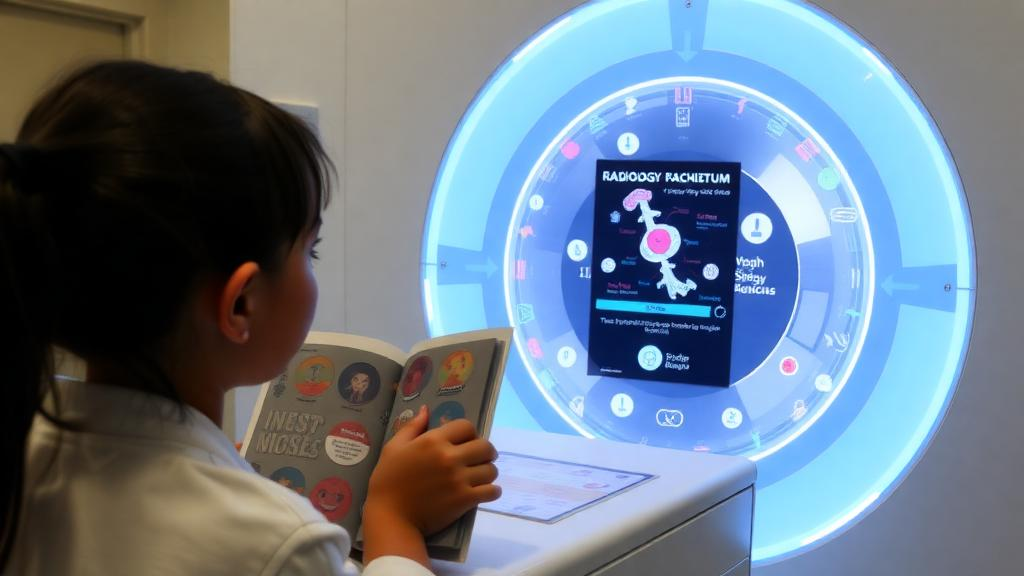
Medical students navigating the clinical years of their degree often encounter radiology departments as intimidating, fast-moving environments where imaging studies stream past in a blur of CT scans, MRIs, and ultrasound examinations. A new study from King Saud University in Riyadh suggests that a carefully constructed narrative framework, complete with a themed storybook, a sticker system, and a limited-access ID/passport, can transform how third-year medical students perceive and engage with a self-directed radiology department visit. The research, published in BMC Medical Education, reports highly positive student perceptions of most gamified design elements embedded within an activity called Radiology Kingdom, while also identifying one element that fell significantly short of the others.
The study was designed as a single-centre, cross-sectional observational survey targeting third-year medical students enrolled in RAD366 at King Saud University who had completed the Radiology Kingdom activity during the 2025–2026 academic year. Of approximately 270 eligible students, 112 submissions were received, representing a submission rate of approximately 41.5 percent. After exclusion of one probable duplicate, 111 responses were analysed, yielding an analytic response rate of approximately 41.1 percent. Participants anonymously reported their perceptions of five items: four assessing specific gamified design features and one assessing a global outcome, namely students’ perceived understanding of radiology concepts facilitated by the gamified elements.
Radiology Kingdom was built around a narrative Kingdom theme that framed the radiology department as an immersive fictional realm. Students navigated the department using a themed storybook that guided their self-directed exploration, collected stickers as tangible markers of their progress through different stations, and carried a limited-access ID/passport that controlled entry to restricted areas of the department. The overall activity was rated for its gamified contribution to students’ perceived understanding. Rather than adding badges, points, or leaderboards to existing content, the design embedded narrative and physical artefacts directly into the clinical environment, creating what the researchers describe as a resource-modest, self-directed clinical immersion activity.
Statistical analysis of the five-item questionnaire revealed substantial internal consistency, with Cronbach’s alpha across the five items calculated at 0.841. However, the researchers were careful to note that because the items assess conceptually distinct constructs, this coefficient was not interpreted as evidence of unidimensionality or instrument validity. A Friedman test identified a significant difference across items, with χ²(4) = 32.353 and p < 0.001. Bonferroni-corrected post-hoc comparisons revealed that the ID/passport received significantly lower ratings than the other four items, with all pairwise comparisons reaching p ≤ 0.001 after correction.
The four remaining elements clustered tightly together in student ratings. The Kingdom theme received a mean rating of 4.63, gamified understanding 4.60, the storybook 4.58, and the sticker system 4.52, with no significant pairwise differences detected among these four items. These scores indicate that students perceived the narrative framing, the storybook guide, the sticker collection mechanism, and the overall gamified contribution to their understanding as roughly equivalent in value, all falling in the highly positive range of the rating scale.
An exploratory finding emerged when ratings were compared between demographic groups. Female students gave significantly higher ratings than male students on the composite score, with means of 4.64 versus 4.33 and p = 0.023. This difference was also observed on three of the five individual items. The researchers characterised this as an exploratory finding, noting that no significant difference in ratings was detected across visit months or prior radiology exposure groups. Between-group comparisons used Mann-Whitney U and Kruskal-Wallis tests to assess differences across demographic categories.
The researchers are explicit about the limitations of their uncontrolled observational design. Because the study did not include a control group or randomised comparison, the findings demonstrate the feasibility of implementing a narrative-based, self-directed clinical immersion activity within a busy radiology department, rather than evidence that gamification itself improved engagement, understanding, or learning. The uncontrolled design does not support causal or comparative-effectiveness conclusions about individual intervention components. The difference in ratings between the ID/passport and the other elements reflects differences in student perceptions rather than evidence of the comparative educational effectiveness of individual components.
The lower rating of the ID/passport element is noteworthy from an instructional design perspective. While the storybook, Kingdom theme, and sticker system all received highly positive ratings, the limited-access ID/passport, which controlled entry to restricted areas, fell significantly short. This may suggest that elements perceived as restrictive or bureaucratic, even when thematically integrated, are received less favourably than elements perceived as exploratory, narrative, or rewarding. The finding offers a practical lesson for educators considering similar designs: artefacts that enable and reward exploration may resonate more strongly than artefacts that control access.
The study was administered under Institutional Review Board approval from King Saud University Medical City, College of Medicine, King Saud University, under approval number R26-IRB-510, approved on 29 June 2026. Informed consent was obtained electronically from all participants before they accessed the anonymous questionnaire. No identifying data were retained, and all data were stored securely with access restricted to the study team. The research received no external funding, and the authors declare no competing interests.
The researchers conclude that the intervention offers a practical, replicable model for similar self-directed department visits that warrants evaluation in controlled, multi-institutional studies incorporating objective measures of learning and retention. The findings demonstrate that a resource-modest, narrative-based clinical immersion activity can be implemented within a busy radiology department and can generate highly positive student perceptions of its gamified design elements. As medical education continues to explore innovative approaches to clinical immersion, the Radiology Kingdom model provides a concrete example of how narrative framing, physical artefacts, and self-directed exploration can be woven together into a cohesive learning experience that students rate favourably across most of its components.
Subject of Research: Medical students’ perceptions of gamified design elements in a self-directed radiology department visit
Article Title: Medical students’ perceptions of gamified design elements in a self-directed radiology department visit
Article References: Alharbi, S. R. (2026). Medical students’ perceptions of gamified design elements in a self-directed radiology department visit. BMC Medical Education, 26(1), Article 1654. https://doi.org/10.1186/s12909-026-10460-y
Image Credits: AI Generated
DOI: 10.1186/s12909-026-10460-y
Keywords: Medical, students, perceptions, gamified, design, elements, self-directed, radiology, department, visit, scientific research
Cite Scienmag News
Courtney Benton. (October 17, 2026). Radiology Kingdom: How a Storybook and Stickers Transformed Medical Student Department Visits. Scienmag. https://scienmag.com/radiology-kingdom-how-a-storybook-and-stickers-transformed-medical-student-department-visits/
Courtney Benton. "Radiology Kingdom: How a Storybook and Stickers Transformed Medical Student Department Visits." Scienmag, 17 October 2026, https://scienmag.com/radiology-kingdom-how-a-storybook-and-stickers-transformed-medical-student-department-visits/. Accessed 17 October 2026.
Courtney Benton. "Radiology Kingdom: How a Storybook and Stickers Transformed Medical Student Department Visits." Scienmag. October 17, 2026. https://scienmag.com/radiology-kingdom-how-a-storybook-and-stickers-transformed-medical-student-department-visits/


