


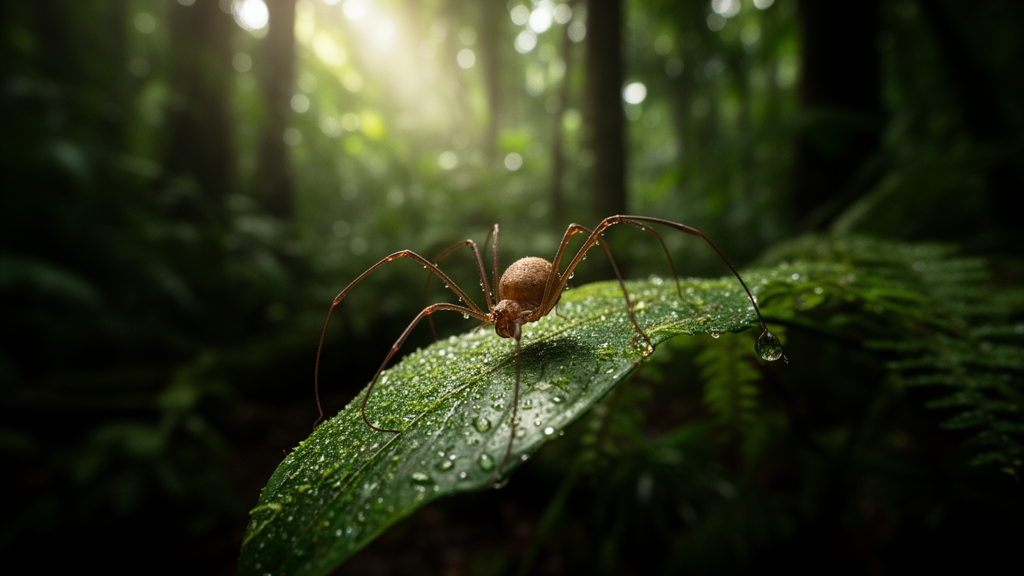
Deep in the humid forests of Ankasa National Park in southwestern Ghana, a small arachnid has just rewritten a chapter of African taxonomy. Scientists have described Metalacurbs foordi, a new species of harvestman belonging to the poorly known subfamily Lacurbsinae, based on a single male specimen collected in February 2013 near the park’s entrance. The description, published in the journal African Invertebrates, marks the first modern taxonomic treatment of any lacurbsine species and the first time the male genital morphology of this subfamily has ever been illustrated and characterized in detail.
Harvestmen, the order Opiliones, are often mistaken for spiders, but they lack silk glands and venom, and their bodies are fused into a single oval unit. The subfamily Lacurbsinae, part of the family Biantidae within the suborder Laniatores, is among the most conspicuous African opilionids, yet paradoxically one of the least understood. All eight previously known species were described decades ago with inadequate descriptions and poor illustrations, leaving the morphological boundaries of the group obscure. The new species is the ninth member of the subfamily and the first addition in more than half a century.
The specimen’s journey to science began thanks to Bernhard Huber, head of the Arachnida Section and curator at the Zoologisches Forschungsmuseum Alexander Koenig in Bonn, Germany, who collected the animal during daytime fieldwork in the forest near the park entrance at an elevation of 180 meters. The researchers examined the holotype, catalogued as ZFMK Op835, using a Leica M205A stereomicroscope and a Leica DF295 digital camera, capturing images at different focal planes. Detailed illustrations were drawn with a camera lucida, and the male genitalia were cleared in glycerine following established protocols before being drawn under a compound microscope.
The new species honors the late Stefan Foord (1971–2023), a passionate and dedicated contributor to African arachnology, whose name appears in the genitive case as foordi. The taxonomic description follows modern morphological nomenclature standards, and even the coloration was documented using the standardized names of the 267 colour centroids of the NBS/IBCC colour system, a level of precision rarely applied to harvestmen from this region.
What makes Metalacurbs foordi immediately recognizable is a suite of male-specific features. Males possess a basally enlarged metatarsus II, the second segment of the walking legs, and a dorsal spiniform apophysis on the fourth femur. These traits distinguish the new species not only from other members of the genus Metalacurbs but from every other lacurbsine. Only two related species, Metalacurbs oedipus and Metalacurbs villiersi, show a similarly stout and enlarged fourth tibia, but the outline and armature of that segment differ completely among the three species, providing a reliable diagnostic contrast.
The holotype male measures just 2.78 millimeters in total body length, with a bell-shaped dorsal outline and a carapace wider than long. Its second pair of legs stretches to 11.76 millimeters, nearly four times the body length, reflecting the long-legged silhouette typical of harvestmen. The pedipalps are raptorial, armed with spines concentrated on the tibia and tarsus, while the fourth leg bears an array of spiniform apophyses and pointed tubercles. Tarsi III and IV carry a dense scopula, a brush-like pad of hairs that likely aids grip on forest vegetation.
The most scientifically significant part of the description concerns the penis. In harvestmen, genital morphology is a crucial taxonomic character, often the decisive feature for distinguishing species. The penis of Metalacurbs foordi is tubular with a clearly defined basal and distal portion, ending in a thin lamina apicalis with a dorsal fold and two ventral pairs of small acute macrosetae. The glans, the functional tip of the penis, is built from rigid sclerites rather than the soft titillators typical of related biantids. The capsula externa forms a rigid plate with two long, curved projections that are basally fused, while the capsula interna carries a pointed stylus with the opening of the ejaculatory duct.
This rigid architecture forces a distinctive mechanical solution. During hydraulic expansion, the glans unfolds from the truncus in a jack-knife movement to expose the capsula interna and stylus, a mechanism strikingly similar to that seen in the superfamily Zalmoxoidea and completely different from the typical in-and-out expansion of biantine harvestmen. The researchers note that the ventral pars distalis is tagmatised, divided into a folded lamina apicalis resembling the zalmoxoidean rutrum and a rounded basal region akin to a pergula, convergent features that echo structures in Phalangodella and Hevelia crucis. As early as 1978, J. Martens pointed to the markedly different glans structure of Lacurbs and Metalacurbs to justify excluding both genera from his concept of Biantidae, a view this new description now substantiates with full anatomical detail.
The broader context is a continent whose harvestman fauna remains astonishingly underdocumented. Ghana holds only 16 opilionid records, a figure that contrasts starkly with 41 species in neighboring Côte d’Ivoire, 31 in the much smaller Equatorial Guinea, and more than 200 in South Africa. Much of tropical Africa’s humid forest harbors undescribed harvestman diversity, and the two previously known Ghanaian biantids, Eulacurbs paradoxa and Prolacurbs singularis, were described by Carl Roewer in 1949 from Aburi in the Eastern Region and never re-examined in modern terms.
Lacurbsines are restricted to western tropical Africa, with records concentrated in continental localities and notable sympatry on Mount Nimba, plus island occurrences on São Tomé and Bioko. Their distribution shows enormous gaps where no lacurbsines have yet been recorded, and the authors consider it highly probable that new species will surface once specimens from those regions are studied. The subfamily’s taxonomic history is itself convoluted: Lawrence cryptically proposed Lacurbsinae in 1959 without detailed treatment, later doubted his own subfamily, and the name was largely ignored until it was resurrected in 2003. The authors caution that the generic placement of the new species within Metalacurbs remains tentative, since no previous lacurbsine has ever been re-described and their penial morphology remains unpublished. Metalacurbs foordi therefore stands as a starting point for the long-overdue taxonomic revision of the entire subfamily, and the female of the species remains unknown, awaiting future collections in Ghana’s vanishing forest refuges.
Subject of Research: Metalacurbs foordi sp. nov., a new Lacurbsinae (Opiliones, Laniatores, Biantidae) from Ankasa National Park, Ghana
Article Title: Metalacurbs foordi sp. nov., a new Lacurbsinae ( Opiliones , Laniatores , Biantidae ) from Ankasa National Park, Ghana
Article References: Pérez-González, A., & Mamani, V. (2024). Metalacurbs foordi sp. nov., a new Lacurbsinae (Opiliones, Laniatores, Biantidae) from Ankasa National Park, Ghana. African Invertebrates, 65(2), 199-211. https://doi.org/10.3897/afrinvertebr.65.138398
Image Credits: AI Generated
DOI: 10.3897/afrinvertebr.65.138398
Keywords: Metalacurbs, foordi, Lacurbsinae, Opiliones, Laniatores, Biantidae, Ankasa, National, Park, Ghana, scientific research
Cite Scienmag News
Margaret Porter. (October 17, 2026). New Harvestman Species Discovered in Ghana’s Ankasa National Park. Scienmag. https://scienmag.com/new-harvestman-species-discovered-in-ghanas-ankasa-national-park/
Margaret Porter. "New Harvestman Species Discovered in Ghana’s Ankasa National Park." Scienmag, 17 October 2026, https://scienmag.com/new-harvestman-species-discovered-in-ghanas-ankasa-national-park/. Accessed 17 October 2026.
Margaret Porter. "New Harvestman Species Discovered in Ghana’s Ankasa National Park." Scienmag. October 17, 2026. https://scienmag.com/new-harvestman-species-discovered-in-ghanas-ankasa-national-park/


