


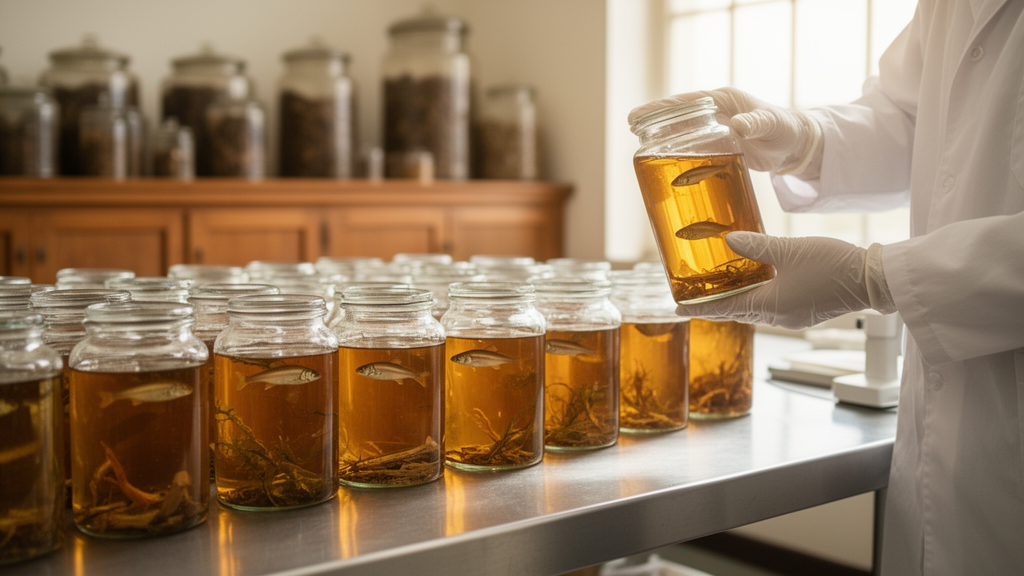
For more than a century, the world’s great natural history museums have relied on a handful of container designs to keep their priceless spirit collections submerged in alcohol. Now, a comprehensive audit of nearly 2,600 jars housing true flies at the Natural History Museum in London has produced something curators have never had before: hard numbers on which containers actually work best. The results, published in the Journal of Natural History Collections (the study appears in a peer-reviewed venue dedicated to collection care), upend conventional wisdom — and suggest that the humble jam jar, of all things, may be the unsung hero of specimen preservation.
The collection in question is the museum’s Diptera spirit collection, roughly 2,600 jars of flies and fly larvae preserved in alcohol, one of the largest such holdings anywhere. Since 2005 it has been stored in a purpose-built facility at the museum’s South Kensington site, kept at a steady temperature and controlled humidity. Each jar holds multiple glass tubes, one per taxon, plugged with cotton wool and topped up with industrial denatured alcohol — a mixture the museum uses instead of the ethanol-water solutions favoured by most of the world’s institutions.
Between April 2024 and January 2025, a team led by collection manager and researcher at the museum surveyed every single jar in the collection, recording container type, preservative level, alcohol concentration measured with a calibrated density meter, and any signs of lid or gasket failure. The survey was designed to answer a question that has long nagged collection managers: with no rigorous comparative data available, how do you decide which containers to buy, and how often should you check them?
The answer, it turns out, is not what the standard reference works recommend. The most widely cited guides to fluid-preserved collections — including the authoritative manuals by John Simmons and by Neumann and colleagues — favour ground-glass stoppered jars and warn against cheaper alternatives. But the London data tell a different story. Ground-glass stoppered jars, which make up about 13 per cent of the collection, suffered the highest rate of complete preservative loss: 7.1 per cent of them had gone entirely dry. Wire-bail clip-top jars fared little better, with 18.8 per cent showing substantial fluid loss and 7.1 per cent gone completely dry. Jam jars with metal twist lids, by contrast, lost preservative at a far lower rate — just 3.6 per cent — and only 5.2 per cent showed substantial loss.
Alcohol concentration told a similar tale. When the team measured the strength of the preservative in jars that were still full, they found that ground-glass stoppered jars averaged 74 per cent alcohol — barely within the 70–80 per cent target range — while wire-bail clip tops averaged 72 per cent and jam jars 76 per cent. In other words, the cheapest containers held their alcohol best.
Cost sealed the argument. A ground-glass stoppered jar from a scientific supplier costs £42. A wire-bail clip top with a replacement nitrile gasket runs to roughly £2. A commercial jam jar costs pennies. Over a collection of thousands of jars, the difference is transformative — and, given that jam jars performed best, the museum’s data suggest there is no trade-off between price and performance.
The findings diverge sharply from published guidance. The standard manuals recommend ground-glass stoppers and warn that partial-thread jam jar lids — the kind with quarter-turn lugs — are prone to failure. But the London collection has used them for decades with good results, echoing long-term experience at the Swedish Museum of Natural History, where similar lids have held up well since the 1970s. The museum’s own data on lid failure bear this out: only 2 per cent of jam jar lids showed any sign of failure, compared with 15 per cent of wire-bail gaskets.
There are caveats. The survey did not record how long each jar had been in the collection, so it cannot fully separate container performance from age. The museum’s use of industrial denatured alcohol rather than ethanol-water may also affect gasket deterioration in wire-bail tops, an effect noted in earlier surveys of spirit collections around the world. And the team acknowledges that the standard protocols for restoring alcohol strength in jars that have fallen below target — which involve lengthy re-strength procedures — were not applied, because curators lack the time to carry them out.
Even so, the implications are considerable. The survey provides the first quantitative evidence that the two-year inspection interval used at the museum is broadly adequate, and that jam jars with metal twist lids offer the best combination of seal quality, alcohol retention and cost. The team suggests that museums worldwide could adopt similar audits, recording container type and preservative level in their collection management systems, to build the comparative dataset that collection care has always lacked.
The study also touches on a question of growing urgency for museomics — the study of genomes from museum specimens. High-alcohol preservation improves DNA survival, and the team notes that concentrations of 95 per cent are ideal for genomic work. But they caution that the museum’s target of 70–80 per cent, while adequate for morphological study, may fall short for cutting-edge genomic research, and that curators may need to weigh the cost of higher concentrations against the scientific value of the specimens they hold.
For now, the message to collection managers is refreshingly practical. The best container for preserving a priceless fly specimen, the largest audit of spirit jars ever conducted suggests, may be the same one you use for marmalade.
Subject of Research: Collection care and natural history conservation
Article Title: Evidence-based assessment of container suitability for alcohol-preserved natural history specimens
Article References: Adams, Z. J. O., Baker, P., Ireland, N., & Price, S. (2026). Evidence-based assessment of container suitability for alcohol-preserved natural history specimens. Natural History Collections and Museomics, 3, 1-12. https://doi.org/10.3897/nhcm.3.181881
Image Credits: AI Generated
Keywords: natural history collections, collection care, spirit collections, diptera, museum conservation, Evidence-based, assessment, container, suitability, alcohol-preserved, natural, history
Cite Scienmag News
Beatrice Stafford. (October 17, 2026). Jam Jars Beat Museum Classics in Landmark Test of Specimen Preservation. Scienmag. https://scienmag.com/jam-jars-beat-museum-classics-in-landmark-test-of-specimen-preservation/
Beatrice Stafford. "Jam Jars Beat Museum Classics in Landmark Test of Specimen Preservation." Scienmag, 17 October 2026, https://scienmag.com/jam-jars-beat-museum-classics-in-landmark-test-of-specimen-preservation/. Accessed 17 October 2026.
Beatrice Stafford. "Jam Jars Beat Museum Classics in Landmark Test of Specimen Preservation." Scienmag. October 17, 2026. https://scienmag.com/jam-jars-beat-museum-classics-in-landmark-test-of-specimen-preservation/


