


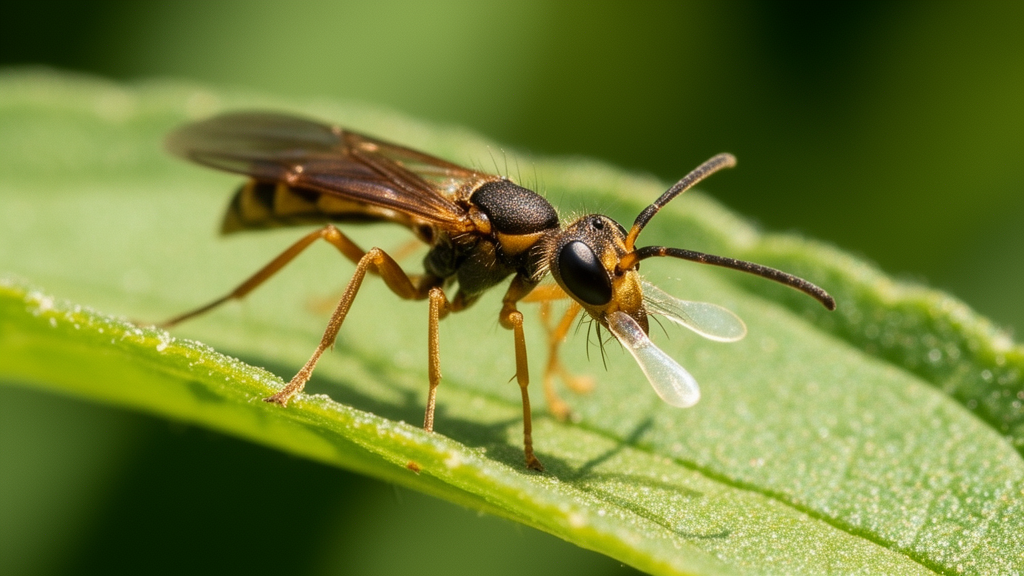
At barely 0.2 to 0.3 millimeters long, the parasitoid wasp Megaphragma viggianii is one of the smallest flying insects on Earth, a creature whose entire body is comparable in size to some single-celled organisms. Yet new research reveals that even at this astonishing scale, the wasp’s mouthparts carry a complete sensory toolkit: 70 sensilla of four distinct types, arranged in a pattern so stable that it is essentially identical from one individual to the next. The findings, published in the Journal of Hymenoptera Research, offer a rare window into how evolution rebuilds sensory systems when space runs out.
Sensilla are modified cuticular hairs that serve as the insect body’s primary sensors, each typically housing at least one bipolar neuron plus several auxiliary cells that support and maintain the structure. They cover the insect body surface but cluster densely on the antennae, mouthparts, legs, wings, and genitalia, detecting mechanical forces, chemicals, temperature, and humidity. For decades, scientists have catalogued these organs in larger insects, but how they scale down at the extreme limits of body size has remained largely unexplored, particularly for the mouthparts, which most studies have overlooked in favor of antennae and eyes.
Megaphragma wasps are ideal test cases for this question because their miniaturization goes far beyond simple shrinkage. Previous work by Alexey Polilov and colleagues at Lomonosov Moscow State University has shown that these wasps have dramatically reduced hearts, tracheal systems, and musculature, and even possess anucleate neurons, cells that have lost their nuclei, a phenomenon otherwise unknown in the animal kingdom outside one other genus of miniature wasps. Despite this radical cellular economy, female Megaphragma perform complex behaviors such as locating the eggs of their thrips hosts, which means their sensory systems must remain fully functional.
To map the mouthpart sensors of M. viggianii, the researchers raised 41 males and 35 females in the laboratory from eggs of the thrips Heliothrips haemorrhoidalis, then prepared them with careful fixation, dehydration, and critical-point drying before coating them in a 20-nanometer layer of gold. Scanning electron microscopes captured surface views of the mandibles, maxillae, and labium, while hidden surfaces were exposed by physically splitting heads apart with entomological pins. For the internal ultrastructure, the team turned to volumetric electron microscopy, reconstructing three-dimensional images from serial sections to see the neurons inside each sensillum.
The survey identified four major sensillum types. Chaetoid sensilla, elongated hair-like structures with sockets and a tubular body at the base of a single neuron, were the most numerous, appearing on every mouthpart and ranging from about 2.8 to 13.4 micrometers in length depending on position. Coeloconic sensilla sat partially submerged in deep cuticular pockets on the mandibles, their visible tips barely one micrometer long. Basiconic sensilla came in two flavors: porous pegs on the maxillary palps packed with six dendrites, and aporous cones on the labium tip with three dendrites, one bearing a tubular body. Finally, campaniform sensilla, ten per mandible, were completely buried beneath the cuticle, invisible from the surface.
The ultrastructural details point to clear functional assignments. Most of the sensilla appear to be mechanoreceptors: the aporous surfaces, basal sockets, and tubular bodies of the chaetoid and campaniform types are hallmarks of touch and deformation sensing. The campaniform sensilla, hidden under the mandible cuticle, likely act as proprioceptors monitoring the stresses of biting and manipulating food. Notably, these buried sensors lack the cuticular dome and sensillar cavity found in their counterparts in larger insects, a simplification the authors suggest is possible because the wasp’s cuticle is thin enough for deformation to reach the dendrite directly.
The porous basiconic sensilla on the maxillary palps, with their six dendrites and pore-covered thick cuticle, are probably contact chemoreceptors that taste whatever the wasp touches, while the aporous basiconic sensilla on the labium may combine mechanosensation with chemosensory or thermo-hygroreceptive roles. The coeloconic sensilla, lacking both pores and tubular bodies, are unlikely to be either mechanoreceptors or chemoreceptors and may instead respond to temperature or humidity, a function documented electrophysiologically for the same type in katydids. One curious finding is a set of non-innervated chaetoid sensilla on the tips of the maxillae: these stout spike-like structures contain no neurons at all and may serve purely mechanical roles in food processing.
The most striking signature of miniaturization is what the sensilla lack: auxiliary cells. In larger insects, each sensillum is typically supported by thecogen, tormogen, and trichogen cells that provide structural support, nourishment, and secretion of the cuticular apparatus. In M. viggianii’s mouthpart sensilla, these cells are absent, mirroring the loss previously documented in the wasp’s antennal placoid sensilla. Because auxiliary cells perform critical maintenance functions, the researchers suggest their elimination likely occurs after the sensillum has fully formed, though confirming this will require studying the pupal stages when these structures develop.
Comparisons across the Hymenoptera reveal a consistent scaling pattern. The closely related Trichogramma dendrolimi, slightly larger, carries about 80 mouthpart sensilla in a similar arrangement. Mid-sized parasitoids in the 0.7 to 1.5 millimeter range, such as Telenomus dendrolimusi and Leptocybe invasa, have 85 to 110, while larger species like Aphidius gifuensis reach 250 to 300. Social insects push the counts far higher, with wasps of the genus Vespula bearing several thousand. Crucially, the types of sensilla and their relative positions stay the same across this size spectrum: what shrinks is the number, not the diversity. Males of the even smaller wasp Dicopomorpha echmepterygis, at 0.14 to 0.24 millimeters, represent the opposite extreme, having abandoned mouthparts entirely in favor of a brief life devoted solely to transferring sperm.
Another unexpected result is the complete absence of sexual dimorphism in the mouthparts. Males and females showed no significant differences in sensillum size or distribution, a contrast with the wasp’s antennae, where females bear more sensilla and possess types that males lack. The authors interpret this as functional divergence: antennae handle sex-specific tasks such as mate detection and host location, while mouthparts perform the same food-handling jobs in both sexes. The overall picture that emerges is one of evolutionary compromise in which miniaturization strips away cellular complexity and reduces sensor counts but preserves the full functional repertoire, a principle that may govern how all biological systems scale toward the limits of size.
Subject of Research: Mouthpart sensilla structure and scaling in the miniature parasitoid wasp Megaphragma viggianii
Article Title: Combining simplicity and functionality: mouthpart sensilla in the miniature parasitoid wasp Megaphragma viggianii ( Hymenoptera , Trichogrammatidae )
Article References: Abu Diiak, K. T., & Polilov, A. A. (2025). Combining simplicity and functionality: mouthpart sensilla in the miniature parasitoid wasp Megaphragma viggianii (Hymenoptera, Trichogrammatidae). Journal of Hymenoptera Research, 98, 1067-1085. https://doi.org/10.3897/jhr.98.167764
Image Credits: AI Generated
Keywords: Megaphragma viggianii, parasitoid wasp, miniaturization, sensilla, mouthparts, electron microscopy, mechanoreception, chemoreception, Hymenoptera, Trichogrammatidae, sensory biology, evolutionary morphology
Cite Scienmag News
Gavin Prescott. (October 17, 2026). Tiny Wasp Packs Full Sensory Toolkit Into Mouthparts Smaller Than a Cell. Scienmag. https://scienmag.com/tiny-wasp-packs-full-sensory-toolkit-into-mouthparts-smaller-than-a-cell/
Gavin Prescott. "Tiny Wasp Packs Full Sensory Toolkit Into Mouthparts Smaller Than a Cell." Scienmag, 17 October 2026, https://scienmag.com/tiny-wasp-packs-full-sensory-toolkit-into-mouthparts-smaller-than-a-cell/. Accessed 17 October 2026.
Gavin Prescott. "Tiny Wasp Packs Full Sensory Toolkit Into Mouthparts Smaller Than a Cell." Scienmag. October 17, 2026. https://scienmag.com/tiny-wasp-packs-full-sensory-toolkit-into-mouthparts-smaller-than-a-cell/


