


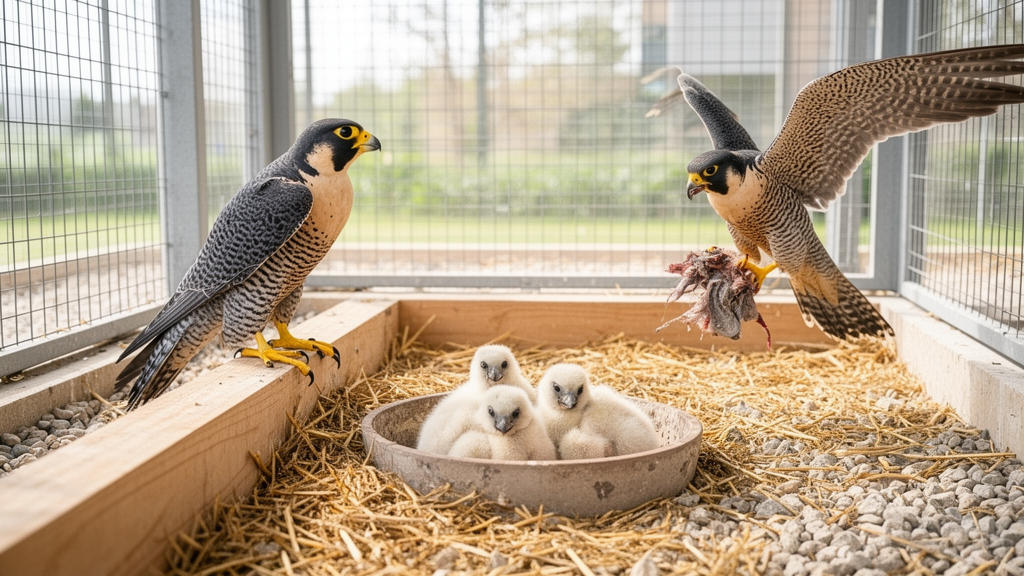
Falcons are famously single-brooded birds, laying one clutch of eggs each spring and pouring their energy into raising a single family. A new decade-long study from breeding centres in Bulgaria and Romania now shows that this rule is far more flexible than anyone assumed. Researchers report that three falcon species — the Common Kestrel (Falco tinnunculus), the Saker Falcon (Falco cherrug) and the Peregrine Falcon (Falco peregrinus) — each produced three successive clutches within a single breeding season under controlled captive conditions. The findings, published in the Biodiversity Data Journal, suggest that with careful husbandry, the reproductive output of conservation breeding programmes could be multiplied several times over from the same precious pairs of birds.
The study spanned the breeding seasons of 2011 to 2020 and followed two breeding pairs of each species. Common Kestrels were observed during 2011 and 2012 at the Wildlife Rehabilitation and Breeding Centre run by Green Balkans in Stara Zagora, Bulgaria. Saker Falcons were monitored in 2015 and 2016 at the Breeding Centre for Birds of Prey in Burgas, Bulgaria, while Peregrine Falcons were studied in 2019 and 2020 at the Centre for Birds of Prey in Bucharest, Romania. All the birds were classified as non-releasable, either because prolonged contact with humans had altered their behaviour or because injuries had compromised their chances of survival in the wild. For each pair, the team recorded clutch frequency, egg production, fertilisation rates, hatching success, chick survival and the final fate of every juvenile.
The enclosures were engineered with reproduction in mind. Common Kestrels were housed in aviaries measuring 3.0 by 2.5 by 2.5 metres and given enclosed nest boxes with a single frontal opening, while the larger Saker and Peregrine Falcons occupied 5.0 by 3.0 by 3.0 metre aviaries with nest boxes of 100 by 50 by 50 centimetres featuring two open sides for observation. Every aviary provided room for flight, elevated perches, visual barriers to reduce disturbance, shelter from bad weather and exposure to natural light and ambient climate. Breeding behaviour was tracked around the clock by Dahua IP security cameras with resolutions of two to eight megapixels, which recorded continuously to network video recorders. This system allowed researchers to observe laying, incubation, hatching and parental behaviour while keeping human presence near the birds to a minimum, and it enabled remote veterinary assessment of posture, feeding activity and signs of stress.
Nutrition played a central role in the protocol. The team implemented a two-week rotational feeding system designed to provide dietary variety while maintaining a consistent supply of whole-prey items, informed by published studies of the natural diets of these raptors. Once the first egg hatched, the scheduled fasting day was suspended and rodent provisions were increased to meet the heightened energy demands of chick rearing. Feeding took place during the warmer hours of the day to align with the birds’ natural hunting rhythms. These details matter because sustained egg production is expensive: each egg requires substantial allocations of protein, lipids, calcium and micronutrients, and a female cannot draw on reserves she does not have.
The most striking result came from the kestrels, where triple clutching occurred entirely naturally. Both monitored pairs completed three successive clutches within a single season in two consecutive years, with no egg removal and no artificial incubation. Initial laying began in late February, around 23 February, and females initiated subsequent clutches roughly seven to ten days after the previous brood hatched, meaning egg formation proceeded concurrently with the rearing of dependent young. The second clutch of both pairs was lost to rat predation six to nine days after the last egg was laid, yet the females resumed laying about ten days after the failure and produced a third clutch in mid-April, which hatched around 20 May. Clutch size remained stable at four to six eggs and successful clutches yielded four to five fledglings each, demonstrating a remarkable capacity for rapid re-nesting.
In the two larger species, triple clutching was deliberately induced through a well-established technique in raptor propagation: systematic egg removal. For Saker Falcons, whose first clutches began in early February, eggs were removed after the fifth egg was laid and placed in artificial incubation, triggering re-laying approximately twenty days later. Subsequent clutches appeared around 25 February and 20 March. Peregrine Falcons followed a nearly identical schedule, with first clutches in early February, removal after the fourth or fifth egg, and replacement clutches around 4 March and 26 March. Eggs were incubated artificially in a Falcon C-30SK incubator at 37.3 degrees Celsius and ten percent relative humidity with automatic turning, and fertilisation was assessed by candling between days seven and ten of incubation. Chicks hatched under artificial conditions were kept under controlled care for five to seven days for veterinary assessment before being transferred to foster parents where appropriate.
Reproductive output remained impressively high across successive clutches in all three species, but the data revealed a subtle warning sign. In both Saker and Peregrine Falcons, eggs in later clutches — particularly the third — were noticeably smaller, with the reduction becoming evident after the eighth to tenth egg laid within a season. This pattern is generally interpreted as a consequence of the cumulative energetic costs of repeated egg formation, and comparable reductions have been reported in other raptors subjected to sustained laying. Crucially, however, the smaller eggs did not impair fertility, hatchability or chick survival in this study. All Saker Falcon chicks were eventually released into the wild, while Peregrine juveniles were retained within the breeding programme. The authors suggest that reduced egg size may reflect either physiological limitation or an adaptive adjustment in investment, allowing females to keep producing viable eggs while lowering the energetic cost of each one — and they recommend monitoring egg size as a practical welfare indicator in induced multi-clutch programmes.
The contrast between the species carries its own lessons. The natural triple clutching of the kestrels closely mirrors replacement and overlapping brooding strategies documented in small raptors and suggests the species maintains reproductive readiness across an extended breeding window, likely an adaptation to high nest-loss rates in the wild. Recent evidence indicates that replacement clutching may be far more widespread among raptors than once believed: even large, long-lived species traditionally considered strictly single-brooded, such as the Greater Spotted Eagle and the Chaco Eagle, have now been documented laying replacement clutches when clutch loss occurs early and food is plentiful. This supports the interpretation that re-nesting capacity in birds of prey is constrained primarily by ecological conditions rather than by hard physiological limits. In kestrels, reproductive success in the study was limited by external factors — predation — rather than by any intrinsic inability to keep laying.
The implications for conservation breeding are considerable. Induced multi-clutching has long been a cornerstone of Peregrine Falcon recovery programmes, and the new results confirm that it can be applied predictably, with a consistent re-nesting interval of roughly twenty days after egg removal. For Saker Falcons, whose captive breeding supports both conservation recovery and regulated use, the technique offers a way to multiply the output of genetically valuable pairs. In species such as the Common Kestrel, the findings suggest that management focused on environmental quality and food availability may boost productivity without direct intervention at all. Comparable management-driven increases in reproductive output have been reported in other raptor conservation programmes that used targeted reproductive manipulation.
The authors are careful to temper these conclusions. With only two breeding pairs per species, and all observations made under optimal captive conditions with predictable food and minimal disturbance, the results demonstrate reproductive potential rather than typical performance in wild populations. Repeated clutch production is also likely to carry physiological costs that may not be immediately visible, and the long-term effects on breeding females warrant careful monitoring, particularly in conservation contexts. Future research, the team argues, should focus on long-term tracking of repeatedly breeding females and comparative analyses between captive and wild populations to define the ecological and physiological limits of multiple clutching — and to establish safe management thresholds that balance short-term productivity against the long-term welfare and breeding viability of the birds themselves.
Subject of Research: Induced and natural triple clutching in three captive falcon species
Article Title: Induced triple clutching in captivity for three falcon species: Common Kestrel ( Falco tinnunculus ), Saker Falcon ( Falco cherrug ) and Peregrine Falcon ( Falco peregrinus )
Article References: Petrov, R., & Valchev, A. (2026). Induced triple clutching in captivity for three falcon species: Common Kestrel (Falco tinnunculus), Saker Falcon (Falco cherrug) and Peregrine Falcon (Falco peregrinus). Biodiversity Data Journal, 14, Article e197934. https://doi.org/10.3897/bdj.14.e197934
Image Credits: AI Generated
Keywords: Common Kestrel, Saker Falcon, Peregrine Falcon, triple clutching, captive breeding, egg removal, artificial incubation, raptor reproduction, conservation breeding, reproductive plasticity, egg size, Bulgaria
Cite Scienmag News
Drew Townsend. (October 17, 2026). Three Broods in One Season: Falcons Reveal Surprising Breeding Flexibility in Captivity. Scienmag. https://scienmag.com/three-broods-in-one-season-falcons-reveal-surprising-breeding-flexibility-in-captivity/
Drew Townsend. "Three Broods in One Season: Falcons Reveal Surprising Breeding Flexibility in Captivity." Scienmag, 17 October 2026, https://scienmag.com/three-broods-in-one-season-falcons-reveal-surprising-breeding-flexibility-in-captivity/. Accessed 17 October 2026.
Drew Townsend. "Three Broods in One Season: Falcons Reveal Surprising Breeding Flexibility in Captivity." Scienmag. October 17, 2026. https://scienmag.com/three-broods-in-one-season-falcons-reveal-surprising-breeding-flexibility-in-captivity/


