


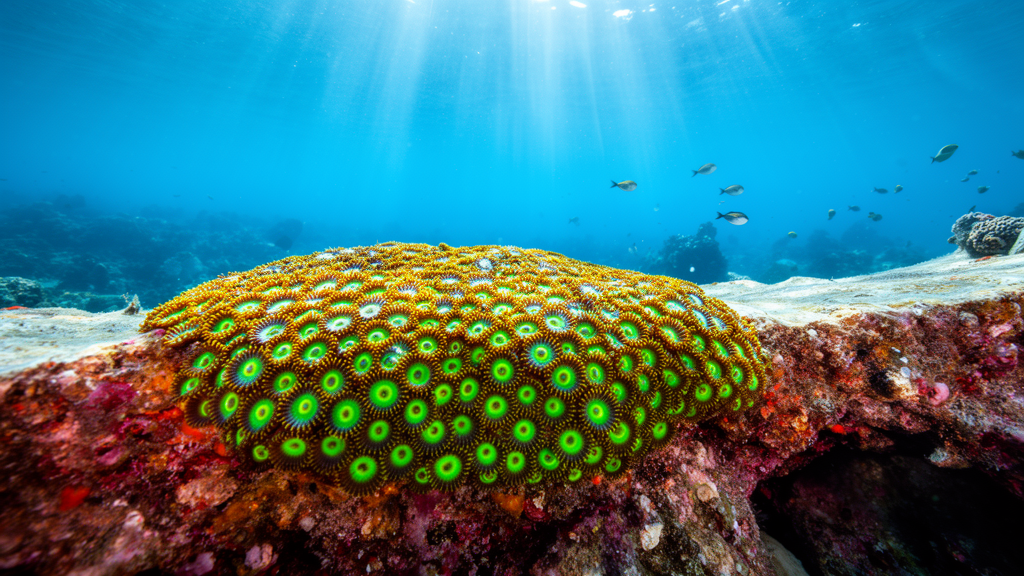
Some of the ocean’s most successful animals have just rewritten one of science’s favorite biogeographical rules. Zoantharians, an order of cnidarians related to stony corals, show remarkably weak genetic differentiation between the Atlantic and Indo-Pacific oceans, according to the first comprehensive global assessment of their distribution. The finding, published in Frontiers of Biogeography, upends patterns seen in reef fishes and stony corals, where the Indo-Pacific Ocean typically holds several times the diversity of the Atlantic Ocean at the family and genus level.
Zoantharians are among the most abundant non-calcifying hexacorals in shallow-water ecosystems, with colonies of some species capable of covering dozens of square meters across tropical and temperate regions. Despite this ecological prominence, they remain understudied compared with better-known reef groups. The research team combined an extensive literature review with new field surveys conducted by snorkeling and SCUBA diving at depths of 0 to 40 meters across Yucatan, Hong Kong, Cebu, South Africa, Bali, and Kenting, Taiwan. They supplemented these observations with morphological examination and DNA sequence data from specimens held at the Bernice Pauahi Bishop Museum in Hawai’i, the Smithsonian National Museum of Natural History, and the National Museum of Rio de Janeiro.
Two striking results emerged that contrast with previously established marine biogeographical patterns. First, several zoantharian genera are cosmopolitan, inhabiting most biogeographic provinces within and between ocean basins. Although the highest diversity was observed in the Indo-Pacific Ocean, concordant with biogeographic assays of reef fishes and stony corals, the distribution of genera was not significantly different between the Atlantic and the Indo-Pacific. Second, the team identified multiple sibling species complexes between the two basins, pairs or groups of lineages that occupy distinct oceans yet share highly similar DNA sequences and morphology.
The order Zoantharia comprises nine families subdivided into the suborders Brachycnemina and Macrocnemina. Most brachycneminan species host Symbiodiniaceae microalgae, also known as zooxanthellae, and are restricted to shallow waters, while macrocneminans have a broader distribution into the deep sea and polar regions and are mostly azooxanthellate. Several Macrocnemina genera, and one Brachycnemina genus, Acrozoanthus, display epizoic symbioses in which polyps attach to other benthic invertebrates, including crabs, hydroids, octocorals, sponges, or polychaete worm tubes. These associations are often obligatory, with the zoantharian species found only with a specific genus or family of hosts.
The biogeographic analysis revealed that 6 out of the 8 zoantharian families reported in shallow waters are cosmopolitan, with only Nanozoanthidae and Neozoanthidae so far restricted to the Indo-Pacific, though the authors suspect these are also present in the Atlantic. The shallow-water diversity center was the Indo-Polynesian province in the Central Indo-Pacific, while within the Atlantic, the Caribbean province held the highest diversity. In deep waters, a different pattern emerged, with the most diverse provinces being Sino-Japanese, Lusitania, and Hawaiian. Parazoanthidae was the most diverse and widely distributed family, with 16 genera reported across 19 provinces.
To quantify these patterns, the researchers compiled records across global marine biogeographic provinces following the framework of Briggs and Bowen, chosen because its provinces defined by more than 10 percent endemism align well with phylogeographic breaks recovered in fishes and crustaceans. They used the Jaccard dissimilarity index and Unweighted Pair Group Method with Arithmetic Mean to summarize relationships among provinces, and applied non-metric multidimensional scaling to plot similarities in zoantharian composition by ocean basin and seawater temperature. Statistical testing with pairwise Adonis showed no significant differences in the composition of genera and families between the Atlantic and Indo-Pacific, yet tropical and temperate provinces had significant differences, meaning temperature rather than basin separation structures zoantharian communities.
The phylogenetic reconstruction, built from a concatenated alignment of mitochondrial COI and 16S rDNA markers plus nuclear ITS rDNA totaling 120 sequences and 3,219 sites, confirmed that Brachycnemina is monophyletic while Macrocnemina is paraphyletic, with the family Hydrozoanthidae residing within brachycnemic zoantharians. At least four shallow-water families had sibling species complexes. In Brachycnemina, three genera from two families had species reported in both basins: Palythoa from Sphenopidae, and Zoanthus and most likely Isaurus from Zoanthidae. The suborder Macrocnemina had at least two sibling species groups, one from Hydrozoanthidae and another from Parazoanthidae. The sibling pair Palythoa caribaeorum from the Atlantic and Palythoa tuberculosa from the Indo-Pacific had the most extensive distribution among zoantharians analyzed, with reports across all tropical and subtropical provinces.
What explains this puzzling weak genetic differentiation between ocean basins? The authors hypothesize that low or moderate genetic diversity may partially explain the pattern. Anomalously low mutation rates have been observed in a diversity of taxa including plants, cnidarians, and vertebrates, and a low mitochondrial DNA mutation rate may prevail in most anthozoan orders, including stony corals and zoantharians. Hybridization and incomplete lineage sorting may also obscure evolutionary relationships for many Palythoa and Zoanthus lineages. Additionally, many zoantharian lineages have evolved high ecological plasticity, adapting to distinct habitats and environmental settings, with endosymbiosis and epizoism gained and lost multiple times across several distinct genera and families.
At species and population scales, three dispersal strategies may at least partly explain the low levels of genetic differences between ocean basins. A long pelagic larval duration is one factor; research on zoantharian larval phases is limited, but an extended planktonic phase of more than 100 days is known for Palythoa tuberculosa, and plankton tows indicate long larval durations for the families Sphenopidae and Zoanthidae. Asexual reproduction promotes local dispersal and increases substrate occupancy, a trait described for genera such as Palythoa, Parazoanthus, and Zoanthus. Some zoantharians also have high rafting potential, and many coastal organisms, including stony corals and reef fishes, can disperse for hundreds to thousands of kilometers attached to drift material such as volcanic pumice, seaweed, logs, or man-made objects.
The low molecular and morphological divergence observed between zoantharian sibling species may reflect a similar use of resources and related niches. Palythoa tuberculosa is often the most abundant zoantharian in shallow waters of the Indo-Pacific, including Okinawa, Taiwan, Malaysia, and the Red Sea, while its Atlantic sibling Palythoa caribaeorum is widespread along the Brazilian and Caribbean coasts, the Mid-Atlantic Ridge, and the East Atlantic. Both species are generalists found in diverse environments from the backreef moat to the outer reef, and from the intertidal zone to more than 20 meters deep. In contrast, the siblings Palythoa mutuki and Palythoa grandiflora are relatively less abundant and occur most commonly on intertidal reef crests or exposed habitats in both ocean basins. Considering that most zoantharians are widely distributed across regions and might share similar traits, it is unlikely that these sibling species result from ecological differences between the basins. Instead, geological events are the most likely drivers: the rise of the Isthmus of Panama closed the tropical exchange between the Atlantic and Pacific approximately 3.5 million years ago, while the Benguela upwelling zone, starting approximately 2 million years ago, created a cold-water environmental barrier along the South Atlantic coast of Angola, Namibia, and South Africa. The authors note that the closure of the Tethys Sea, a much older event from 20 to 12 million years ago, would have likely resulted in higher genetic differentiation than observed from zoantharian siblings.
Zoantharians are often overlooked in ecological surveys, and their distributions as reported here are still underestimated. There is a paucity of research along the African coasts and Polynesian archipelagos, and great potential for discovering additional species within cryptic habitats such as caves, rubble zones, and turf. The two current Indo-Pacific-endemic families, Nanozoanthidae and Neozoanthidae, are most likely cosmopolitan; Nanozoanthidae species are difficult to spot due to a pale, translucid color and small polyp size under one millimeter, while molecular data suggest Isozoanthus sulcatus off western Europe likely belongs to Nanozoanthidae, and phylogenetic analyses indicate Neozoanthidae should be reassigned to the cosmopolitan family Zoanthidae. Species of Palythoa and Zoanthus play a significant ecological role in phase shifts from coral to zoantharian-dominated reefs, and with ongoing environmental change, such phase shifts may become more common in coral reefs worldwide. Filling knowledge gaps on the distributions and biology of zoantharians will be essential to support monitoring and management of marine ecosystems.
Subject of Research: Global biogeography and sibling species patterns of zoantharian cnidarians between the Atlantic and Indo-Pacific oceans
Article Title: Global biogeography of zoantharians indicates a weak genetic differentiation between the Atlantic and Indo-Pacific oceans, and distinct communities in tropical and temperate provinces
Article References: Santos, M. E. A., Kise, H., Fourreau, C. J. L., Kiriukhin, B., Kitahara, M. V., Baker, D. M., Toonen, R. J., Liu, P. J., Chang, A., Tu, T.-H., Widiastuti, Agustini, K. M. P., Bowen, B. W., & Reimer, J. D. (2026). Global biogeography of zoantharians indicates a weak genetic differentiation between the Atlantic and Indo-Pacific oceans, and distinct communities in tropical and temperate provinces. Frontiers of Biogeography, 19, Article e174247. https://doi.org/10.21425/fob.19.174247
Image Credits: AI Generated
Keywords: zoantharians, biogeography, cnidarians, Atlantic Ocean, Indo-Pacific, sibling species, Isthmus of Panama, Benguela upwelling, larval dispersal, coral reefs, phylogenetics, marine invertebrates
Cite Scienmag News
Violet Maxwell. (October 17, 2026). Zoantharians Break the Rules of Marine Biogeography With Weak Ocean-Basin Genetic Split. Scienmag. https://scienmag.com/zoantharians-break-the-rules-of-marine-biogeography-with-weak-ocean-basin-genetic-split/
Violet Maxwell. "Zoantharians Break the Rules of Marine Biogeography With Weak Ocean-Basin Genetic Split." Scienmag, 17 October 2026, https://scienmag.com/zoantharians-break-the-rules-of-marine-biogeography-with-weak-ocean-basin-genetic-split/. Accessed 17 October 2026.
Violet Maxwell. "Zoantharians Break the Rules of Marine Biogeography With Weak Ocean-Basin Genetic Split." Scienmag. October 17, 2026. https://scienmag.com/zoantharians-break-the-rules-of-marine-biogeography-with-weak-ocean-basin-genetic-split/


