


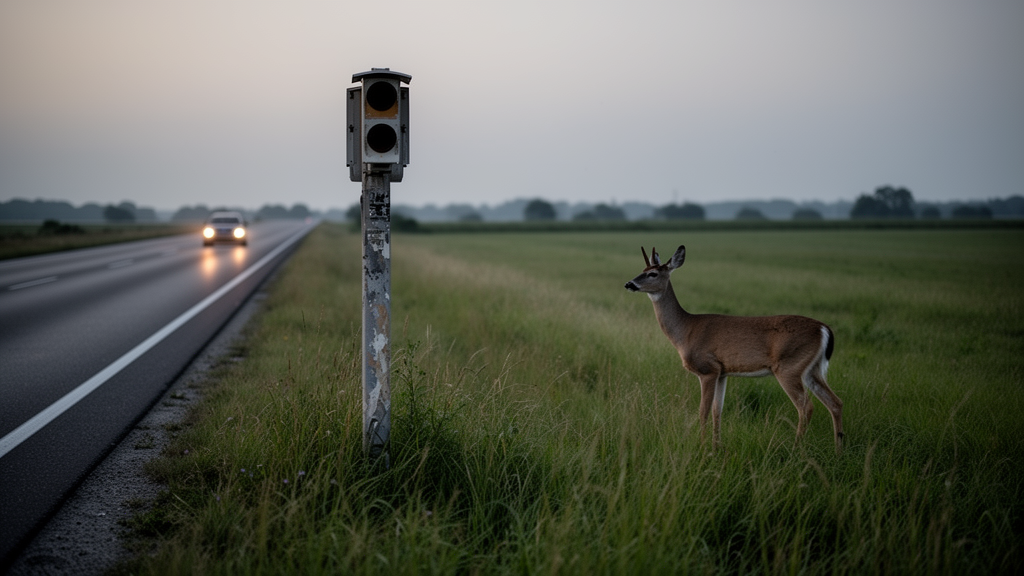
Every year, Europe’s roads become killing fields for wildlife. According to a comprehensive review cited in a new study, up to 194 million birds and 29 million mammals die on European roads annually, while collisions with ungulates claim roughly half a million animals across the continent each year. In the Czech Republic alone, police dealt with 9,317 traffic accidents caused by collisions with wildlife or domestic animals in 2024, representing 10.1 percent of all accidents, and insurance companies paid out more than 442 million Czech koruna, approximately 18.1 million euros. Against this backdrop, a research team spent nearly four years testing whether two commercially available deterrent devices could reduce the carnage on secondary roads. The answer, published in the journal Nature Conservation, is sobering: neither device produced a statistically significant reduction in animal mortality.
The study, conducted in the Vysočina Region of the central Czech Republic, evaluated two types of combined deterrents that had never before been verified in published research. The first, Deer Deter DD430 Generation 5 from the Austrian manufacturer iPTE Traffic Solutions, is an optical-acoustic device activated by an internal daylight sensor from dusk until dawn. When a vehicle’s headlamps are detected at distances of 300 to 500 metres, the device flashes royal blue and amber LEDs while simultaneously emitting a high-frequency acoustic alert in the range of 3.5 to 6.5 kilohertz. The second, Hagopur Kombiset Multiwarn Wildlife Protector from Germany, combines an optical component of eight multi-coloured honeycomb platelets with an olfactory element: a semi-circular chamber containing a sponge soaked in odour concentrate, renewed every three months as the manufacturer recommends. The researchers hypothesised that combining two different stimuli in each device would prove more effective than single-stimulus approaches tested in earlier studies.
The experimental design was unusually rigorous for this field. The team selected seven road sections totalling 18.6 kilometres, all identified as animal-vehicle collision hotspots using the KDE+ method, which pinpoints road segments where collisions cluster at higher frequencies than the surrounding network. Four sections received the Deer Deter devices and three received the Hagopur Kombiset, with units installed every 50 metres along both sides of the road on triangular delineator posts. Crucially, the researchers also monitored seven control sections spanning 88 kilometres of adjacent road, 4.7 times longer than the test sections, to capture any landscape-wide trends in mortality that might otherwise be misattributed to the deterrents. Cadaver monitoring was carried out continuously at weekly intervals: 21 months before installation, from March 2022 to November 2023, and 18 months after, from December 2023 to May 2025.
Data collection drew on three independent sources, an above-standard methodological approach. The researchers themselves walked the test sections back and forth on both sides of the road, recording species, photographs, dates and GPS coordinates for every carcass of roe deer, fallow deer, wild boar, red fox, European brown hare and stone marten. Local hunting association managers from 11 hunting grounds contributed records, as Czech law places responsibility for documenting and removing road-killed game within their competence. Finally, the police database of wildlife collisions provided a third stream of data covering both test and control sections. The team acknowledged that police records capture only a subset of animal-vehicle accidents, but assumed underreporting was evenly distributed across the study area, excluding spatial bias. Traffic intensity was measured directly using mobile automatic counters employing Doppler-effect radar, deployed for at least 168 hours during May and November of 2023 and 2024, periods chosen to coincide with peak roe deer and wild boar migration and mortality.
The statistical analysis followed the Before-After-Control-Impact design widely recommended in road ecology literature. Mortality data were annualised and adjusted for section length, expressing wildlife deaths per kilometre per year, and effect sizes were calculated as standardised mean differences using Hedges’ d, adapted to a before-after comparison. Five analytical models were run, ranging from the researchers’ own data alone to combinations incorporating police and hunter records, including one conservative specification that excluded hunter data from treated sections to ensure structural comparability with control sections. Parametric paired t-tests, non-parametric sign tests, Mann-Whitney U tests, ANOVA and regression models were all applied, with the sign test chosen specifically because very small sample sizes rendered conventional non-parametric methods unreliable.
The results delivered an unexpected twist. Mean annual wildlife mortality per kilometre did decrease after deterrent installation across most sections and most models, but the reductions were statistically weak. Sections treated with the Hagopur Kombiset showed a mean mortality reduction of 22.0 percent, while Deer Deter sections averaged only 7.2 percent, neither reaching statistical significance, with confidence intervals so wide they spanned both meaningful reductions and negligible effects. The control sections, where no deterrents were installed at all, recorded a 45.5 percent decline in mortality, a statistically significant decrease. In other words, mortality fell more on untreated roads than on roads fitted with the devices, suggesting the observed declines reflected natural fluctuations operating at landscape scale rather than any effect of the deterrents themselves.
The Control-Impact comparisons confirmed this interpretation. None of the statistical tests, whether Mann-Whitney U, t-tests or ANOVA across all three groups, revealed significant differences between deterrent-equipped and control sections. Regression models estimating how device type influenced effect size produced coefficients for both the Deer Deter and Hagopur Kombiset variables that were statistically non-significant across all five models, with p-values far above standard thresholds. The researchers noted that the negative intercepts, significant in four of five models, indicated a general decline in mortality across the region during the study period, probably driven by unmonitored external influences such as natural population fluctuations, crop distribution along roads, road characteristics, weather conditions and disturbance, rather than by any sharp decline in local game populations, since hunting rates remained stable.
Traffic intensity emerged as a more meaningful correlate of mortality. In the researchers’ own monitoring data, traffic volume after installation showed a strong positive correlation with mortality, with Pearson’s r reaching 0.84 and Spearman’s rank correlation 0.71, both statistically significant. The percentage change in mortality was also significantly associated with traffic intensity in this dataset. This aligns with a 2020 review reporting that traffic had a predominantly positive effect on animal-vehicle collisions in 75 percent of examined studies, meaning collision risk rises with traffic volume. The researchers also documented practical shortcomings: roughly 20 percent of Deer Deter devices failed night functionality checks, largely because insufficient solar charging, caused by shading vegetation, roads in cuttings or improper panel orientation, drained their batteries, particularly during short winter days and on heavily trafficked roads.
Behavioural observations reinforced doubts about the devices’ underlying principle. Hunters reported seeing fallow deer and wild boars at night near sections equipped with Deer Deter devices, showing no signs of disturbance from the sound and light signals while cars passed by. The study’s authors point to stimulus habituation, a core principle in behavioural ecology, as a likely explanation for the broader failure of light and sound deterrents: animals rapidly learn to ignore predictable, non-threatening cues that lack consistent negative reinforcement. Devices emitting wavelengths or frequencies outside a target species’ perceptual range may be undetectable or meaningless altogether. The team emphasised that no ethological validation, testing whether animals respond to the deterrent stimuli at all, was ever conducted for these specific products, and argued such investigations should precede any field deployment.
The researchers conclude that the tested deterrents showed no statistically significant effect in reducing mortality of the selected wildlife groups, and that despite decades of use, strikingly few studies have evaluated their real effectiveness in field conditions. They call for an end to trusting testimonial reports from product manufacturers, urging rigorous applied ethological research, standard performance protocols and multi-site validation studies so that only measures with proven efficacy are deployed at scale. The findings apply exclusively to the tested device types from specific manufacturers within the particular landscape and traffic context of the Vysočina Region and cannot be generalised to other devices operating on the same principle. For wildlife conservation, human safety and public finances, the knowledge gap remains concerning, and the elusive solution to safer road crossings continues to demand evidence before hardware.
Subject of Research: Effectiveness of combined wildlife deterrent devices for reducing animal-vehicle collisions on roads
Article Title: On the road chasing the elusive solution: Evaluating combined deterrents for safer wildlife road crossings
Article References: Strnad, M., Křápek, M., Dostál, I., Uhlíková, J., Slepica, M., & Hlaváč, V. (2026). On the road chasing the elusive solution: Evaluating combined deterrents for safer wildlife road crossings. Nature Conservation, 63, 173-198. https://doi.org/10.3897/natureconservation.63.170760
Image Credits: AI Generated
DOI: 10.3897/natureconservation.63.170760
Keywords: wildlife road crossings, animal-vehicle collisions, road ecology, wildlife deterrents, optical-acoustic deterrents, olfactory repellents, BACI design, road mortality, habituatation, traffic intensity, Czech Republic, Nature Conservation
Cite Scienmag News
Margaret Porter. (October 17, 2026). Roadside wildlife deterrents fail rigorous three-year field test. Scienmag. https://scienmag.com/roadside-wildlife-deterrents-fail-rigorous-three-year-field-test/
Margaret Porter. "Roadside wildlife deterrents fail rigorous three-year field test." Scienmag, 17 October 2026, https://scienmag.com/roadside-wildlife-deterrents-fail-rigorous-three-year-field-test/. Accessed 17 October 2026.
Margaret Porter. "Roadside wildlife deterrents fail rigorous three-year field test." Scienmag. October 17, 2026. https://scienmag.com/roadside-wildlife-deterrents-fail-rigorous-three-year-field-test/


