


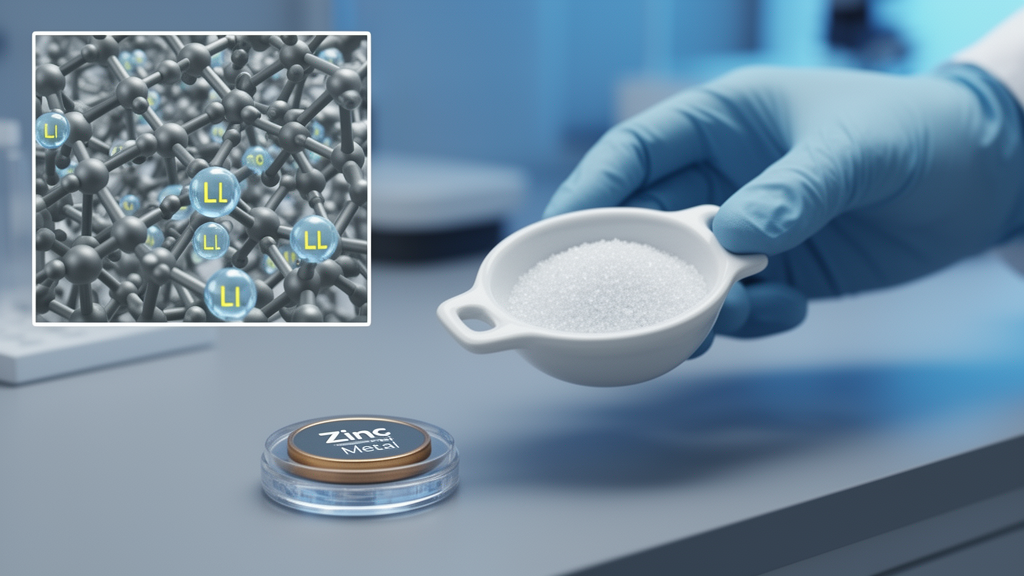
Lithium recovery from brines and seawater depends on a class of materials known as lithium-ion sieves, spinel-structured manganese oxides that selectively pull lithium ions out of complex salt solutions while rejecting sodium, potassium, and magnesium. One of the most promising of these sieves is H1.6Mn1.6O4, a proton-rich spinel derived from delithiated Li1.6Mn1.6O4. But these sieves have a hidden cost: after repeated adsorption-desorption cycles in industrial lithium extraction, the cycled powder loses performance and is typically discarded. A team at Northeastern University in Shenyang, China, has now shown that this spent material is far from worthless. In a study published in the journal Ionics, researchers led by Xiao Liu and Fenghua Li demonstrated that cycled H1.6Mn1.6O4 powder can be directly repurposed as a cathode material for rechargeable zinc-ion batteries, a technology widely viewed as a low-cost, safe alternative to lithium-ion systems for grid-scale energy storage.
The strategy, which the authors call cascading utilization, treats the lithium-ion sieve as a two-stage asset rather than a single-use consumable. In the first stage, the spinel framework performs its designed job of selectively extracting lithium from aqueous resources. In the second stage, the same powder, now depleted and structurally altered by hundreds of lithium extraction cycles, is converted into a functional electrode for a completely different electrochemical device. This cross-domain repurposing addresses a genuine sustainability problem: lithium-ion sieve powders are expensive to synthesize, requiring high-temperature solid-state reactions and careful acid treatment, and throwing them away after their sieving performance declines wastes both the embedded manganese and the energy invested in their manufacture.
The central challenge in converting a cycled sieve into a battery cathode lies in the chemistry of the spinel itself. Fresh H1.6Mn1.6O4 is essentially a lithium-depleted manganese oxide with a dense spinel lattice, and its suitability for hosting zinc ions, which are divalent and much larger than lithium ions, is far from obvious. Zinc-ion batteries store charge by intercalating Zn2+ into host structures at the cathode, and polyvalent cations like zinc diffuse sluggishly through tight crystal frameworks. The researchers recognized, however, that the repeated lithium extraction process the sieve had already endured might have done some of the activation work for them. Each cycle of Li+ removal and reinsertion subtly reshapes the spinel, and the team hypothesized that these structural changes could create favorable diffusion pathways for zinc.
To prepare the cycled powder for its new role, the team applied a photo-excitation-assisted oxidative delithiation process using sodium persulfate as the oxidant. This step removes any residual lithium left in the framework after the sieving cycles while preserving the spinel structure. Conventional acid-based delithiation methods, such as treatment with hydrochloric acid, are known to cause manganese dissolution, which erodes the spinel lattice and degrades performance. The persulfate approach, assisted by photo-excitation, is gentler: it oxidatively extracts lithium without the harsh acidic conditions that dissolve manganese from the framework. The result is a material that retains high structural integrity while carrying the surface activation and diffusion pathways introduced by its prior life as a sieve.
When the regenerated material was assembled into cathodes and tested in aqueous zinc-ion batteries, the performance confirmed the team’s hypothesis. The directly regenerated lithium-ion sieve delivered a reversible capacity of 101.5 mAh per gram at a current density of 0.03 A per gram, a respectable figure for a spinel manganese oxide cathode operating through zinc intercalation. More striking was the cycling stability: the material exhibited a Coulombic efficiency of approximately 99 percent over 200 cycles, indicating that nearly every unit of charge inserted into the cathode during each cycle was recoverable on discharge. Coulombic efficiency close to 99 percent sustained over hundreds of cycles is a hallmark of an electrode whose intercalation chemistry is well matched to the electrolyte and whose structural framework survives repeated zinc insertion and extraction without collapse.
The mechanism behind this performance is rooted in the dual benefit the cycled sieve carries into the battery. First, the repeated Li+ extraction cycles that the material endured during lithium recovery introduced favorable diffusion pathways within the spinel framework, effectively pre-etching channels through which Zn2+ can travel during charge and discharge. Second, the surface activation that accumulates over many sieving cycles lowers the energetic barrier for zinc intercalation at the particle surface, facilitating Zn2+ storage. In effect, the very process that wears out the sieve as a lithium extractor is the process that primes it as a zinc host. This is what makes the cascading strategy so elegant: the degradation in one application is the activation in another.
The connection between lithium-ion sieves and zinc-ion battery cathodes runs deeper than mere convenience, and the researchers situate their work within an established lineage of spinel manganese oxide research. When LiMn2O4 spinel is delithiated, the product is a metastable form of manganese dioxide known as λ-MnO2, first prepared as a new crystal form of manganese dioxide in 1981. λ-MnO2 and related spinel manganese oxides have long been investigated as intercalation hosts for polyvalent cations including Mg2+ and Zn2+ in aqueous batteries. Spinel zinc manganates, formed when zinc intercalates into these frameworks, are recognized cathode materials for zinc-ion batteries. The cycled H1.6Mn1.6O4 sieve, having already been stripped of most of its lithium, occupies precisely this chemical territory, which explains why it can function as a zinc host without extensive reprocessing.
What distinguishes this study from prior recycling efforts is the directness of the conversion. Previous work has regenerated spent lithium manganate battery materials into doped manganese dioxide cathodes for aqueous zinc batteries, and other teams have selectively recycled spent lithium-ion battery components into zinc-ion battery cathodes. But those approaches typically start from battery materials and involve substantial reprocessing, such as doping with aluminum or other elements to stabilize the framework. The Northeastern University team instead starts from an industrial adsorbent, a material whose primary function was never electrochemical, and uses it directly as a cathode after only a mild delithiation treatment. No doping, no reconstruction, no synthesis of a new compound: the cycled sieve powder is simply delithiated, washed, and made into an electrode.
The implications for resource efficiency are considerable. Lithium-ion sieves are deployed in some of the most demanding environments in the chemical industry, from salt-lake brines to shale gas wastewater, and the field has invested heavily in improving their selectivity, capacity, and stability. Researchers have tailored lattice constants and intercalation energies to boost performance, doped sieves with titanium, tungsten, lanthanum, and other high-valence elements to suppress manganese dissolution, and engineered porous and granular structures to improve kinetics. All of this engineering makes the sieves more valuable, and all of it is lost when the cycled powder is discarded. The cascading utilization strategy recovers that value by routing the spent adsorbent into energy storage, where its structural framework, its embedded manganese, and even its cycling-induced defects all contribute to function.
For zinc-ion batteries themselves, the study offers a new avenue toward low-cost and sustainable cathode materials. Aqueous zinc-ion batteries are attractive because they use water-based electrolytes, inexpensive zinc metal anodes, and ambient-air assembly, making them inherently safer than lithium-ion systems and well suited to stationary storage. Their main bottleneck has been the cathode: manganese dioxide and vanadium oxide hosts suffer from dissolution, structural instability, and sluggish zinc diffusion. A cathode derived from a recycled industrial adsorbent, with pre-existing diffusion pathways and a spinel framework proven stable over hundreds of lithium extraction cycles, addresses several of these issues at once. The team confirmed the feasibility of cross-domain application of cycled lithium-ion sieve powder, and in doing so opened a path where the waste stream of one clean technology, lithium recovery from brine, feeds directly into the supply chain of another, grid-scale zinc battery storage. As demand for both lithium and stationary energy storage accelerates worldwide, strategies that link the two, turning one technology’s spent materials into another’s functional components, may prove to be among the most resource-efficient ideas in the battery field.
Subject of Research: Materials Science
Article Title: Direct cascading utilization of cycled H1.6Mn1.6O4 lithium-ion sieves as cathodes for zinc-ion batteries
Article References: Liu, X., Li, Y., Yang, H., & Li, F. (2026). Direct cascading utilization of cycled H1.6Mn1.6O4 lithium-ion sieves as cathodes for zinc-ion batteries. Ionics. https://doi.org/10.1007/s11581-026-07575-z
Image Credits: AI Generated
DOI: 10.1007/s11581-026-07575-z
Keywords: lithium-ion sieve, zinc-ion batteries, H1.6Mn1.6O4, cathode recycling, spinel manganese oxide, sustainable energy storage, lithium recovery, cascading utilization, Direct, cascading, utilization, cycled
Cite Scienmag News
Faith Mcneil. (October 17, 2026). Cycled Lithium-Ion Sieves Get a Second Life as Zinc-Ion Battery Cathodes. Scienmag. https://scienmag.com/cycled-lithium-ion-sieves-get-a-second-life-as-zinc-ion-battery-cathodes/
Faith Mcneil. "Cycled Lithium-Ion Sieves Get a Second Life as Zinc-Ion Battery Cathodes." Scienmag, 17 October 2026, https://scienmag.com/cycled-lithium-ion-sieves-get-a-second-life-as-zinc-ion-battery-cathodes/. Accessed 17 October 2026.
Faith Mcneil. "Cycled Lithium-Ion Sieves Get a Second Life as Zinc-Ion Battery Cathodes." Scienmag. October 17, 2026. https://scienmag.com/cycled-lithium-ion-sieves-get-a-second-life-as-zinc-ion-battery-cathodes/


