


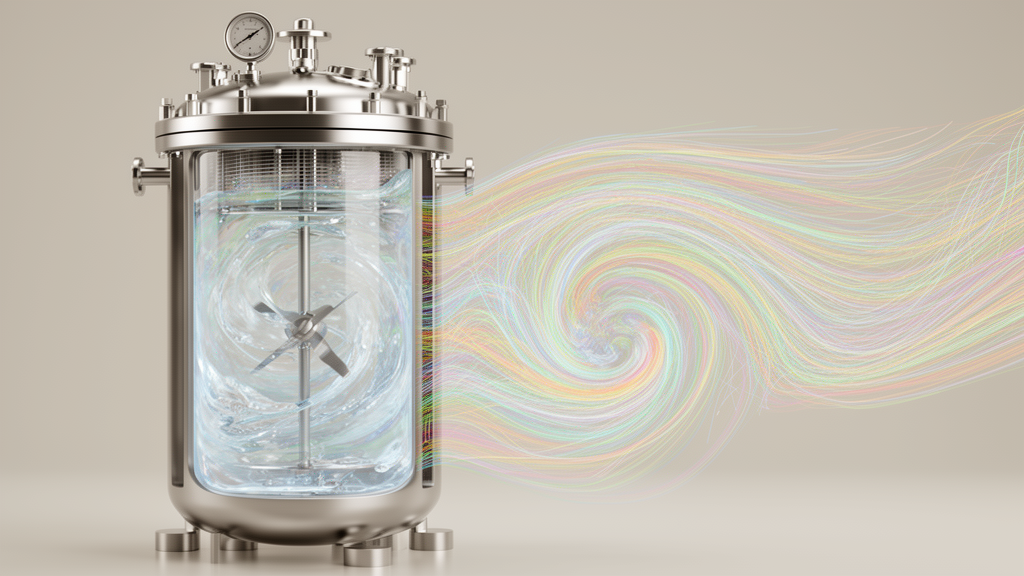
Biopharmaceutical manufacturing has quietly diversified in ways that most patients never see but process engineers feel every day. Monoclonal antibodies and other protein therapeutics are grown in Chinese hamster ovary (CHO) cells inside vessels that mix liquid in fundamentally different ways: classic stirred-tank reactors with spinning impellers, single-use rocking systems that slosh fluid along one axis, and orbital-rocking platforms that swirl the entire liquid body in a circular motion. Each platform has its own advantages in cost, flexibility, and scalability, but moving a production process from one to another has long relied on guesswork. A new study published in Applied Microbiology and Biotechnology offers a quantitative answer to this stubborn problem, using computational fluid dynamics to define a shared hydrodynamic design space across all three reactor types.
The research team, led by Soo Hyun Ryu, Young Jin Kim, and colleagues at Yonsei University in South Korea, confronted a limitation that has shaped bioprocess engineering for decades. The conventional scale-up parameter for stirred-tank reactors, power input per unit volume (P/V), depends on impeller characteristics such as rotational frequency, impeller diameter, and power number. Those impeller-based calculations simply do not exist for rocking systems, which have no impeller at all. When engineers try to transfer a process from a stirred tank to a rocking bioreactor, they lack a common currency for comparing how much energy each system dissipates into the culture. The result is a costly cycle of trial-and-error experiments every time a process crosses platform boundaries.
To break that cycle, the team proposed power dissipation per unit volume (Pd/V) as a platform-independent measure of energy input. Unlike impeller-based P/V, Pd/V can be computed directly from the fluid flow field itself, regardless of how the mixing is generated. The researchers built a computational fluid dynamics (CFD) framework using the lattice Boltzmann method (LBM), a numerical technique that solves the Boltzmann equation on a discrete lattice rather than the traditional Navier-Stokes equations on a mesh. This approach, combined with large eddy simulation (LES) for turbulence modeling, allowed the team to resolve the turbulent flow structures inside each bioreactor with high fidelity while running efficiently on graphics processing units.
The CFD simulations covered three distinct platforms: a 2-liter stirred-tank reactor (STR), a 1-D rocking bioreactor (RM20), and an orbital-rocking system (CELBIC50). Each was simulated under diverse operating conditions, spanning different agitation rates, rocking angles, and filling volumes. The simulations revealed that the three platforms produce strikingly different flow patterns even when their overall energy inputs appear similar. Stirred tanks generate localized high-energy zones around the impeller blades, while rocking systems distribute energy more uniformly through the bulk liquid through periodic sloshing and wave motion. These differences matter because cells respond not just to average conditions but to the full spectrum of shear stresses and energy dissipation rates they experience over time.
From the resolved flow fields, the team extracted three key hydrodynamic parameters: power dissipation per unit volume, shear stress, and mixing time. Shear stress, the tangential force per unit area that the fluid exerts on itself, is a critical concern for mammalian cells, which lack the protective cell wall of bacteria and yeast. Mixing time, the time required to achieve homogeneity after a perturbation, determines how quickly nutrients, oxygen, and pH control agents distribute through the vessel. By combining these three parameters into a multi-constraint design space, the researchers created a quantitative map of feasible operating regions for each platform, allowing engineers to identify conditions that satisfy all constraints simultaneously across different reactor types.
The hydrodynamic analysis revealed meaningful differences among the platforms. Under the selected operating conditions, the orbital-rocking CELBIC50 exhibited a lower mean shear stress of 0.012 Pa compared with 0.019 Pa in the 1-D rocking RM20, and it achieved a shorter mixing time of 80.9 seconds versus 146.6 seconds. In other words, the orbital system was both gentler on the fluid and faster at homogenizing it, a combination that would be difficult to predict without the CFD framework. The Kolmogorov length scale, the smallest turbulent eddy size in the flow, provided an additional lens for comparing energy dissipation patterns across platforms, connecting the microscopic structure of turbulence to the macroscopic performance of the bioreactor.
The critical question, of course, was whether these hydrodynamic differences actually affect cell culture performance. To find out, the team ran fed-batch CHO cell cultures producing a monoclonal antibody under the selected conditions in all three platforms. The results were remarkably consistent: viable cell density, productivity, metabolite profiles, and product quality attributes remained comparable across the STR, RM20, and CELBIC50, with most performance variables falling within a common ±2 standard deviation range. Product quality was assessed using capillary electrophoresis–sodium dodecyl sulfate (CE-SDS) and capillary zone electrophoresis (CZE), confirming that the antibody molecules themselves were structurally equivalent regardless of which bioreactor produced them.
This finding carries significant implications for the biopharmaceutical industry. Process transfer between platforms currently demands extensive empirical experimentation, consuming time, materials, and labor that could otherwise support development of new therapies. A validated CFD-based design space changes that equation by allowing engineers to predict, before running a single experiment, which operating conditions in a new platform will reproduce the hydrodynamic environment of the original. The framework supports what the field calls model-informed process development, an approach aligned with modern regulatory expectations for quality by design (QbD), where processes are understood and controlled through systematic, science-based reasoning rather than accumulated trial and error.
The study also fits into a broader movement toward digital twins in biomanufacturing. The research was funded in part by a Korean government program to develop a digital twin system for high-yield fed-batch culture of antibody therapeutics based on AI-QbD technology. Digital twins, virtual replicas of physical processes that update in real time with sensor data, depend on exactly the kind of validated hydrodynamic models this study provides. As single-use bioreactors continue to expand across the industry, the ability to map processes between platforms computationally will become increasingly central to flexible, efficient production of biologics.
For the field of bioprocess engineering, the message is clear: the hydrodynamic design space defined by Pd/V, shear stress, and mixing time offers a common language for describing bioreactor performance across platforms that mix liquid in entirely different ways. Rather than treating each bioreactor type as an isolated system with its own empirical rules, engineers can now use a unified, physics-based framework to identify transferable operating conditions. The study demonstrates that cells grown under hydrodynamically matched conditions perform equivalently, regardless of the mixing mechanism, providing a quantitative foundation for the next generation of biopharmaceutical process development.
Subject of Research: Bioprocess engineering and computational fluid dynamics for bioreactor process transfer
Article Title: Hydrodynamic design space for process transfer across different bioreactor platforms
Article References: Ryu, S. H., Kim, Y. J., Kang, D. E., Kim, M. H., Kim, T.-J., & Hong, J. K. (2026). Hydrodynamic design space for process transfer across different bioreactor platforms. Applied Microbiology and Biotechnology. https://doi.org/10.1007/s00253-026-14067-7
Image Credits: AI Generated
DOI: 10.1007/s00253-026-14067-7
Keywords: computational fluid dynamics, bioreactor hydrodynamics, process transfer, hydrodynamic design space, power dissipation per unit volume, CHO cell culture, biopharmaceutical manufacturing, single-use bioreactors, lattice Boltzmann method, quality by design, Hydrodynamic, design
Cite Scienmag News
Audrey Campbell. (October 17, 2026). CFD framework maps hydrodynamic design space for bioreactor process transfer. Scienmag. https://scienmag.com/cfd-framework-maps-hydrodynamic-design-space-for-bioreactor-process-transfer/
Audrey Campbell. "CFD framework maps hydrodynamic design space for bioreactor process transfer." Scienmag, 17 October 2026, https://scienmag.com/cfd-framework-maps-hydrodynamic-design-space-for-bioreactor-process-transfer/. Accessed 17 October 2026.
Audrey Campbell. "CFD framework maps hydrodynamic design space for bioreactor process transfer." Scienmag. October 17, 2026. https://scienmag.com/cfd-framework-maps-hydrodynamic-design-space-for-bioreactor-process-transfer/


