


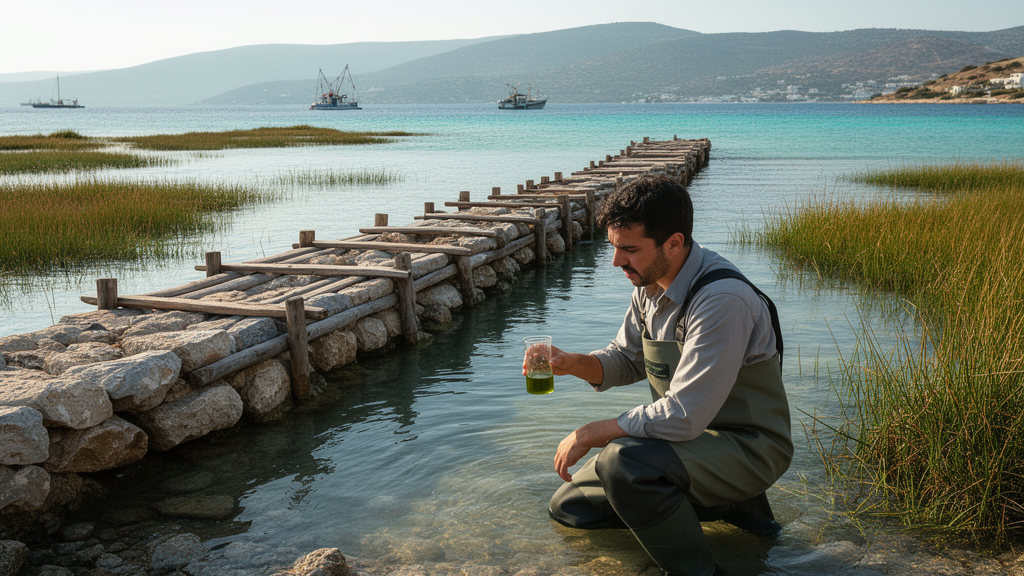
Wetlands cover less than one percent of the Earth’s landmass, yet they shelter roughly ten percent of global biodiversity and rank among the most imperilled ecosystems on the planet. In island landscapes, their ecological identity becomes even more pronounced: isolated within islands and embedded in a terrestrial matrix that restricts biotic exchange, they function as habitat islands within true islands. A new study published in Frontiers of Biogeography has exploited this layered isolation to answer one of the most contested questions in microbial ecology, namely whether microscopic organisms obey the same biogeographic rules as plants and animals, or whether they truly float everywhere and are selected only by local conditions.
The research team surveyed 24 small, shallow wetlands across nine Aegean islands, including Andros, Tinos, Mykonos, Naxos, Astypalaia, Rodos, Kos, and Chios, all located within a radius of about 150 kilometres in the eastern Mediterranean biodiversity hotspot. These wetlands ranged from freshwater ponds and marshes to brackish dams and saline cisterns, spanning surface areas from under ten square metres to more than ten thousand, and elevations from sea level to over 200 metres. Their intrinsic mesocosm-like character, combined with varying degrees of human influence and biogeographic isolation, provided an ideal natural experimental setup for disentangling the processes that govern community assembly.
Phytoplankton, the microscopic photosynthetic organisms at the base of aquatic food webs, served as the study’s focal group. Because these organisms respond rapidly to environmental disturbance, their diversity and community composition provide a sensitive indicator of human-mediated change. During the warm periods of 2022 and 2023, the researchers collected surface water samples from each wetland, fixed them immediately with Lugol’s solution, and examined them under an inverted light microscope. Taxonomic identification relied on established keys, while abundance counts followed the Utermöhl sedimentation method, with at least 400 individuals counted per sample to achieve greater than 90 percent accuracy. Biomass was estimated by measuring cell dimensions of dominant species and applying geometric formulae to calculate biovolume.
In total, the team identified 195 phytoplankton taxa across the 24 wetlands. Chlorophyceae, the green algae, proved the richest class with 50 taxa, followed by Bacillariophyceae, the diatoms, with 36, Dinophyceae, the dinoflagellates, with 20, and Zygnematophyceae with 17. Species richness ranged from 4 to 47 taxa per site, with brackish and saline wetlands supporting markedly fewer species, averaging 8 taxa, compared with freshwater sites, which averaged 25. Total abundance varied enormously, from roughly 500 to 300,000 individuals per millilitre, with a general tendency for saline waters to exhibit lower counts. Hierarchical clustering based on Bray-Curtis dissimilarity revealed two distinct groups: freshwater systems clustered independently of their location, size, or habitat type, while non-freshwater systems formed a separate cluster dominated by a few tolerant taxa, including the diatom genera Navicula and Nitzschia and the prymnesiophyte Chrysochromulina.
To identify the drivers of community assembly, the researchers fitted generalized linear mixed-effects models to pairwise Bray-Curtis dissimilarities across 276 site comparisons, incorporating ten environmental and anthropogenic predictors. These included salinity, habitat type, wetland area, pairwise geographic distance, elevation, distance from the sea, overlap with Nominally Protected Areas under the Natura 2000 framework, surrounding land cover classified from Copernicus Corine data, a composite Human Footprint index, and phytoplankton biomass as a proxy for trophic state. The best-fit model achieved a marginal R-squared of 0.57 and a conditional R-squared of 0.97, indicating that the measured fixed effects explained a substantial portion of compositional variation while random effects absorbed additional site- and island-specific influences.
Salinity emerged as the strongest environmental filter. Comparisons between freshwater and non-freshwater sites yielded significantly higher dissimilarity, with a standardized beta coefficient of 0.82, than comparisons within either salinity category, which did not differ from each other. Protection status also proved significant: wetland pairs differing in Natura 2000 designation, with one site inside and one outside a Nominally Protected Area, were more dissimilar than pairs sharing the same status. Pairwise geographic distance contributed an approximately equal effect size, with a beta of 0.15. When the analysis was restricted to freshwater-only sites, protection status became the strongest predictor, followed by geographic distance, suggesting that within uniform salinity regimes, human-related filtering and dispersal limitation jointly structure these microscopic communities.
Complementary matrix-based analyses reinforced these findings. Distance-based redundancy analysis identified salinity, broad-scale spatial structuring captured by principal coordinates of neighbour matrices, and protection status as significant predictors across all sites. Variance partitioning showed that environmental variables explained the largest unique fraction of variation across all sites, at 14.8 percent, followed by a smaller spatial component of 4.7 percent. For freshwater-only sites, however, the spatial signal strengthened dramatically, with pure spatial predictors accounting for 19.2 percent of variation compared with just 5.9 percent for environmental predictors. This shift indicates that once the dominant salinity filter is removed, dispersal processes become the primary force shaping community turnover among island wetlands.
The most striking results concerned distance-decay relationships. Community similarity declined steeply with geographic distance up to approximately 25 kilometres, a threshold coinciding with the maximum distance among within-island wetland comparisons. Beyond this threshold, which corresponds to between-island comparisons, similarity remained uniformly low irrespective of distance. Mantel correlograms confirmed the same structure, showing significant positive spatial autocorrelation only at the shortest distance classes, followed by rapid decline to non-significant or negative correlations at broader scales. This plateau demonstrates that seawater imposes a strong dispersal barrier despite the theoretical capacity of phytoplankton for long-distance passive transport, directly challenging the long-standing paradigm that everything is everywhere but the environment selects.
The researchers further discovered that the strength of distance-decay among freshwater sites depended on protection status. The steepest slope occurred when neither site fell within protected areas, closely followed by comparisons involving protected sites. Within-island community similarity was significantly higher than between-island similarity, and this tendency persisted across all combinations of Natura 2000 status. The authors interpret this pattern cautiously, noting that many Nominally Protected Areas may in practice operate as paper parks with limited enforcement, so wetlands inside protected areas likely experience weaker distance-decay simply because they are more remote and subject to lower human influence rather than active management.
Synthesising these results, the study proposes a hierarchical triple insularity framework in which phytoplankton assembly is shaped by nested spatial filters: strong among-wetland environmental filtering dominated by salinity gradients, island-level dispersal limitation moderated by human accessibility, and cross-island isolation enforced by marine corridors. The findings provide empirical support for microbial regionalism, or provincialism, the idea that microscopic communities exhibit spatially structured patterns similar to those of macro-organisms, shaped by both environmental and historical processes. Only four taxa, the diatoms Navicula and Nitzschia, the dinoflagellate Peridinium, and the chlorophyte Chlorella, proliferated across more than half of the sampled wetlands, sharing traits that favour survival in eutrophic and human-impacted environments, including resting stages and robust cell structures. Their dominance signals a shift toward generalist, disturbance-tolerant communities in island landscapes increasingly shaped by human activity. The researchers argue that regionalism, typically reserved for macro-organisms, also governs phytoplankton biogeography in fragmented systems, and that island wetlands should be recognised as discrete ecological units of high conservation value, isolated not only by geography but also by socio-economic gradients such as land-use intensity and accessibility.
Subject of Research: Phytoplankton regionalism in natural mesocosm-like wetlands of an island archipelago in the Aegean Sea
Article Title: Phytoplankton regionalism in natural mesocosm-like wetlands of an island archipelago in the Aegean Sea
Article References: Proios, K., Parmakelis, A., Papadaki, C., Maranti, A., Christopoulos, A., Stefanidou, N., Mazaris, A. D., & Genitsaris, S. (2026). Phytoplankton regionalism in natural mesocosm-like wetlands of an island archipelago in the Aegean Sea. Frontiers of Biogeography, 19, Article e164401. https://doi.org/10.21425/fob.19.164401
Image Credits: AI Generated
Keywords: Phytoplankton, regionalism, natural, mesocosm-like, wetlands, island, archipelago, Aegean, scientific research
Cite Scienmag News
Morgan Morrow. (October 17, 2026). Sea Barriers Trap Microscopic Life in Aegean Island Wetlands. Scienmag. https://scienmag.com/sea-barriers-trap-microscopic-life-in-aegean-island-wetlands/
Morgan Morrow. "Sea Barriers Trap Microscopic Life in Aegean Island Wetlands." Scienmag, 17 October 2026, https://scienmag.com/sea-barriers-trap-microscopic-life-in-aegean-island-wetlands/. Accessed 17 October 2026.
Morgan Morrow. "Sea Barriers Trap Microscopic Life in Aegean Island Wetlands." Scienmag. October 17, 2026. https://scienmag.com/sea-barriers-trap-microscopic-life-in-aegean-island-wetlands/


