


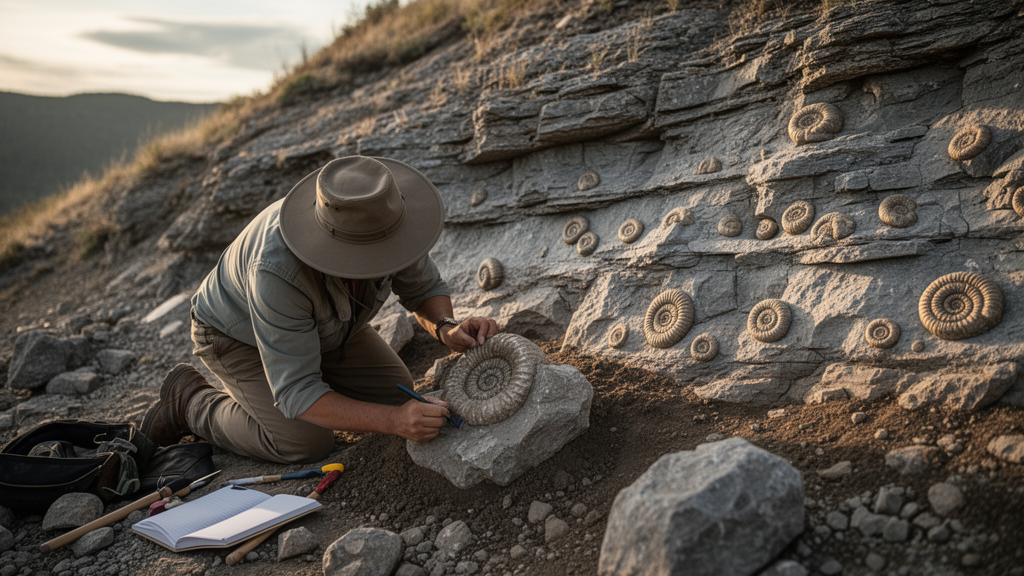
On a forested hill in the Swabian Alb of southwestern Germany, a team of palaeontologists has spent nearly a decade patiently chiselling apart layers of 170-million-year-old rock. Their reward is one of the most detailed records yet of ammonite evolution during the Aalenian Stage of the Middle Jurassic. Excavations at the Wochenberg hill near Schömberg-Schörzingen, conducted between 2014 and 2022, have yielded hundreds of ammonites collected bed by bed, allowing researchers to distinguish five successive ammonite biohorizons in the Achdorf Formation and to introduce a new biohorizon, the viallii, the youngest yet identified within the Bifidatum Subzone of the Opalinum Zone.
The Achdorf Formation is a succession of claystones, arenaceous claystones and occasional limestone beds up to 60 metres thick, cropping out in the Wutach area and across the western and middle Swabian Alb. Historically it was lumped together with the ferruginous sandstones of the Eisensandstein Formation in eastern Swabia and Franconia under the old label Braunjura beta. The nearby town of Aalen, whose abandoned iron mines produced spectacular ammonite faunas in the nineteenth century, gave its name to the entire Aalenian Stage. Yet the Wochenberg itself has a distinguished pedigree: Friedrich August Quenstedt first described ammonites from the hill in 1886, and Hans Rieber’s 1963 monograph on the Braunjura beta treated its sections in detail.
Natural outcrops along the steep hillsides expose only short intervals of the succession, and most of the ammonites in institutional and private collections lacked precise information about the bed they came from. That gap made it impossible to trace evolutionary trends, sexual dimorphism, or shifts in faunal composition through time. The only remedy was excavation. The team dug at the southwestern edge of the hill, near a model airfield, sampling the Staufensis-Bank bed by bed, and later opened a second section about twenty metres to the west targeting the interval between the Untere Wilflingen-Bank and the Staufensis-Knollenlage. Smaller excavations followed at distances of roughly 50 and 170 metres further southeast, and additional sections were sampled at the headwaters of the Schörzinger Starzel River and along the northern escarpment.
The fossils were prepared mechanically with pneumatic chisels and airbrasive iron powder, and the illustrated specimens now reside in the State Museum of Natural History Stuttgart. The stratigraphic work produced a surprise: new measurements showed the vertical distance between the top of the Untere Wilflingen-Bank and the top of the Staufensis-Bank is only about 12 to 13 metres, far less than the roughly 24 metres Rieber had reported. The discrepancy appears to stem from Rieber’s method of interpolating distances across the hill in several steps, a procedure prone to significant error. The revised measurements compress the interval between the two Wilflingen beds to just 3.2 to 4 metres.
The lowest of the five biohorizons, the crassicostatum, is contained in the Untere Wilflingen-Bank, a chamosite-oolitic marly limestone about 1.6 metres thick. Its ammonites are dominated by coarsely ribbed macroconchs of Leioceras crassicostatum and Leioceras goetzendorfense, together with the microconchs Leioceras paucicostatum and Leioceras striatum. A curious geographic pattern emerged: microconchs, the presumed males, are significantly more common at the Wochenberg and the Starzel headwaters than at Gosheim a few kilometres to the southwest, possibly because calmer conditions there favoured both the living animals and their preservation. The old identification of the macroconchs as Leioceras comptum had to be abandoned after the rediscovered holotype of Reinecke’s Nautilus comptus turned out to be a latest Toarcian Pleydellia.
Above a barren interval of clay-marl lies the Obere Wilflingen-Bank, a 1.6 to 1.7 metre unit that yielded the newly introduced viallii biohorizon. Its fauna is transitional between the older crassicostatum assemblage and the younger subfalcatum biohorizon of the Haugi Subzone. Roughly half the ammonites belong to Leioceras and half to Ancolioceras, with specimens showing every gradation between the two genera. The name-bearing Ancolioceras viallii sits firmly on the Ancolioceras side, while species such as Ancolioceras citaae, Ancolioceras krymholzi and Ancolioceras noszkyi, which first appear here, go on to dominate the younger subfalcatum biohorizon. The taxonomy of this interval is notoriously tangled, and the authors deliberately treated many of Buckman’s genera as subjective synonyms rather than adding new names to the maze.
The Staufensis-Bank, a 1.2 to 1.6 metre set of limestones near the top of the section, preserves the three youngest biohorizons. The latiumbilicus biohorizon is defined by Staufenia latiumbilicus, an ammonite Quenstedt originally described from the hill itself, making the new specimens topotypes. The team designated a lectotype from Quenstedt’s figures to stabilise the name, and showed that Hoffmann’s later Staufenia sehndensis from northern Germany is either a younger synonym or a very close predecessor. Only three fragmentary Ludwigia accompanied roughly 65 Staufenia specimens in this horizon. Above it, the discoidea alpha and discoidea beta biohorizons record the lineage of Staufenia discoidea, accompanied by a rich array of Ludwigia species and the earliest Brasilia, ending with a single Planammatoceras at the top.
The bed-by-bed sampling reveals four clear evolutionary trends in the Staufenia lineage as it marched from Staufenia latiumbilicus through Staufenia discoidea toward Staufenia staufensis. The umbilicus, the central opening of the shell, becomes progressively narrower, and the umbilical wall changes from steep to overhanging during growth. Ribbing weakens and retreats into ever earlier growth stages, and the suture line, the complex junction between the septa and the shell wall, becomes progressively simplified. The first three trends are linked and echo Buckman’s rules of covariation, a phenomenon seen in many highly variable ammonite genera. Intriguingly, the simplification of the suture shows no consistent correlation with water depth, suggesting it reflects some other environmental adaptation that cannot be deciphered without ecological data.
Why, then, does Staufenia evolve in a smooth, seemingly targeted fashion while Leioceras and Ancolioceras change in a discontinuous, apparently random way? The authors point to geography. Staufenia was endemic, restricted to present-day Germany, eastern France and southern England, whereas Leioceras and Ancolioceras ranged across the entire Tethyan realm. In such a wide distribution, different environmental conditions in different basins could drive different adaptations in isolated populations. When sea-level rise later reconnected those basins and the populations interbred, the result would be a patchwork of characters that looks random in the fossil record. The Wochenberg excavations, by pinning each specimen to its exact bed, have turned a modest hillside into a laboratory for testing how geography and evolution interacted in the Jurassic seas of Europe.
Subject of Research: Ammonite biostratigraphy and evolution in the Aalenian Achdorf Formation at the Wochenberg hill, Swabian Alb, Germany
Article Title: Ammonites and stratigraphy of the Achdorf Formation (Braunjura Group; Aalenian) at the Wochenberg hill near Schömberg-Schörzingen (W Swabian Alb, SW Germany)
Article References: Dietze, V., Hofbauer, A., Rieber, H., Wannenmacher, N., & Schweigert, G. (2022). Ammonites and stratigraphy of the Achdorf Formation (Braunjura Group; Aalenian) at the Wochenberg hill near Schömberg-Schörzingen (W Swabian Alb, SW Germany). Zitteliana, 96, 69-101. https://doi.org/10.3897/zitteliana.96.82835
Image Credits: AI Generated
DOI: 10.3897/zitteliana.96.82835
Keywords: ammonites, Aalenian, Middle Jurassic, biostratigraphy, Swabian Alb, Achdorf Formation, Staufenia, Leioceras, Ancolioceras, evolution, Germany, palaeontology
Cite Scienmag News
Gavin Prescott. (October 17, 2026). Ammonite treasure trove in German hillside reveals evolution in action. Scienmag. https://scienmag.com/ammonite-treasure-trove-in-german-hillside-reveals-evolution-in-action/
Gavin Prescott. "Ammonite treasure trove in German hillside reveals evolution in action." Scienmag, 17 October 2026, https://scienmag.com/ammonite-treasure-trove-in-german-hillside-reveals-evolution-in-action/. Accessed 17 October 2026.
Gavin Prescott. "Ammonite treasure trove in German hillside reveals evolution in action." Scienmag. October 17, 2026. https://scienmag.com/ammonite-treasure-trove-in-german-hillside-reveals-evolution-in-action/


