


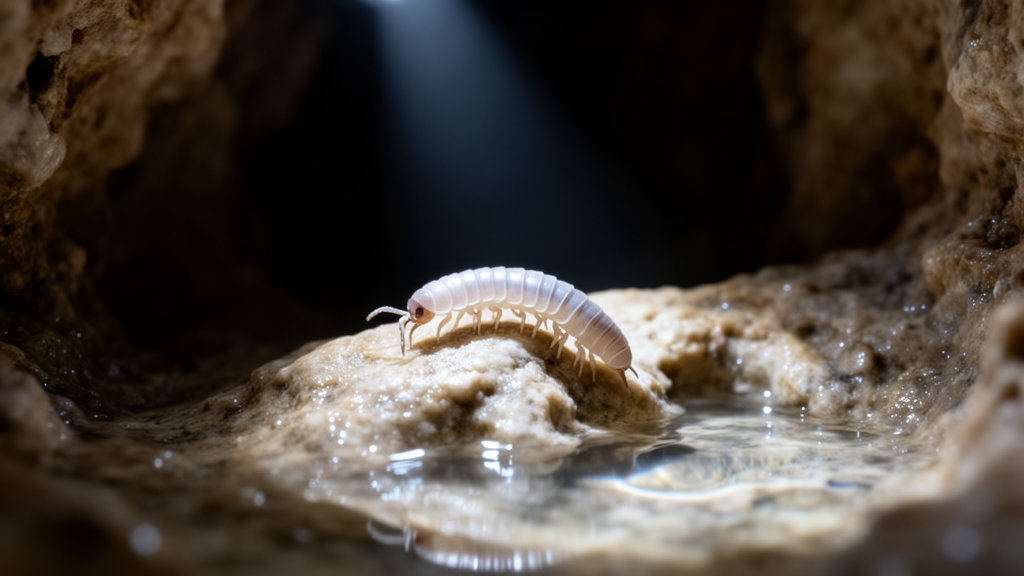
Deep inside a narrow, unlit side passage of a cave steeped in Greek mythology, a team of zoologists has found something remarkable: a millipede species that science had not seen alive for more than half a century. Euxinopetalum dobatorum, a dwarf millipede described in 1973 from the Zonguldak Province on Turkey’s western Black Sea coast, has been rediscovered in Heracles Cave, its type locality, after more than 50 years. The find, published in the journal Caucasiana, comes with the first photographs, photomicrographs, and scanning electron micrographs ever made of the species, finally giving researchers a detailed visual record of one of the strangest millipedes in the order Callipodida.
The rediscovery matters because E. dobatorum is not just any millipede. When the American myriapodologist Richard Hoffman described it in 1973, he was so struck by its unusual combination of traits that he created an entirely new subfamily, Euxinopetalinae, for what he called a remarkable new form. The species is tiny by callipodidan standards, with males measuring only 13 to 15 millimeters and females 15.5 to 23 millimeters. It also has an exceptionally low number of body segments, an undivided hypoproct at the rear of the body, distinctive gonopods, and, most peculiarly, a rudimentary second pair of legs in females, a feature not found in any other genus of the family Schizopetalidae. Until now, the species was known only from the original description, based on a single male and a single female from two caves in Zonguldak Province.
The new material consists of three males and one female collected on 18 August 2020 by Mert Elverici in Heracles Cave, part of the Cehennem Ağzı Caves complex near the town of Ereğli. The specimens are now deposited in the Biodiversity Science Museum at Atatürk University in Erzurum, the Institute of Zoology at the University of Belgrade, and the Naturhistorisches Museum Wien in Vienna. The collection site lies in a fossil, narrow lateral passage that falls entirely within the dark zone of the cave, far from the transformed and illuminated main gallery that tourists walk through daily. The environment is an oligotrophic subterranean ecosystem with an extremely low abundance of organisms, where roots occasionally penetrate the ceilings from the surface world above.
Heracles Cave itself carries extraordinary historical and mythological weight. The three closely located caverns of the complex, known in direct translation from Turkish as Hell’s Mouth Caves, are linked to the story of Hercules and his descent into the Underworld. According to Greek mythology, this is where Hercules entered Hades to capture Cerberus, the three-headed guard dog of the Underworld, as part of his Twelfth Labour. The area is also associated with the ancient city of Herakleia Pontica, named after Hercules, and the modern Turkish name Ereğli is a derivative of Herakleia. The caves are sometimes called the Acheron Caves, after the ancient name of the nearby river, further tying the site to mythological depictions of the Underworld. That a scientific rarity has survived in a cave visited by many people daily adds a conservation dimension to the story.
Technically, the examination of the new specimens relied on a combination of stereo microscopy, compound microscopy, and scanning electron microscopy. Specimens preserved in 70 percent ethanol were studied with Nikon SMZ745T, Nikon SMZ1270, and Zeiss Stemi 2000-C binocular stereo microscopes. Images of body structures were captured with a Nikon DS-Fi2 camera on a Nikon SMZ1270, while dissected gonopods mounted in glycerin were photographed with a Canon PowerShot A80 digital camera connected to a Carl Zeiss Axioscope 40 compound microscope. Focal stacking with Zerene Stacker Professional produced sharp composite images of these minute structures. For scanning electron microscopy, samples were dehydrated in an ascending alcohol series, treated with acetone, air dried, mounted on aluminum stubs with sticky aluminum tape, coated with platinum using a Leica EM SCD500, and examined with a JEOL JSM 6610-LV scanning electron microscope at an accelerating voltage of 15 kilovolts. After imaging, all parts were returned to ethanol, and live animals were photographed in the field with a Nikon D7000 camera and a macro lens.
The morphological analysis confirmed the defining features of the species. Living animals are brownish grey, with black ommatidia, the individual units of the compound eye-like field on the head, arranged in a subtriangular field of 33 to 35 units. The body carries 36 segments including the telson in all four specimens, with metazonae bearing roughly 16 plus 16 longitudinal crests and ozopores, the defensive gland openings, positioned between the fourth and fifth crests. The female shows a pair of white anterodorsal spots on segment 3 and a vestigial second leg pair, triangular in shape with a coxa and one visible podomere covered by long setae. The gonopods, the male copulatory structures that serve as the primary basis for species identification in millipedes, are relatively simple and lack sternal remnants. Each telopodite is columnar and distally bifurcated, with a lateral branch carrying a digitiform rounded lobe and an acuminate or bifurcated lamella, and a mesal branch bearing three processes: a solenomere, a medial process parallel to it, and a trifurcated, partly lamellar mesal process. The vulvae of the female are extruded very long and tubular.
The comparison with Hoffman’s original description reveals intriguing discrepancies. Hoffman recorded males about 15 millimeters long and a female about 23 millimeters long, each with 38 segments. The newly collected individuals are smaller, with males 13 to 13.5 millimeters and the female 15.5 millimeters, and they have two segments fewer, 36 in total. The second leg pair of the examined female, while reduced, shows a clearly visible podomere and long setae on both parts, slightly different from Hoffman’s description of minute biramous vestiges. The authors note that it cannot be ruled out that Hoffman’s female belongs to a different species. The study also corrects a small error in the original gonopod description, clarifying that what Hoffman labeled as process 6 on the mesal branch of the telopodite is actually part of process 3, and confirming that the telopodite attaches to the posterior side of the coxa, as Hoffman correctly stated on one page of his monograph but contradicted on another.
The rediscovery also settles a long-standing question about the type locality. Hoffman gave the type locality as Cave Nr. 2, Indere, 2 kilometers northwest of Ereğli, without further details, but he noted that the Austrian zoologist Hans Strouhal had described the exact cave in 1971 when describing new isopod species from the same site. By comparing Strouhal’s cave plan of Höhle 2 with the newly documented plan of Heracles Cave, the authors established that the two refer to the same cavern. The second site mentioned by Hoffman, Kapuz Cave in the city center of Zonguldak about 40 kilometers northeast of Ereğli, could indicate a wider distribution range for this troglophilic species in the karst landscape of the western Black Sea, but differences in the structure of the female second leg pair raise the possibility that the two records represent two distinct species.
Beyond the rediscovery itself, the new specimens carry significant implications for understanding body size evolution in the order Callipodida. Most callipodidans are medium-sized to large animals, and the largest representatives, found in the schizopetalid genera Eurygyrus and Apfelbeckia, can grow to 10 centimeters or more. Small species within the family Schizopetalidae exist but are uncommon, and the only extant schizopetalid comparable in size to E. dobatorum is Schizopetalum koelbeli, with a body length of 17.5 to 20 millimeters. Miniature callipodidans also occur in the families Dorypetalidae and Tynommatidae, with the smallest representatives measuring 12 to 13 millimeters. Small body size is usually associated with a reduced number of body segments, and the newly collected individuals of E. dobatorum, with 36 segments including the telson, now represent callipodidans with the lowest recorded segment number in adults. The only species of the order known to be smaller is the fossil Burmanopetalum inexpectatum from Cretaceous amber, with a holotype female of 8.2 millimeters and 36 segments.
The authors hypothesize, following earlier work on the fossil species, that the small body and reduced segment number in Callipodida, including E. dobatorum, may be features inherited from the ancestral form shared by Callipodida and Chordeumatida. The study also highlights the broader context of Turkish cave biology. The millipede fauna of Turkey remains poorly known, with only about 140 species recorded from the entire country, and just 18 species of Callipodida from five genera and two families. As recent surveys have emphasized, several new and little-known cave-dwelling taxa have been discovered or rediscovered in recent years thanks to the efforts of Turkish cave biologists. Despite the fine original description of E. dobatorum, the authors judged that new data and illustrations of the species would be helpful for future studies of the order. Half a century after its description, this mythological cave dweller is finally back on the scientific record, photographed in life and under the electron microscope, and ready to answer questions about miniature body plans in an order of giants.
Subject of Research: Rediscovery of the cave-dwelling millipede Euxinopetalum dobatorum in Turkey after more than 50 years
Article Title: Rediscovery of Euxinopetalum dobatorum Hoffman, 1973 ( Diplopoda , Callipodida , Schizopetalidae ) in Turkey
Article References: Antić, D., Aleksić, T., Milovanović, J., & Elverici, M. (2024). Rediscovery of Euxinopetalum dobatorum Hoffman, 1973 (Diplopoda, Callipodida, Schizopetalidae) in Turkey. Caucasiana, 3, 223-234. https://doi.org/10.3897/caucasiana.3.e137308
Image Credits: AI Generated
DOI: 10.3897/caucasiana.3.e137308
Keywords: millipede, Euxinopetalum dobatorum, Callipodida, Schizopetalidae, Turkey, cave biology, taxonomy, rediscovery, Zonguldak, Heracles Cave, Euxinopetalum, dobatorum
Cite Scienmag News
Margaret Porter. (October 17, 2026). Lost for 50 Years, a Tiny Turkish Cave Millipede Emerges from the Dark. Scienmag. https://scienmag.com/lost-for-50-years-a-tiny-turkish-cave-millipede-emerges-from-the-dark/
Margaret Porter. "Lost for 50 Years, a Tiny Turkish Cave Millipede Emerges from the Dark." Scienmag, 17 October 2026, https://scienmag.com/lost-for-50-years-a-tiny-turkish-cave-millipede-emerges-from-the-dark/. Accessed 17 October 2026.
Margaret Porter. "Lost for 50 Years, a Tiny Turkish Cave Millipede Emerges from the Dark." Scienmag. October 17, 2026. https://scienmag.com/lost-for-50-years-a-tiny-turkish-cave-millipede-emerges-from-the-dark/


