


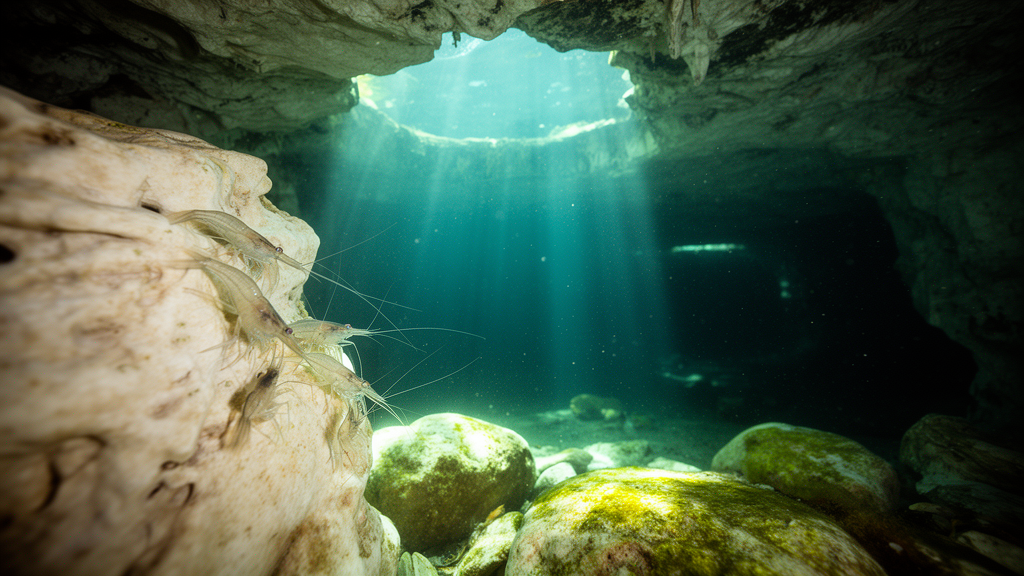
Deep beneath the Yucatan Peninsula, in flooded limestone caves that stretch for hundreds of kilometers, tiny blind shrimps of the genus Typhlatya are quietly holding entire ecosystems together. A new study published in Subterranean Biology has now mapped the feeding roles of these anchialine shrimps using stable isotope analysis, revealing that three coexisting species each occupy their own well-defined trophic niche. The findings confirm long-standing suspicions that Typhlatya shrimps act as keystone species, converting microbial production into animal biomass that fuels the rest of the cave food web.
The research team, led by Fernando Álvarez of the Universidad Nacional Autónoma de México and colleagues, compiled published carbon and nitrogen isotope data for Typhlatya shrimps from the Yucatan Peninsula and added new measurements from five cenotes. In total, the dataset covered three of the four species present in the region, Typhlatya mitchelli, T. pearsei, and T. dzilamensis, across thirteen cave systems. The fourth Mexican species, T. campecheae, is so rare that no ecological or isotopic data exist for it, so it was excluded from the analysis.
Stable isotope analysis works because the ratio of heavy to light isotopes in an animal’s tissue reflects the food it has consumed. Carbon isotope values, expressed as δ13C, distinguish between different basal food sources: decaying plant material and particulate organic matter typically produce values around -20 to -35 per mil, while biomass from methanotrophic bacteria, which oxidize methane rising from anoxic sediments, yields far more negative values that can reach below -50 per mil. Nitrogen isotope values, δ15N, indicate trophic position, increasing roughly 3 to 4 per mil with each step up the food chain. By reading these signatures, researchers can reconstruct what an animal has been eating without observing it directly.
The results show that Typhlatya shrimps span almost the complete range of δ13C values found in the entire anchialine community, from -22.31 to -55.48 per mil, reflecting the diversity of microbial resources they exploit. The three species showed partially overlapping but distinct carbon ranges. Typhlatya mitchelli had the least negative values, from -22.31 to -39.65 per mil, consistent with feeding on decaying vegetation and bacterial mats dominated by nitrifying bacteria in shallower cave sections. Typhlatya pearsei showed the most negative values, reaching -55.48 per mil, indicating a diet rich in methanotrophic bacteria. Typhlatya dzilamensis fell in between, from -31.26 to -43.78 per mil, likely exploiting resources associated with the halocline, the sharp salinity gradient that traps imported organic material in deeper cave layers.
Statistical comparisons confirmed these differences. A Kruskal-Wallis test revealed significant variation among species, and Dunn’s multiple comparison showed that T. mitchelli differed significantly from T. pearsei and from unidentified Typhlatya individuals. The unidentified specimens from Cenote Bang, reported by Brankovits and colleagues in 2017, showed carbon values between -29.27 and -49.65 per mil, a range consistent with any of the three known species or potentially with a yet undescribed lineage suggested by prior molecular analyses.
To examine how the two dominant freshwater species partition resources, the team constructed convex hulls in δ13C-δ15N space. The hulls for T. mitchelli and T. pearsei overlapped by roughly 20 percent, with T. mitchelli sharing 23.05 percent of its area and T. pearsei sharing 17.62 percent. This limited overlap leaves ample margin for coexistence. Typhlatya pearsei showed broader carbon and nitrogen ranges and a larger total hull area than T. mitchelli, indicating a wider diversity of exploited resources. The overlap zone, at carbon values between -33 and -40 per mil, appears to mark a transition between the two primary feeding strategies.
Seasonal comparisons between the rainy and dry seasons showed no significant differences in carbon isotope values for either species across four cenotes. Paired Wilcoxon signed-rank tests conducted separately for each species and site revealed no seasonal shifts. This stability contrasts with expectations based on prior work showing an inverse relationship between methane concentration and rainfall in an inland cenote of the Ox Bel Ha system. The authors caution that their samples came from geographically distant cenotes collected in 2022 and 2023, whereas the earlier methane study examined a single site during 2015 and 2016, so larger standardized datasets will be needed to determine whether seasonal methane variation consistently affects shrimp isotopic signatures.
Geography mattered. Cenotes in the Ring of Cenotes, an arch of deep, short, unconnected passages around the city of Mérida, showed narrower and less negative carbon ranges for Typhlatya species, averaging -28.65 per mil, than those in the Caribbean Cave Area of Quintana Roo, which averaged -36.20 per mil. The Caribbean Cave Area contains shallower caves with tens to hundreds of kilometers of interconnected passages and strong lateral flows. In this region, organic matter from the overlying rainforest percolates through the rock matrix, generating small amounts of methane that are oxidized by methanotrophic bacteria near cave ceilings. These bacteria provide an additional basal resource that complements direct organic inputs, producing broader carbon ranges consistent with mixed reliance on particulate organic matter and methanotrophic biomass. This process depends on the integrity of the rainforest, which is crucial for maintaining the rich anchialine fauna in remote cave sections where surface organic matter is not transported.
The evolutionary context adds weight to these findings. The family Atyidae is an ancient group of primary freshwater shrimps that probably arose around the Permo-Triassic boundary roughly 250 million years ago. The clade inhabiting anchialine caves may have evolved in late Jurassic or early Cretaceous times, possibly occupying coastal areas of the ancient Tethys Sea. The contemporary distribution of Typhlatya in coastal areas of the Greater Caribbean, Mediterranean Sea, Ascension and Galapagos Islands, and Indian Ocean, along with related genera in Madagascar and Australia, supports this Tethyan origin hypothesis. Fifteen of forty-two atyid genera include cave-dwelling species, a success probably linked to their specialized filter-feeding and scraping mouthparts.
Support for trophic convergence comes from Australia, where Stygiocaris stylifera, a close relative of Typhlatya endemic to the Cape Range Peninsula and Barrow Island, displays isotope values indicative of partial reliance on chemoautotrophic bacterial biomass. This parallel evolution of bacterial-based feeding in distant atyid lineages suggests that the ability to exploit chemoautotrophic production may explain the persistence of anchialine systems as ecological refugia over geological timescales. The versatile feeding apparatus of atyids, with modified first and second pairs of pereopods adapted for scraping rather than cutting, likely facilitates this opportunistic strategy, setting them apart from epigean filter-feeding relatives.
The study’s authors propose that Typhlatya shrimps function as keystone species, introducing nutrients to the anchialine trophic web by taking advantage of microbial production from nitrifying bacteria acting on plant debris and methanotrophic bacteria consuming methane from the water column. Other anchialine species that could feed on bacterial mats, such as the thermosbaenacean Tulumella unidens, occur in numbers too low to play a comparable central role. By converting microbial biomass into animal tissue accessible to predators, Typhlatya shrimps connect primary producers and particulate organic matter with higher trophic levels, potentially facilitating the arrival of other species once they colonize a cave. The breadth of their isotopic niches underscores their trophic importance, the diversity of resources they exploit, and the influence of regional geomorphological differences. Continued study of these shrimps promises to further illuminate the functioning of this still poorly known ecosystem, one of the largest anchialine cave networks on Earth, which may exceed 1,700 kilometers in Quintana Roo alone.
Subject of Research: Stable isotope analysis of trophic niches of Typhlatya cave shrimps in Yucatan anchialine caves
Article Title: The trophic role of cave shrimps of the genus Typhlatya seen through stable isotope eyes
Article References: Durán, B., & Álvarez, F. (2026). The trophic role of cave shrimps of the genus Typhlatya seen through stable isotope eyes. Subterranean Biology, 55, 43-56. https://doi.org/10.3897/subtbiol.55.164068
Image Credits: AI Generated
DOI: 10.3897/subtbiol.55.164068
Keywords: Typhlatya, anchialine caves, stable isotopes, trophic ecology, Yucatan Peninsula, cenotes, methanotrophic bacteria, food webs, Subterranean Biology, isotopic niche, cave shrimps, chemoautotrophy
Cite Scienmag News
Gavin Prescott. (October 17, 2026). Stable isotopes reveal how blind cave shrimps anchor Yucatan anchialine food webs. Scienmag. https://scienmag.com/stable-isotopes-reveal-how-blind-cave-shrimps-anchor-yucatan-anchialine-food-webs/
Gavin Prescott. "Stable isotopes reveal how blind cave shrimps anchor Yucatan anchialine food webs." Scienmag, 17 October 2026, https://scienmag.com/stable-isotopes-reveal-how-blind-cave-shrimps-anchor-yucatan-anchialine-food-webs/. Accessed 17 October 2026.
Gavin Prescott. "Stable isotopes reveal how blind cave shrimps anchor Yucatan anchialine food webs." Scienmag. October 17, 2026. https://scienmag.com/stable-isotopes-reveal-how-blind-cave-shrimps-anchor-yucatan-anchialine-food-webs/


