


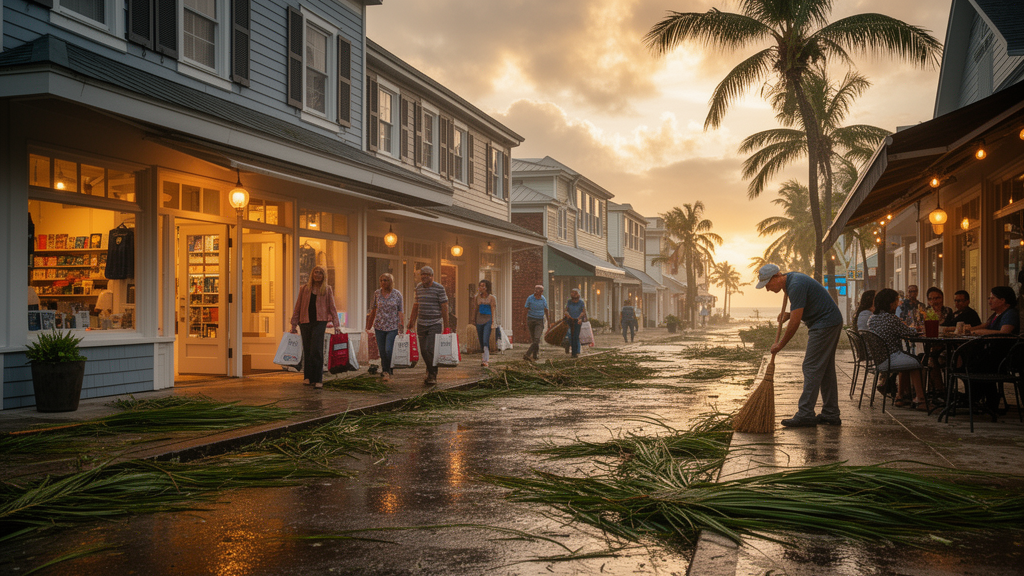
When a major hurricane slams into the US coastline, the immediate economic toll is often measured in headlines about destroyed homes and flooded streets. But a new study published in Nature Communications offers something rarer: a real-time, ZIP-code-by-ZIP-code account of how local economies actually sputter and restart when the storm passes overhead. Drawing on daily transaction records from 7,987 US ZIP codes exposed to 21 Atlantic hurricanes between 2017 and 2024, researchers tracked aggregate merchant sales and consumer spending as the storms unfolded, revealing a pattern of disruption that is strikingly brief, surprisingly shallow, and far harder to predict from storm categories than most people would assume.
The headline finding is deceptively simple. Hurricanes cause economic losses equivalent to about two days of typical sales in affected areas. That is a real hit, but it is a far cry from the weeks-long shutdowns that dominate public perception after catastrophic storms. Even more notable is the speed of the rebound: local economies recover to pre-hurricane levels within roughly ten days. The study, led by Sumit Agarwal of the National University of Singapore together with Smarajit Paul Choudhury of the Mastercard Economics Institute, Mingxuan Fan of the National University of Singapore, and Leora Klapper of the World Bank, provides some of the first systematic real-time evidence on how local economies adjust to hurricanes as they happen.
The technical achievement behind these numbers lies in the data infrastructure. The researchers used aggregated and anonymized transaction data, provided under controlled access by the Mastercard Economics Institute, to measure merchant sales and consumer spending at daily frequency across thousands of ZIP codes. This granularity matters enormously. Traditional economic damage assessments rely on surveys, insurance claims, or official statistics that arrive weeks or months after the event, by which time the recovery has already occurred and the dynamics of disruption have been lost. Daily transaction data, by contrast, capture the economic pulse of a community as the storm approaches, makes landfall, and passes, allowing researchers to watch the disruption unfold hour by hour and day by day.
One of the study’s most consequential findings concerns what economists call substitution. In theory, when a hurricane shuts down businesses in one location, consumers might simply shift their spending to neighboring areas that escaped the worst of the storm, or they might move purchases across channels, buying online instead of from flooded storefronts. If such substitution were widespread, the aggregate economic damage of a hurricane would be much smaller than the local damage suggests. But the researchers found limited offsetting substitution across locations and channels. The losses in hit areas are not meaningfully recouped by gains elsewhere, meaning the disruption represents a genuine net loss to the economy rather than a mere reshuffling of economic activity.
Perhaps the most counterintuitive result is that storm category alone is a poor predictor of short-run economic impacts. A Category 4 storm that makes landfall in a sparsely populated area with robust infrastructure may cause less economic disruption than a weaker storm that strikes a densely populated urban corridor with fragile power grids. Instead, the study found that economic disruption increases with physical damage, evacuation restrictions, and infrastructure outages. These are the variables that actually matter for the economic pulse of a community. Evacuation orders, by emptying towns of consumers, can shut down sales even before the storm arrives. Power outages, by disabling payment systems and refrigeration, can keep businesses closed after the skies have cleared. Physical damage to buildings and roads determines how quickly commerce can resume.
The disruption and recovery patterns also vary significantly across industries, merchant types, and sales channels. Restaurants, which depend on foot traffic and perishable inventory, likely experience different disruption dynamics than hardware stores, which may see surges in demand as residents prepare for and repair after storms. Online merchants may weather the disruption differently than brick-and-mortar establishments. These differences matter for policymakers trying to target relief efforts and for businesses trying to anticipate how a storm will affect their operations. The study’s industry-level breakdown provides a granular map of economic vulnerability that could inform everything from emergency lending programs to supply chain planning.
The findings arrive at a moment of growing urgency. Climate projections indicate substantial increases in hurricane activity under continued warming, meaning the economic exposure of coastal communities is set to grow in the decades ahead. Understanding the short-run dynamics of disruption and recovery is therefore not merely an academic exercise. It helps identify the conditions under which short-run economic disruption is most severe, which in turn can guide the design of evacuation policies, infrastructure hardening, and emergency financial support. If power outages and evacuation restrictions are the key drivers of economic pain, then investments in grid resilience and communication systems may yield outsized economic benefits relative to their cost.
The research also carries implications for how economists and policymakers measure the cost of natural disasters. Official damage estimates typically focus on physical destruction, the value of destroyed property and infrastructure. But the study suggests that the short-run economic disruption, the lost sales and interrupted commerce, represents a distinct and measurable component of hurricane costs. Because the disruption is brief, it may be systematically underestimated in traditional assessments that arrive too late to capture it. Real-time transaction data offer a way to fill this gap, providing a running tally of economic damage as the storm unfolds rather than a retrospective estimate after the fact.
The study was supported financially by the World Bank Research Support Budget, and the authors are careful to note that the findings, interpretations, and conclusions expressed in the paper are entirely those of the authors and do not necessarily represent the views of Mastercard, the World Bank, or the governments they represent. Mastercard provided data access for academic research purposes only and had no role in study design, analysis, interpretation, or the decision to publish. These safeguards matter for a study that relies on proprietary financial data, and they help establish the credibility of the results for a research community that has long called for better real-time economic monitoring of natural disasters.
As warming oceans continue to fuel more intense Atlantic hurricane seasons, the ability to watch local economies stumble and recover in real time may become one of the most valuable tools in the climate adaptation toolkit. The study’s message is ultimately one of measured reassurance mixed with caution: local economies are more resilient in the short run than the aftermath of catastrophic storms might suggest, bouncing back within ten days, but the depth of disruption depends on factors that are within human control, the robustness of infrastructure, the design of evacuation policies, and the speed of physical repairs. In the race between warming and adaptation, real-time economic data may prove to be the compass that shows which investments actually keep communities economically alive when the next storm makes landfall.
Subject of Research: Real-time measurement of economic disruption and recovery in US ZIP codes affected by Atlantic hurricanes using daily transaction data
Article Title: Real-time economic disruption and recovery from Atlantic hurricanes across the US
Article References: Agarwal, S., Choudhury, S. P., Fan, M., & Klapper, L. (2026). Real-time economic disruption and recovery from Atlantic hurricanes across the US. Nature Communications. https://doi.org/10.1038/s41467-026-78686-4
Image Credits: AI Generated
DOI: 10.1038/s41467-026-78686-4
Keywords: hurricanes, economic disruption, recovery, transaction data, ZIP codes, substitution, infrastructure outages, evacuation, storm category, climate change impacts, environmental economics, Nature Communications
Cite Scienmag News
Violet Maxwell. (October 17, 2026). Hurricanes Cost Local Economies Two Days of Sales but Recover Within Ten Days. Scienmag. https://scienmag.com/hurricanes-cost-local-economies-two-days-of-sales-but-recover-within-ten-days/
Violet Maxwell. "Hurricanes Cost Local Economies Two Days of Sales but Recover Within Ten Days." Scienmag, 17 October 2026, https://scienmag.com/hurricanes-cost-local-economies-two-days-of-sales-but-recover-within-ten-days/. Accessed 17 October 2026.
Violet Maxwell. "Hurricanes Cost Local Economies Two Days of Sales but Recover Within Ten Days." Scienmag. October 17, 2026. https://scienmag.com/hurricanes-cost-local-economies-two-days-of-sales-but-recover-within-ten-days/


