


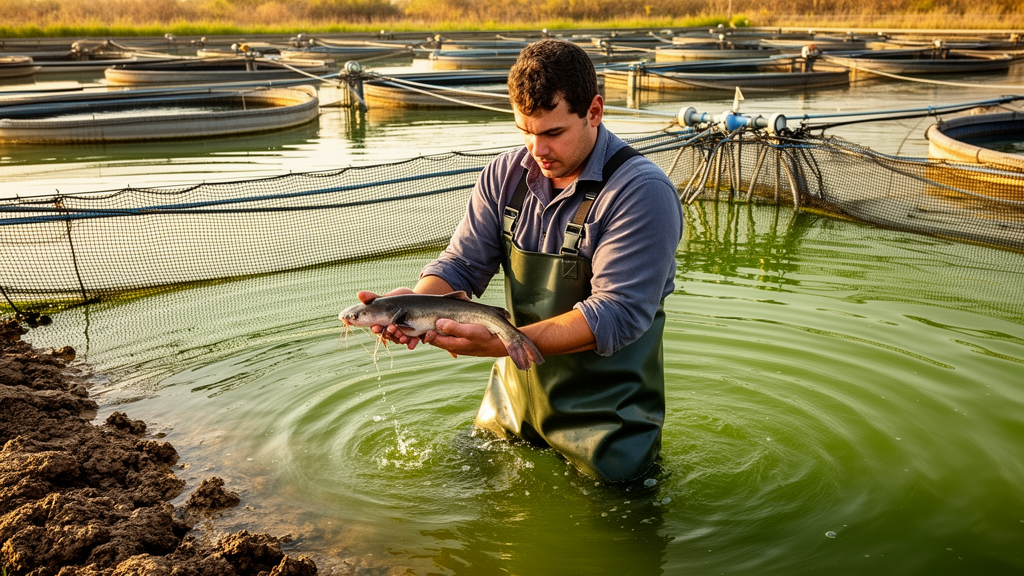
In the world of aquaculture, few tricks are as valuable as producing an entire crop of fast-growing males. Channel catfish, the American catfish that has become a pillar species of freshwater farming in China and a global aquaculture workhorse, shows a pronounced growth advantage in males during the later stages of commercial culture, which translates directly into higher profitability per unit of pond area. Now, a team working at the National Genetic Breeding Center for Channel Catfish in Jiangsu Province has taken a major step toward making all-male production simpler, cheaper, and more reliable, by asking a deceptively simple question: do genetically male fish that have been hormonally transformed into females actually look and grow like real females? The answer, published in Acta Ichthyologica et Piscatoria, turns out to be a resounding yes, and it comes with a bonus: a statistical formula that can predict a fish’s body weight from a few key measurements.
The biological foundation of the work is the channel catfish’s XX/XY sex-determination system. Because males carry two different sex chromosomes and females two identical ones, breeders can exploit chromosome combinations to skew offspring sex ratios. The research group had previously established a three-generation breeding pipeline: larvae are treated with the estrogen 17β-estradiol to create XY pseudofemales, genetically male fish that develop functional ovaries; these are crossed with normal XY males to yield YY supermales, fish carrying two Y chromosomes; and YY supermales are then crossed with ordinary XX females to produce all-male XY progeny on a commercial scale. The catch is efficiency. Crossing an XY pseudofemale with an XY male produces a mixture of YY supermales, XY males, and XX females, forcing breeders to identify and sort the YY supermales they need for the next round of production.
The elegant shortcut is to sex-reverse the YY supermales themselves. Feed 17β-estradiol to genetically YY larvae and they develop as females, known as YY pseudofemales. Crossing a YY supermale with a YY pseudofemale yields offspring that are 100% YY supermales, no sorting required. But for this system to work in practice, the YY pseudofemales must be usable as female broodstock, which means they must be compatible in size and shape with ordinary females. If hormonally induced pseudofemales grew differently from genetic females, mating success and reproductive output could suffer. That is precisely the gap the new study set out to close, by systematically comparing the body shapes and weights of five distinct fish types at six months of age: XX females, XY males, YY supermales, XY pseudofemales, and YY pseudofemales, with fifty individuals in each group.
The experimental design was rigorous from the start. Fry from carefully mated families were split into two feeding groups: one received a microdiet laced with 17β-estradiol at 60 micrograms per gram of feed, a dose previously shown in the group’s own dose-response trials to be the only concentration achieving complete sex reversal, while the control group received ordinary feed. After six months of rearing under tightly controlled conditions, with dissolved oxygen held above 5 milligrams per liter and ammonia nitrogen below 0.02 milligrams per liter, one thousand fish from each group were tagged with passive integrated transponders carrying unique twelve-digit codes. Genetic sex was then confirmed using a sex-linked molecular marker that exploits a six-base-pair deletion found specifically on the Y chromosome, allowing XX, XY, and YY individuals to be distinguished unambiguously by capillary electrophoresis. Anatomical examination verified that every pseudofemale possessed normal ovaries despite her male genetic constitution.
Each fish was measured for eleven morphological traits, from total length and standard length to head depth, maximum body depth, body depth at the anus, and caudal peduncle dimensions, along with body weight. Every measurement was repeated three times and taken by the same person to eliminate observer bias, and the data passed normality and variance-homogeneity tests before analysis. The results painted a clear picture. Males of both genotypes significantly outmeasured females across all eleven traits, with mean body weights of 253.14 grams for XY males and 238.04 grams for YY supermales, compared with 184.96 grams for XX females and just 171.18 grams for YY pseudofemales. Trait after trait followed the same ranking: XY males largest, then YY supermales, then XY pseudofemales, then XX females, and finally YY pseudofemales smallest.
The crucial comparisons, however, were between YY pseudofemales and the other groups. Against XY males, YY pseudofemales were significantly smaller in body weight, total length, standard length, prepelvic fin length, head depth, and caudal peduncle length, with effect sizes in the medium-to-large range. Against YY supermales, they were again significantly lighter and shorter, with smaller heads. But against XX females and XY pseudofemales, not a single one of the eleven morphological traits showed a statistically significant difference. A cluster analysis drove the point home visually: XY pseudofemales grouped first with XX females, and YY pseudofemales joined that female branch, rather than sitting anywhere near the males. In other words, the hormonally transformed supermales do not occupy some intermediate body form between the sexes; they are morphologically indistinguishable from genuine females, exactly what a breeding program needs.
The study then went beyond simple comparison, deploying correlation analysis, path analysis, and multiple regression to dissect how each trait contributes to body weight, a standard toolkit in quantitative genetics that has proven its worth in grouper, tilapia, largemouth bass, and many other farmed species. Across all five groups, every pair of traits correlated strongly, with coefficients above 0.68, and body weight correlated with most individual traits at values exceeding 0.85. Standard length and total length were almost perfectly correlated in every group, while maximum body depth and body depth at the anus covaried so tightly, with correlations between 0.987 and 0.995, that the trunk profile of the species is evidently a very stable feature.
The most striking finding emerged from the path analysis, which separates the direct effect of each trait on weight from indirect effects channeled through correlated traits. Pseudofemales, whether XY or YY, and ordinary females all shared what the authors call a body depth-dominant pattern: weight gain depended primarily on increasing body depth at the anus. Males, by contrast, showed a standard length-dominant or total length-dominant pattern, packing on mass by stretching out. The authors interpret this divergence through the lens of sex-specific energy allocation. Females must reserve substantial energy for reproduction, and abdominal cavity capacity, which tracks body depth, directly governs fecundity, favoring a deeper body. Males tend to elongate rapidly to gain advantages in territorial competition and mating opportunities. Similar sex-divergent growth strategies have been documented in other species, including Diptychus maculatus in the Muzat River, and earlier channel catfish work had already hinted that standard length is the key trait for male weight while female weight responds to both length and depth. The new study extends that pattern to artificially induced YY pseudofemales, confirming their growth biology is fundamentally female.
For breeders, this has immediate practical consequences. If the goal is heavier commercial fish, selection on the female and pseudofemale side should favor individuals with greater body depth at the anus, while male lines destined for direct grow-out should be selected for standard length, and YY supermales for total length and caudal peduncle depth. The team distilled these relationships into a predictive equation for YY pseudofemale body weight based on total length, prepelvic fin length, and body depth at the anus, achieving a coefficient of determination of 0.914, with variance inflation factors confirming the model was free of problematic multicollinearity. Power-function curve fits showed the relationships were slightly nonlinear, with exponents near three for total length and about two and a half for the depth traits. In principle, this allows early screening of six-month-old broodstock candidates from simple morphological measurements, shortening generation intervals and accelerating genetic progress in all-male breeding.
The authors are appropriately cautious about the limits of their model, noting that its broader applicability must be validated across independent populations and different rearing systems before it becomes a routine selection tool. Still, the study delivers what the all-male breeding system has been missing: phenotypic evidence that YY pseudofemales face no morphological barriers to serving as female broodstock, and a population-specific roadmap for selecting them. Combined with earlier molecular work showing that estrogen induction activates normal female reproductive gene pathways in pseudofemale ovaries, the picture is now remarkably complete. A fish that is genetically supermale, hormonally reshaped into a functional female, and statistically indistinguishable from a natural female in body form may soon become the quiet engine behind a new generation of all-male catfish farms, turning a chromosome trick into a commercial reality.
Subject of Research: Morphological comparison and body weight prediction of hormone-induced YY pseudofemale channel catfish for all-male breeding
Article Title: Comparative morphological analysis and body weight prediction of hormone-induced YY pseudofemale channel catfish, Ictalurus punctatus ( Actinopterygii , Siluriformes , Ictaluridae )
Article References: Zhu, Z., Liu, H., Duan, Y., Chen, Y., Zhang, S., Wang, J., Wang, M., Chen, X., Duan, R., & Zhang, S. (2026). Comparative morphological analysis and body weight prediction of hormone-induced YY pseudofemale channel catfish, Ictalurus punctatus (Actinopterygii, Siluriformes, Ictaluridae). Acta Ichthyologica et Piscatoria, 56, 417-430. https://doi.org/10.3897/aiep.56.198566
Image Credits: AI Generated
Keywords: channel catfish, YY pseudofemale, 17β-estradiol, sex reversal, all-male breeding, aquaculture, morphometrics, path analysis, body weight prediction, YY supermale, selective breeding, Ictalurus punctatus
Cite Scienmag News
Juliet Wilcox. (October 17, 2026). Hormone-Turned Supermales Reshape the Future of All-Male Catfish Farming. Scienmag. https://scienmag.com/hormone-turned-supermales-reshape-the-future-of-all-male-catfish-farming/
Juliet Wilcox. "Hormone-Turned Supermales Reshape the Future of All-Male Catfish Farming." Scienmag, 17 October 2026, https://scienmag.com/hormone-turned-supermales-reshape-the-future-of-all-male-catfish-farming/. Accessed 17 October 2026.
Juliet Wilcox. "Hormone-Turned Supermales Reshape the Future of All-Male Catfish Farming." Scienmag. October 17, 2026. https://scienmag.com/hormone-turned-supermales-reshape-the-future-of-all-male-catfish-farming/


