


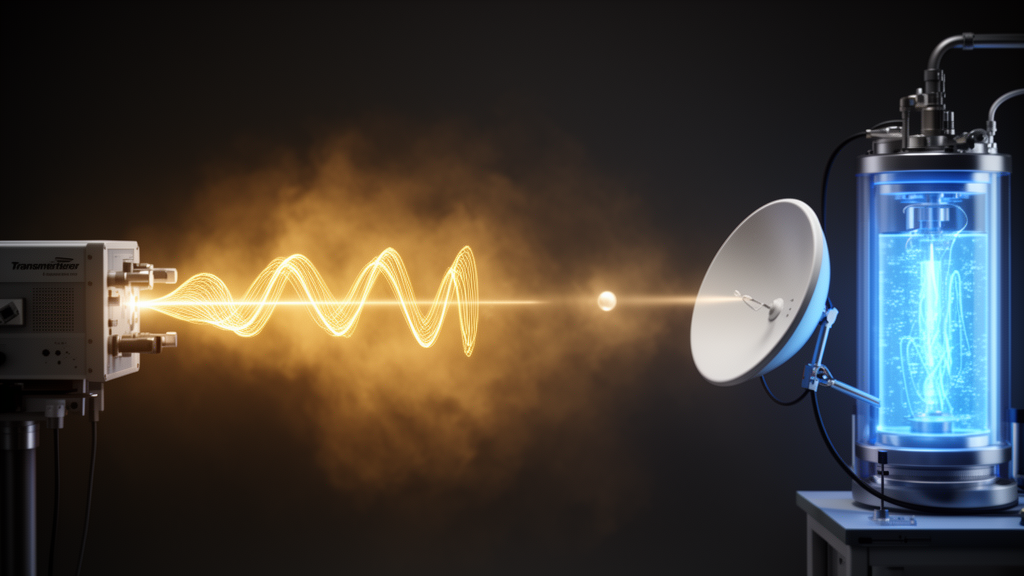
Quantum illumination is one of the most counterintuitive success stories in quantum information science. In its canonical form, a pair of entangled light beams is prepared, one beam is sent toward a faint target embedded in a bright, noisy thermal environment, and the returning light is jointly measured with the retained reference beam. The remarkable claim, first made by Seth Lloyd in 2008, is that even when the entanglement between signal and reference is completely destroyed by the environment, the protocol can still detect the target with an error probability exponentially lower than any classical scheme operating at the same signal brightness. For years, researchers have debated what quantum resource actually powers this advantage. Is it the initial entanglement, which is so fragile that it vanishes almost immediately in the noisy channel, or is it some subtler form of quantum correlation that survives the journey? A new theoretical study by Mojtaba Asadollahi and Mohammad Hossein Zarei of Shiraz University in Iran, published in Quantum Information Processing, delivers the sharpest answer yet: within an important family of probe states, quantum discord, not entanglement, is the resource that must be consumed to achieve the illumination advantage, and in the high-noise regime the advantage is, to leading order, simply a linear function of the initial discord.
To appreciate the technical achievement, one must first understand the two competing quantities. Entanglement is the famous nonclassical correlation that allows quantum states to be inseparable, the resource behind teleportation, quantum cryptography, and much of quantum computing. Quantum discord, introduced by Ollivier and Zurek in 2001, is a more general measure of quantumness of correlations. It captures the discrepancy between two classically equivalent ways of measuring mutual information in a bipartite quantum state, and it can be nonzero even in states that are completely unentangled. Discord was long dismissed as a curiosity, but a series of results, including the Datta-Shaji-Caves demonstration that discord alone can power a quantum computational speedup and the Gu et al. experiment observing the operational significance of discord consumption, established it as a genuine resource. The question of which resource underlies quantum illumination has been particularly contentious because the protocol’s advantage persists even when entanglement does not.
Asadollahi and Zarei approach this problem through a carefully chosen family of probe states: the maximally mixed marginal, or MMM, states. These are two-qubit states whose individual subsystems are each in the maximally mixed state, meaning the reduced density matrices are proportional to the identity operator. The Bell-diagonal states, which are the eigenstates of two-qubit Pauli operators, belong to this family. Crucially, the authors consider a setup in which the environmental state is also completely mixed. In this configuration, they prove that the quantum advantage of the illumination protocol equals exactly the amount of discord consumed during the illumination process. This is a powerful simplification: rather than needing to compare error probabilities between quantum and classical schemes, one can simply track how much discord the protocol uses up, and that consumed discord is the advantage itself.
The core of the paper is a conditional extremal analysis. The authors ask: for fixed values of entanglement and discord in the initial probe state, what range of quantum advantages is accessible? Through rigorous mathematical arguments, they establish two complementary conclusions. First, at fixed discord, higher entanglement restricts the accessible advantage to higher values, making high entanglement sufficient for achieving high advantage. Second, and more importantly for the resource question, at fixed entanglement, low discord limits the advantage to low values, indicating that high discord is necessary for high advantage in MMM states. In the language of resource theories, sufficiency and necessity are distinct concepts: a resource is sufficient if having enough of it guarantees the desired performance, but it is necessary if the desired performance cannot be achieved without it. The authors’ analysis shows that discord plays the necessary role, while entanglement plays a sufficient but not necessary role.
A natural objection to any such resource claim is that it might depend on the specific mathematical measure used to quantify the correlations. Different entanglement measures, such as concurrence, negativity, and relative entropy of entanglement, can order states differently, and the same is true for discord measures. To address this concern, the authors repeat their analysis using conceptually distinct quantifiers: relative entropy of discord, Bures entanglement, and geometric discord. The consistency of their conclusions across all these measures indicates that the observed resource-advantage relation is not an artifact of a particular quantifier but a robust structural feature of the protocol within the family of MMM states. This kind of measure-independence is rare and valuable in quantum information theory, where the choice of measure often matters enormously.
The most striking quantitative result concerns the high-noise regime, where the probe state approaches the maximally mixed state. In this limit, the authors compute the ratio of quantum advantage to initial discord and find that, to leading order, the advantage is a linear function of the initial discord. The technical calculation, detailed in the paper’s appendix, involves expanding the quantum discord of the relevant states in powers of the correlation parameters and carefully taking the limit as these parameters approach zero. The result is that the limit of the ratio equals p₀η²(1-p₀), where p₀ is the prior probability of the target being present and η is a parameter characterizing the environmental noise. This linear relationship is a clean, experimentally testable prediction: if one prepares MMM probe states with varying amounts of discord in a high-noise environment, the quantum advantage should scale proportionally with the discord.
The significance of this work extends beyond the specific protocol of quantum illumination. It contributes to a broader research program, articulated in the framework of quantum resource theories by Chitambar and Gour, that seeks to identify which quantum resources power which quantum advantages. For quantum computing, the role of discord has been debated since the Datta-Shaji-Caves result. For quantum cryptography, Pirandola has shown that discord can serve as a resource. For quantum illumination, the present work provides the most rigorous identification of the resource within the MMM family. The authors’ conclusions align with and extend previous results by Weedbrook et al., who showed how discord underlies the noise resilience of quantum illumination, and by Kim et al., who questioned whether entanglement is a unique resource in the protocol.
From a practical standpoint, the identification of discord as the key resource has important implications for the design of quantum illumination systems. Entanglement is notoriously difficult to generate and maintain in realistic environments, especially at the low signal brightness levels required for detecting very faint targets. Discord, by contrast, can survive in states that are much more robust to noise. If the advantage is powered by discord rather than entanglement, then experimentalists have more freedom in choosing probe states, and the protocol may be implementable with resources that are easier to prepare. This could accelerate the development of quantum radar and quantum sensing technologies, which are among the most promising applications of quantum illumination.
The authors acknowledge valuable discussions with A. Ramezanpour, which led to improvements in their arguments. The data and code for the figures are publicly available on GitHub, reflecting a commitment to reproducibility. As quantum illumination moves from theoretical curiosity to practical technology, understanding the resource structure of the protocol becomes increasingly important. The present work represents a significant step in that direction, providing a clear, measure-independent identification of discord as the necessary resource for quantum illumination advantage within the MMM family, and establishing a linear relationship between initial discord and quantum advantage in the high-noise regime that should be directly testable in laboratory experiments.
Subject of Research: Resources of the advantage in quantum illumination: Discord and entanglement
Article Title: Resources of the advantage in quantum illumination: Discord and entanglement
Article References: Asadollahi, M., & Zarei, M. H. (2026). Resources of the advantage in quantum illumination: Discord and entanglement. Quantum Information Processing, 25(11), Article 345. https://doi.org/10.1007/s11128-026-05368-x
Image Credits: AI Generated
DOI: 10.1007/s11128-026-05368-x
Keywords: Resources, advantage, quantum, illumination, Discord, entanglement, scientific research
Cite Scienmag News
Katie Riggs. (October 17, 2026). Discord, not entanglement, emerges as the key resource behind quantum illumination’s advantage. Scienmag. https://scienmag.com/discord-not-entanglement-emerges-as-the-key-resource-behind-quantum-illuminations-advantage/
Katie Riggs. "Discord, not entanglement, emerges as the key resource behind quantum illumination’s advantage." Scienmag, 17 October 2026, https://scienmag.com/discord-not-entanglement-emerges-as-the-key-resource-behind-quantum-illuminations-advantage/. Accessed 17 October 2026.
Katie Riggs. "Discord, not entanglement, emerges as the key resource behind quantum illumination’s advantage." Scienmag. October 17, 2026. https://scienmag.com/discord-not-entanglement-emerges-as-the-key-resource-behind-quantum-illuminations-advantage/


