


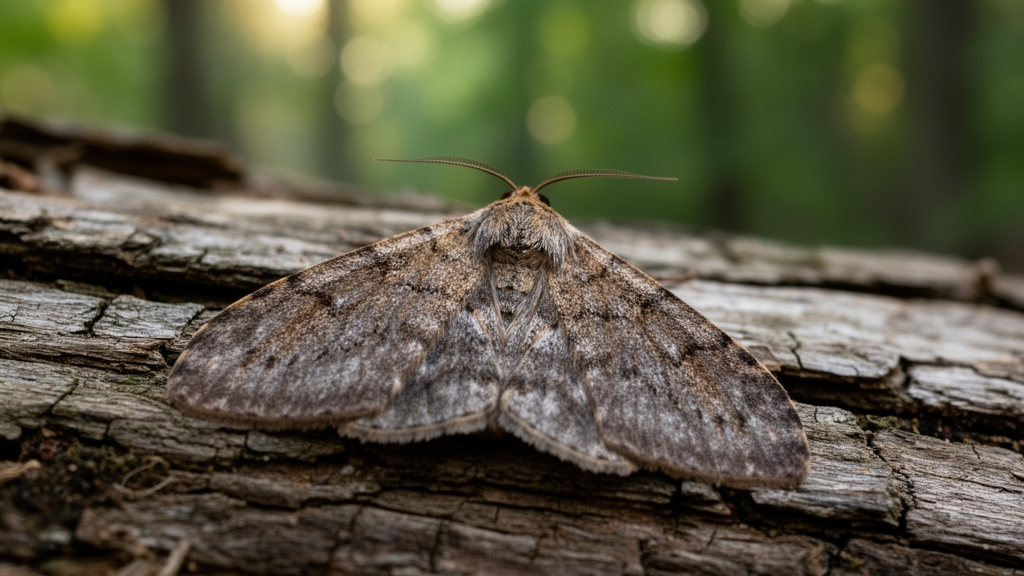
Georgia’s carpenter moth fauna has just grown by three species and two genera, according to a new study published in the journal Caucasiana. Entomologist L-G Japaridze documented the first Georgian records of the genera Cecryphalus and Dieida, along with the species Dyspessa infuscata, based on specimens collected in different parts of the country between 2022 and 2024. The discovery raises the total number of Cossidae genera known from Georgia from ten to twelve, and the number of species from fourteen to seventeen.
Carpenter moths belong to the family Cossidae, a group of mostly large, heavy-bodied moths whose caterpillars bore into wood, stems, and roots of trees and shrubs. Unlike many familiar butterflies and moths, cossids are often inconspicuous, cryptically colored, and poorly studied, particularly in mountainous and arid regions where many species live highly localized lives. The scientific knowledge of Georgia’s Cossidae began with Romanoff in 1885 and has grown steadily through the work of researchers such as Didmanidze, whose most recent survey with Yakovlev in 2007 reported fourteen species in ten genera. The biology of many of these species, however, remains largely unknown.
The first new record concerns Cecryphalus strix, a nocturnal species first described by Grum-Grshimailo in 1895. The genus Cecryphalus contains only two known species, which inhabit deserts of Central Asia, North Africa, and the South Caucasus. Until now, only C. strix was known to occur in the South Caucasus, reported from Azerbaijan and Armenia. Three male specimens were documented in Georgia: two from Vashlovani National Park in Dedoplistkaro Municipality at 114 meters above sea level, collected on 6 June 2023, and one from Chachuna Managed Reserve at 248 meters, collected on 17 July 2023. The species is otherwise known from Southern Kazakhstan, Kyrgyzstan, Southern Mongolia, Northwestern China, Tajikistan, Uzbekistan, Turkmenistan, Azerbaijan, Northern Iran, and Southern Armenia. Its host plant and immature stages remain unknown.
The second new record is Dieida ledereri, first described by Staudinger in 1871. Dieida is a small genus of only six species of diurnal Palaearctic carpenter moths, and D. ledereri was previously known in the South Caucasus only from Azerbaijan. A single male specimen was hand collected in Vashlovani National Park at 460 meters above sea level on 16 April 2022. The species is otherwise distributed in Turkey, Azerbaijan, Afghanistan, Syria, Iraq, Israel, and Iran. Its host plant, eggs, and caterpillar are unknown, making the Georgian record an important addition to the understanding of its range.
The single D. ledereri specimen came with an unusual story. The moth was preyed upon by a robber fly of the family Asilidae, which was caught and dropped the specimen on the ground. Unfortunately, the specimen was later damaged during transportation, so no photograph of the undamaged individual exists to fully express its natural colors. The study nevertheless records the appearance of the undamaged moth: it had bipectinate black antennae with two-thirds white on the anterior side, half the length of the forewing, with long black rami. The head, tegula, thorax, and abdomen were densely hirsute and black with a golden terminal part, golden-brown both dorsally and ventrally. The forewings were semitranslucent with a white-ivory basal area, and the hindwings were semitranslucent with white-ivory spots on the submedian area and hind margin.
Because the specimen was damaged, the study provides a detailed description of the male genitalia, which is essential for confirming the identification of cossid species. The tegumen is long and triangular, the uncus small, sclerotized, and triangular peak-shaped, and the socii oval with setae. The arms of the gnathos are long, thin, and fused by membrane, with a triangular membranous gnathos knob. The valvae are lanceolate, six times longer than wide, with a roundish apex; the basal half of the costal margin is convex and the apical half concave, while the apical sixth of the valva is membranous and the basal five-sixths sclerotized. The sacculus is clearly separated from the valvae, slender, and about two-thirds the length of the valvae, gradually narrowing towards its outer end. The aedeagus is cylindrical, slightly longer than the valvae, and without a cornutus, while the vesica is membranous with a large roundish basal part and a gladiate distal part.
The third new record is Dyspessa infuscata, described by Staudinger in 1892. Dyspessa is the most speciose genus of nocturnal carpenter moths, with over 80 species widely distributed in the western Palaearctic. Most species have restricted distributions limited by mountain ranges and deserts, and many are local endemics. Only four species had previously been reported from Georgia: D. alpherakyi, D. pallidata, D. salicicola, and D. ulula. A single female specimen was collected on the Nutsubidze Plateau in Tbilisi at 621 meters above sea level on 24 April 2024. The species is distributed in Turkey, Russia’s North Caucasus, Ukraine’s Crimea, the South Caucasus, and Syria. Because earlier authors did not specify an exact location within the South Caucasus or mention the species in Georgia in later works, this appears to be the first documented record of D. infuscata in the country.
The specimens were collected using light traps, except for the male D. ledereri, which was hand collected. Elevations and GPS coordinates were obtained with a Garmin GPS MAP 64s device, and all specimens are deposited in the personal collection of the author. The moths were examined on the basis of both external and internal morphological characters. Genital dissection followed the technique published by Robinson in 1976 with certain modifications, using a 15 percent potassium hydroxide solution to macerate the full abdomen. Weakly sclerotized structures were stained with chlorazol black and mounted into Euparal. Preserved specimens were photographed with a Canon EOS 60D camera and a Canon EF 60 mm macro lens, with digital images prepared using Zerene Stacker image stacking software and Adobe Photoshop CS6. Genitalia were photographed using a Nikon SMZ745T stereo microscope equipped with a Moticam 2500 camera.
The study places the Georgian discoveries in a broader regional context. Recent collecting efforts in Georgia and adjacent territories have resulted in the descriptions of several new Cossidae species: Holcocerus didmanidzae from Georgia, Stygiodies nupponenorum from Turkey, Isoceras shevnini from Armenia, Phragmataecia effendii from Azerbaijan, and Dieida versicolor from Turkey. Even though the Cossidae fauna of Turkey is relatively well studied compared to that of the South Caucasus, a new genus, Stygia, was recorded there in recent years. Since some of the species listed above are known only from type specimens, and others were described based solely on males or females, investigating the biology and life cycles of these rare species would be highly valuable.
Given the limited study of the Cossidae family in Georgia, the author notes that it is quite possible that rare diurnal genera, such as Stygioides, may still await discovery in the country’s remote arid regions. The new records highlight how much remains to be learned about the moth fauna of the South Caucasus, where arid lowlands, mountain ranges, and isolated valleys create conditions for localized and often endemic species. For a family whose caterpillars bore invisibly inside wood and whose adults fly briefly and cryptically, every documented specimen represents a meaningful expansion of scientific knowledge, and the Georgian carpenter moth checklist now stands at seventeen species in twelve genera.
Subject of Research: First records of two genera and three carpenter moth species (Lepidoptera, Cossidae) in Georgia
Article Title: First records of two genera and three carpenter moths ( Lepidoptera , Cossidae ) from Georgia
Article References: Japaridze, L.-G. (2024). First records of two genera and three carpenter moths (Lepidoptera, Cossidae) from Georgia. Caucasiana, 3, 273-280. https://doi.org/10.3897/caucasiana.3.e140978
Image Credits: AI Generated
DOI: 10.3897/caucasiana.3.e140978
Keywords: Cossidae, carpenter moths, Lepidoptera, Georgia, Cecryphalus strix, Dieida ledereri, Dyspessa infuscata, South Caucasus, biodiversity, new records, Vashlovani National Park, entomology
Cite Scienmag News
Gavin Prescott. (October 17, 2026). Two New Genera and Three Carpenter Moth Species Recorded in Georgia for the First Time. Scienmag. https://scienmag.com/two-new-genera-and-three-carpenter-moth-species-recorded-in-georgia-for-the-first-time/
Gavin Prescott. "Two New Genera and Three Carpenter Moth Species Recorded in Georgia for the First Time." Scienmag, 17 October 2026, https://scienmag.com/two-new-genera-and-three-carpenter-moth-species-recorded-in-georgia-for-the-first-time/. Accessed 17 October 2026.
Gavin Prescott. "Two New Genera and Three Carpenter Moth Species Recorded in Georgia for the First Time." Scienmag. October 17, 2026. https://scienmag.com/two-new-genera-and-three-carpenter-moth-species-recorded-in-georgia-for-the-first-time/


