


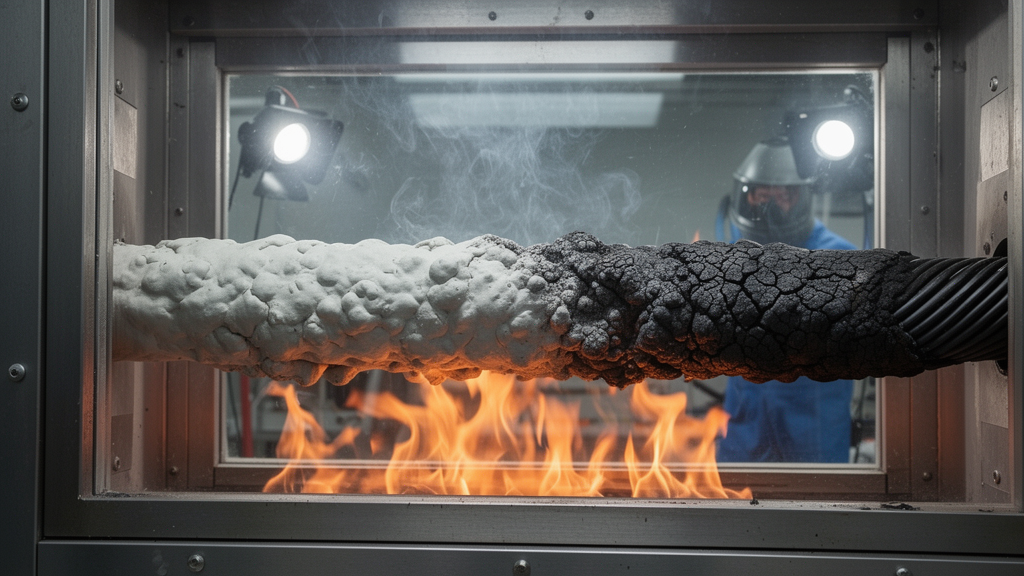
Deep inside a nuclear power plant or a sprawling warehouse, the humble power cable is both lifeline and liability. Wrapped in PVC sheathing and XLPE insulation, these cables carry electricity through some of the most safety-critical environments on Earth, yet their plastic armor is combustible. When fire strikes, cables can stop carrying power and start spreading flames, disabling the very firefighting and safety systems designed to protect the facility. A new study from researchers at IIT Roorkee, GD Goenka University, UPES, Johns Hopkins University, and the Bhabha Atomic Research Center has now quantified, layer by layer and second by second, exactly how long a live power cable survives under radiative fire exposure, and how much protection a thin fire-retardant coating can buy.
The team, led by Raj Kumar Mishra of IIT Roorkee’s Fire Research Laboratory and Mahesh Kumar Tiwari of GD Goenka University, published their findings in Frontiers in Thermal Engineering on 13 August 2025. Their motivation is rooted in hard lessons from industrial history. During the initial stage of the 2010 fire at Dalian’s oil depot in China, flames damaged electricity supply cables and distribution rooms, interrupting the low-voltage power supply needed to electrically shut off emergency tank valves. Manual valve operation was slow and dangerous, and firefighting efforts suffered enormously. The episode illustrated a chilling truth: in a fire, key cables connected to safety equipment become the weak point of the entire emergency system.
To probe this vulnerability under controlled conditions, the researchers designed a bench-scale experimental campaign around a 1.1-kV, four-core, XLPE-insulated, armored, PVC-sheathed power cable with an aluminum conductor. The cable had an outer diameter of 26.2 millimeters and a current rating of 70 amperes. Specimens were cut to 1.2 meters in length, with 100 millimeters stripped from each end, leaving an experimental length of 1,000 millimeters. Two precisely drilled holes reached the insulation and the aluminum core, where high-accuracy K-type thermocouples were inserted to track temperatures deep inside the cable. Additional thermocouples monitored the outer surface and the flame itself, while a step-up transformer and variac supplied rated current through copper bus bars throughout the test.
The experimental protocol unfolded in three phases. First came the current phase, in which the cable carried its rated load for 20 to 25 minutes until its temperature reached a steady state, mimicking normal operation. Then the pre-burning phase began: fuel from a reservoir pan, maintained at a constant 50-millimeter fuel level, ignited and bathed the cable in external radiation. Finally, the burning phase arrived, when the cable itself became a source of ignition. The team defined failure by two criteria: electrical failure, marked by a short circuit when insulation damage caused a breakdown, and mechanical failure, when the cable surface began smoldering, igniting, or flaming. Both failure modes were considered in every test.
Experiments were conducted at two average heat flux levels, roughly 15 kilowatts per square meter (13 to 15 kW/m2) and 20 kilowatts per square meter (17 to 20 kW/m2), achieved by adjusting the distance between the burner and the cable. For each heat flux, five fire-retardant coating thicknesses were tested, ranging from 0 to 0.8 millimeters, yielding ten experiments in total. The fire-retardant paint, or FRP, was prepared by mixing 10 grams of flame-retardant agent with 10 milliliters of fire-retardant paint, with epoxy thinner added to improve workability. A single coat achieves 90 to 100 microns of thickness and dries within 20 to 24 hours. The cured coating was characterized on a physical property measurement system, revealing an average thermal conductivity of 1.633 watts per meter-kelvin, a specific heat capacity of 1,690.581 joules per kilogram-kelvin, and a density of 1,272.308 kilograms per cubic meter. Coating thickness was verified with a CALTECH gauge accurate to 1.5 percent or 2 percent.
The results for uncoated cables are sobering. Under an average heat flux of 15 kilowatts per square meter, the bare cable failed after 1,897 seconds, with the aluminum core reaching 282.60 degrees Celsius and the outer sheath 353.90 degrees Celsius at the moment of failure. Raising the heat flux to 20 kilowatts per square meter nearly halved the survival time: the cable failed after just 991 seconds, with core and sheath temperatures of 223.16 and 310.16 degrees Celsius respectively. The counterintuitive drop in failure temperature at higher heat flux reflects the thermal impact of intense radiation, which degrades the insulation faster than heat can diffuse inward, so the sheath breaks down before the core heats fully.
Coatings changed the picture dramatically. At 15 kilowatts per square meter, failure time increased from 1,897 seconds for the bare cable to 2,017 seconds at 0.2 millimeters of coating, 2,140 seconds at 0.4 millimeters, 2,241 seconds at 0.6 millimeters, and 2,542 seconds at 0.8 millimeters, a gain of nearly 11 minutes. At 20 kilowatts per square meter, failure times rose from 991 seconds bare to 1,204, 1,300, 1,386, and 1,522 seconds across the same thicknesses. The ignition time increased almost linearly with coating thickness, and the coating also altered failure chemistry: instead of melting and dripping off, the treated insulation hardened, adhering to the cable as solid particles or falling off in layers, making the burning cable less hazardous than bare wire. The fire-retardant paint suppresses the intense heat flux directly striking the cable and restricts flame spread along its surface.
Using the measured data, the team developed empirical correlations for cable failure time as a function of heat flux and coating thickness, fitted by least-squares regression. The correlations agreed with experimental results within 2 percent variation and provided a conservative estimate of time to failure. The researchers also introduced a temperature reduction ratio, or TRR, defined as the difference between the steady-state surface temperature of uncoated and coated cables divided by the bare cable temperature at failure. For the 15 kilowatts per square meter case, the maximum experimental TRR of 0.1822 occurred at 0.8 millimeters of coating, suggesting a critical thickness of 0.8 to 1.0 millimeters. For the 20 kilowatts per square meter case, the maximum experimental TRR of 0.1813 appeared at 0.2 to 0.4 millimeters, indicating that the optimal coating thickness depends on the fire’s thermal stress.
To extend the bench-scale findings, the team built a three-dimensional numerical model in COMSOL Multiphysics, replicating the cable’s complex cylindrical geometry with four aluminum cores, concentric insulation, inner sheath, galvanized steel armor, and outer PVC jacket. The mesh consisted of approximately 1,063,432 extremely fine tetrahedral elements, with local refinement in high-gradient regions. The model coupled the Heat Transfer in Solids and Electric Currents physics interfaces, applying Fourier’s law of heat conduction and Ohm’s law for current flow, with Dirichlet conditions fixing temperatures at inlets and Neumann conditions imposing heat flux at boundaries. A steady current of 210 amperes was supplied for 1,470 seconds to reach steady state, after which heat flux was applied to one-quarter of the cable’s outer sheath, matching the burner geometry in the experiments. The simulation tracked four stages: steady-state operation, failure by short circuit, complete burning, and convective cooling, which took nearly 3,498 seconds to return the cable to its initial temperature.
The numerical validation delivered strong agreement with the experiments. For the uncoated cable at 15 kilowatts per square meter, the simulation predicted a failure time of 1,898 seconds, just one second off the measured 1,897 seconds, with core and sheath temperatures of 333.37 and 361.83 degrees Celsius. At 20 kilowatts per square meter, the simulated failure time was 990 seconds against the measured 991 seconds, with core and sheath temperatures of 212.73 and 256.45 degrees Celsius. Across all ten cases, the absolute mean deviation was 9.94 percent for the outer sheath and 14.19 percent for the core. The team notes that the correlations were fitted to a narrow range of heat flux values due to limited experimental data, and validating them across wider heat flux ranges is future work. Still, the benchmark data now available can inform material specification decisions for cable installations in high-risk areas, guide the development of more effective fire-resistant coatings, and ultimately help engineers ensure that the cables meant to keep a plant safe do not become the spark that endangers it.
Subject of Research: Fire Safety Engineering
Article Title: A comparative study of cable fire dynamics: bench-scale experiments and numerical simulations with and without fire-retardant coating
Article References: Mishra, R. K., Tiwari, M. K., Dasgotra, A., Sharma, A., Gupta, A., Meena, M. K., Kumar, R., & Sharma, P. K. (2025). A comparative study of cable fire dynamics: bench-scale experiments and numerical simulations with and without fire-retardant coating. Frontiers in Thermal Engineering, 5, Article 1560746. https://doi.org/10.3389/fther.2025.1560746
Image Credits: AI Generated
DOI: 10.3389/fther.2025.1560746
Keywords: power cable, fire-retardant coating, heat flux, nuclear power plant, COMSOL simulation, cable failure, comparative, cable, fire, dynamics, bench-scale, experiments
Cite Scienmag News
Denise Maddox. (October 17, 2026). Fire-retardant coatings buy power cables precious minutes in blaze tests. Scienmag. https://scienmag.com/fire-retardant-coatings-buy-power-cables-precious-minutes-in-blaze-tests/
Denise Maddox. "Fire-retardant coatings buy power cables precious minutes in blaze tests." Scienmag, 17 October 2026, https://scienmag.com/fire-retardant-coatings-buy-power-cables-precious-minutes-in-blaze-tests/. Accessed 17 October 2026.
Denise Maddox. "Fire-retardant coatings buy power cables precious minutes in blaze tests." Scienmag. October 17, 2026. https://scienmag.com/fire-retardant-coatings-buy-power-cables-precious-minutes-in-blaze-tests/


