


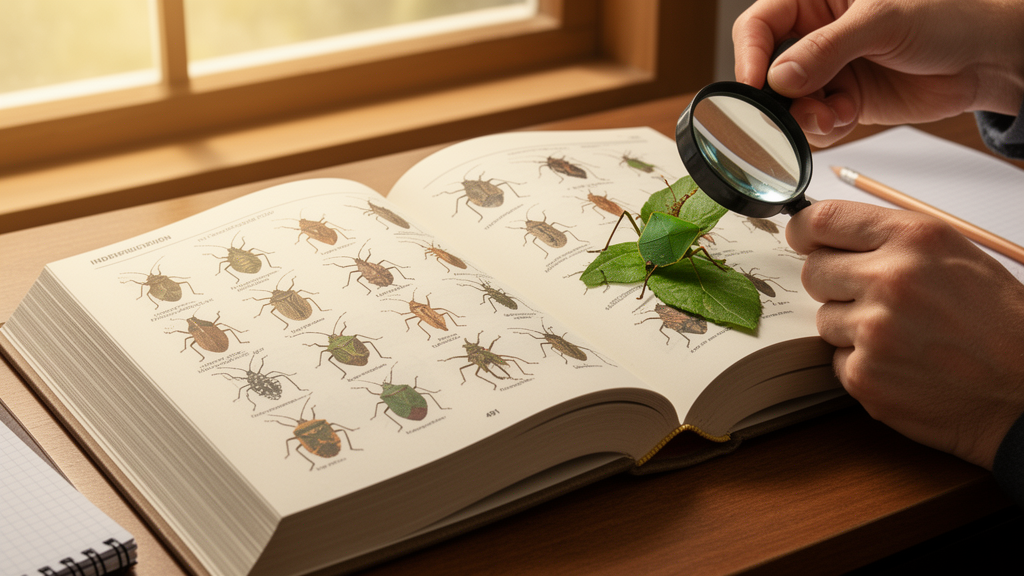
After nearly six decades, German entomology has finally closed one of its most stubborn gaps. The German fauna of true bugs — the insect order Heteroptera — comprises roughly 900 species, an assemblage so ecologically diverse that it includes numerous potential bioindicators and several species of real economic importance. Yet until recently, anyone attempting to identify these insects in Germany had to rely on a manual completed by Eduard Wagner in 1967, a work that had become seriously outdated over the intervening decades. That bottleneck has now been broken by a monumental new volume from Rolf Niedringhaus, Martin Stöckmann and the late Ekkehard Wachmann, published by WABV in Scheeßel in 2025, which for the first time makes it possible to identify every true bug species in the country down to species level.
The new book, whose German title translates as Heteroptera of Germany II: Identification Key to All Species, runs to 491 pages and builds directly on a predecessor published by the same team in 2020. That earlier volume provided a general introduction to the Heteroptera and their families, along with identification keys that stopped at the genus level. The sequel completes the project: it delivers dichotomous keys covering all of Germany’s true bug species, illustrated with mostly original drawings that depict the diagnostic characters needed to separate closely related taxa. For a group long hampered by the absence of up-to-date identification manuals, the arrival of a complete species-level treatment represents a genuine turning point.
One of the strongest features of the new volume is its visual documentation. The authors have assembled photographs of almost every German species of Heteroptera — living specimens wherever possible, and collection specimens in the case of rare species. Many nymphs are photographed as well, and these images are gathered into an appendix at the end of the volume. This photographic coverage is itself a major aid to identification, because it allows users to check whether the specimen in hand actually matches the species suggested by the key, rather than trusting a purely textual diagnosis. The combination of keys, drawings and photographs makes the book usable by a far broader audience than traditional taxonomic literature typically reaches.
Each species profile is rounded out with concise summaries of the insect’s ecology, distribution maps and phenological data — information on when during the year the species can be found in its various life stages. Taken together, these elements elevate the book beyond a simple identification manual into something closer to an encyclopaedia of German true bugs. For ecologists and environmental consultants, the ecological summaries and distribution maps are particularly valuable, since many Heteroptera serve as potential bioindicators whose presence or absence can signal the condition of a habitat. For naturalists, photographers and educators, the photographs and phenological data make the group accessible in a way that dense taxonomic prose never could.
The sheer physical size of the book could be seen as a hindrance for fieldwork — a 491-page volume is not something most researchers will casually slip into a pocket. But the authors turned that scale into an advantage. Because the book is large, the keys and pictures of several related species can be placed on the same page, which makes direct comparison between similar taxa far easier than flipping between distant sections. Anyone who has struggled to distinguish two lookalike species by shuffling between a key on one page and illustrations scattered elsewhere will appreciate how much friction this design choice removes.
The most obvious weakness of the work is that it is written in German only, which limits its immediate accessibility for the many readers outside Germany who might be interested in its content. The reviewer of the volume, Viktor Hartung, writing in the Deutsche Entomologische Zeitschrift, notes that in an era when machine translation tools are readily available on mobile phones, this may not be a very big hindrance in practice. A researcher in Poland or the Netherlands with a smartphone can now work through a German-language key with real-time translation assistance, something that would have been unthinkable when Wagner’s manual was the only option. Still, the language barrier remains a consideration for the international audience that a fauna of this scope inevitably deserves.
Hartung also points out that a manual of such scope will inevitably be worthy of minor improvements here and there — in diagnostic characters or in the keys themselves. This is a normal feature of any comprehensive taxonomic work: as more specimens are examined and more characters tested, small refinements accumulate. Such corrections do not diminish the achievement; they simply mark the starting point for the ongoing refinement that any living identification resource undergoes. The foundation laid by Niedringhaus, Stöckmann and Wachmann is solid enough that these future tweaks will be adjustments to a working system rather than repairs to a broken one.
The significance of the new volume extends well beyond Germany’s borders. By raising research on the true bugs of Germany to a new level, offering great help to experts and simultaneously lowering the entry barrier for beginners, the book gives hope that Heteroptera will become more popular objects of study in Germany and elsewhere in Europe in the future. A complete, well-illustrated, species-level fauna for one of Europe’s largest countries provides a reference point against which neighbouring countries can measure their own faunas, and a template for how a national true bug fauna should be documented. The ecological diversity of the group — with its bioindicators and economically important species — means that better identification tools translate directly into better environmental assessment.
The book also carries a poignant human dimension. Ekkehard Wachmann, one of its three authors, passed away in September 2023 while the new volume was still in preparation. Hartung’s review describes the completed work as a perfect memorial to Wachmann, whose lifelong commitment to the true bugs of Germany advanced the study of these insects like no other. The volume thus stands simultaneously as a technical milestone, a practical tool for a new generation of entomologists, and a tribute to a career devoted to making one of Europe’s most diverse insect orders knowable.
Subject of Research: Biodiversity and taxonomy
Article Title: Book review: Niedringhaus, R., Stöckmann, M. & Wachmann, E. (2025). Die Wanzen Deutschlands II: Bestimmungsschlüssel für alle Arten. [Heteroptera of Germany II: Identification key to all species.] (in German). WABV, Scheeßel, 491 S.
Article References: Hartung, V. (2026). Book review: Niedringhaus, R., Stöckmann, M. & Wachmann, E. (2025). Die Wanzen Deutschlands II: Bestimmungsschlüssel für alle Arten. [Heteroptera of Germany II: Identification key to all species.] (in German). WABV, Scheeßel, 491 S.. Deutsche Entomologische Zeitschrift, 73(1), 13-13. https://doi.org/10.3897/dez.73.180736
Image Credits: AI Generated
Keywords: Heteroptera, true bugs, identification key, German fauna, entomology, taxonomy, bioindicators, book review, Deutsche Entomologische Zeitschrift, species identification, ecology, Wachmann
Cite Scienmag News
Gavin Prescott. (October 17, 2026). New 491-page key finally lets anyone identify every true bug species in Germany. Scienmag. https://scienmag.com/new-491-page-key-finally-lets-anyone-identify-every-true-bug-species-in-germany/
Gavin Prescott. "New 491-page key finally lets anyone identify every true bug species in Germany." Scienmag, 17 October 2026, https://scienmag.com/new-491-page-key-finally-lets-anyone-identify-every-true-bug-species-in-germany/. Accessed 17 October 2026.
Gavin Prescott. "New 491-page key finally lets anyone identify every true bug species in Germany." Scienmag. October 17, 2026. https://scienmag.com/new-491-page-key-finally-lets-anyone-identify-every-true-bug-species-in-germany/


