


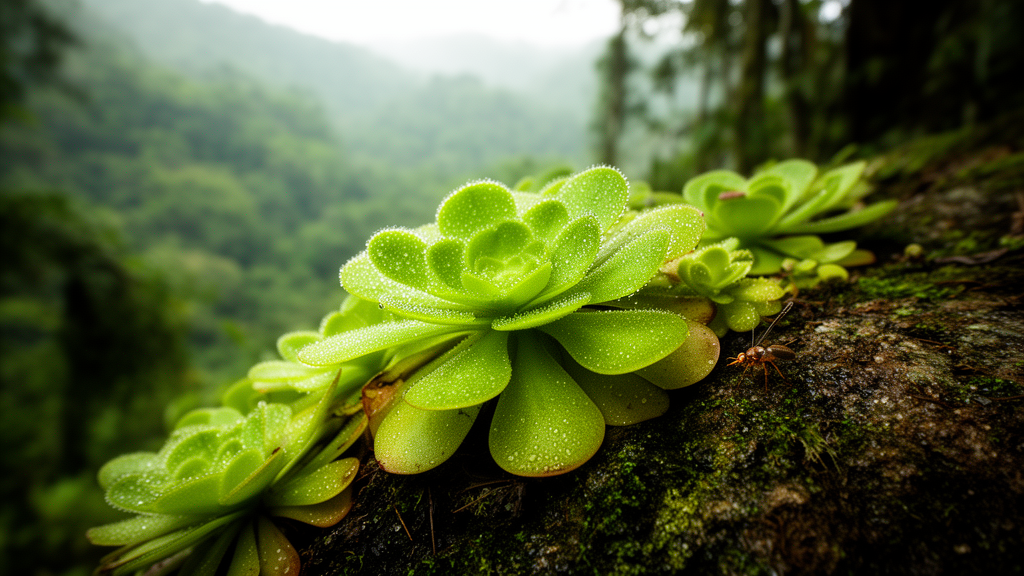
In March 2025, a field team working in Belize’s Mountain Pine Ridge Forest Reserve stumbled across something unexpected: two colonies of carnivorous butterworts, genus Pinguicula, growing on granite outcrops in the Maya Mountains of west-central Belize. The discovery, reported in the journal Neotropical Biology and Conservation, marks the first detailed description of the morphology and ecology of these carnivorous plants in the country. Before this report, the genus had been documented in Belize only twice, once through a specimen collected in 2013 and once through a single photograph posted online, and neither record included a formal account of what the plants looked like or where exactly they lived.
The two colonies were found on 11 March 2025 during an ornithological and geological field study, near sites called Pinol Sands and Privassion Creek, roughly 1.5 kilometers apart. The region is characterized by open pine forest growing on nutrient-poor, saprolitic granitic bedrock, an environment that suits carnivorous plants well because the soils hold few nutrients. The nearest known Pinguicula populations occur in the Sierra Madre regions of Mexico and Guatemala, some 200 to 300 kilometers away, making the presence of these colonies in Belize a significant biogeographic puzzle. To protect the plants from collection, the researchers disclosed only approximate locations in their publication.
Because the team lacked collecting permits, no specimens were taken. Instead, the descriptions rest entirely on field notes and photographic evidence, which the authors emphasize makes all conclusions exploratory. Some plants were accessible and photographed alongside a plastic ruler, allowing absolute measurements. Others grew on inaccessible cliffs, so their dimensions were estimated from photographs using nearby plants as an approximate scale. Relative dimensions, such as the leaf aspect ratio, defined as leaf length divided by width, were measured digitally from the images and supplemented with photographs published on the citizen science platform iNaturalist.
The Pinol Sands colony, at an elevation of about 400 meters, occupied a north-facing slope of a shallow ravine composed of weathered granite. The plants grew on ledges and in crevices where runoff concentrated, allowing localized accumulations of soil, moss, ferns, lichens, and even another carnivorous genus, bladderworts of the species Utricularia. The colony covered a restricted area of one to two square meters and consisted of three clusters plus several isolated individuals, with the densest cluster containing about five plants separated by one to ten centimeters. Intensive searching found no other colonies in the immediate vicinity.
The Pinol Sands plants form basal rosettes about four centimeters in diameter, built from overlapping whorls of three leaves. The leaves are circular to slightly obovate, pale green, and two to three centimeters long, with a sticky, leathery surface that traps small insects. They are less than one millimeter thick and translucent enough that guttation water droplets on their undersides can be seen from above. Each flower is about one centimeter long including the spur, borne singly on a vertical scape six to seven centimeters long. The corolla is lavender, with a two-lobed upper lip and a three-lobed lower lip, and the corolla tube carries thin purple striations outside and two pronounced dark purple streaks inside the throat.
The Privassion Creek colony presented a different picture. It grew on a nearly vertical, north-facing granite cliff about eight meters above a fast-moving river, at an elevation of roughly 384 meters. Because the river could not be crossed, observations were made with binoculars and telephoto lenses, complicating accurate measurements. The plants favored the wettest sections of the rock face, where dark brown to green algal biofilms streaked the granite and water dripped visibly down the surface. Five clusters, each containing four to six plants, grew on a small horizontal fracture in association with flowering Utricularia, ferns, and small grasses. A search of the accessible south-facing side of the canyon found no plants.
Structurally, the Privassion Creek plants resembled those at Pinol Sands, with circular to slightly obovate leaves about two centimeters long arranged in whorls to form basal rosettes, and flowers about one centimeter long on scapes six to eight centimeters long. The striking difference was floral color. The Privassion Creek flowers were completely white, with no hint of purple or any markings inside or outside the corolla tube. This contrast in flower color and pattern suggests the two colonies may represent either separate species or distinct morphs of a single species, a question that cannot yet be resolved.
To explore their affinities, the researchers compared the Belize plants with photographs of verified Pinguicula lilacina and Pinguicula sharpii from across their native ranges, measuring corolla color and pattern and leaf length-to-width ratios from 20 individual plants per species. These comparisons were supplemented with published descriptions from Casper and Kondo’s 1977 monograph and a dedicated hobbyist website. The results indicate that both Belize colonies belong most closely to the P. lilacina–P. sharpii complex, based on their circular to obovate leaves and elongated, tubular flowers with broad, nearly equidimensional petals. The Privassion Creek plants most closely match P. sharpii, which is characterized by whitish, unmarked flowers. The Pinol Sands plants, with their purple corolla and dark purple streaks inside and outside the flower tube, more closely resemble P. lilacina.
Yet subtle differences complicate a simple identification. The leaves of P. lilacina are slightly more oval than those of the Pinol Sands plants, with a distinctly greater leaf aspect ratio of 1.41 compared with 1.15 at Pinol Sands. P. lilacina also appears to carry more purple stripes at the top of the inner corolla tube, although the small flower sample in this study prevents determining whether that difference is robust. For Privassion Creek, the leaf aspect ratios matched those reported for P. sharpii, but published descriptions of P. sharpii report shorter scapes and smaller leaves than documented here, a discrepancy possibly explained by the fact that Casper and Kondo’s descriptions were based on cultivated specimens. Leaf aspect ratio may also vary with environmental conditions such as light exposure, season, and the availability of water and nutrients.
The biogeographic implications are considerable. The Maya Mountains have been geologically and topographically separated from the mountain ranges of Mexico and Guatemala since the early Tertiary period, so the presence of Pinguicula associated with the P. lilacina–P. sharpii complex in Belize must have resulted from dispersal. If the Privassion Creek plants are P. sharpii, dispersal occurred from the Sierra Madre of southeastern Mexico and Guatemala. If the Pinol Sands plants are P. lilacina, dispersal must have come from the Sierra Madre of central Mexico, a possibility made especially significant because the Isthmus of Tehuantepec serves as a robust barrier to east–west wind movement, acting primarily as a corridor for prevailing north–south winds. Determining whether the Belize plants are conspecific with the Mexican taxa or represent new species unique to the Maya Mountains will require detailed study of collected specimens, which remains beyond the scope of this preliminary investigation. The authors hope their findings encourage further systematic surveys for Pinguicula across Belize.
Subject of Research: Discovery and ecological description of Pinguicula butterworts in Belize
Article Title: Description of Pinguicula ( Lentibulariaceae ) in Belize: Discovery and ecological notes
Article References: Lee, H., & Lee, C.-T. (2026). Description of Pinguicula (Lentibulariaceae) in Belize: Discovery and ecological notes. Neotropical Biology and Conservation, 21(3), 261-270. https://doi.org/10.3897/neotropical.21.e190179
Image Credits: AI Generated
DOI: 10.3897/neotropical.21.e190179
Keywords: Pinguicula, butterworts, carnivorous plants, Belize, Maya Mountains, Lentibulariaceae, botany, Neotropical Biology and Conservation, Description, Discovery, ecological, notes
Cite Scienmag News
Gavin Prescott. (October 17, 2026). Carnivorous Butterworts Found Thriving in Belize’s Maya Mountains. Scienmag. https://scienmag.com/carnivorous-butterworts-found-thriving-in-belizes-maya-mountains/
Gavin Prescott. "Carnivorous Butterworts Found Thriving in Belize’s Maya Mountains." Scienmag, 17 October 2026, https://scienmag.com/carnivorous-butterworts-found-thriving-in-belizes-maya-mountains/. Accessed 17 October 2026.
Gavin Prescott. "Carnivorous Butterworts Found Thriving in Belize’s Maya Mountains." Scienmag. October 17, 2026. https://scienmag.com/carnivorous-butterworts-found-thriving-in-belizes-maya-mountains/


