


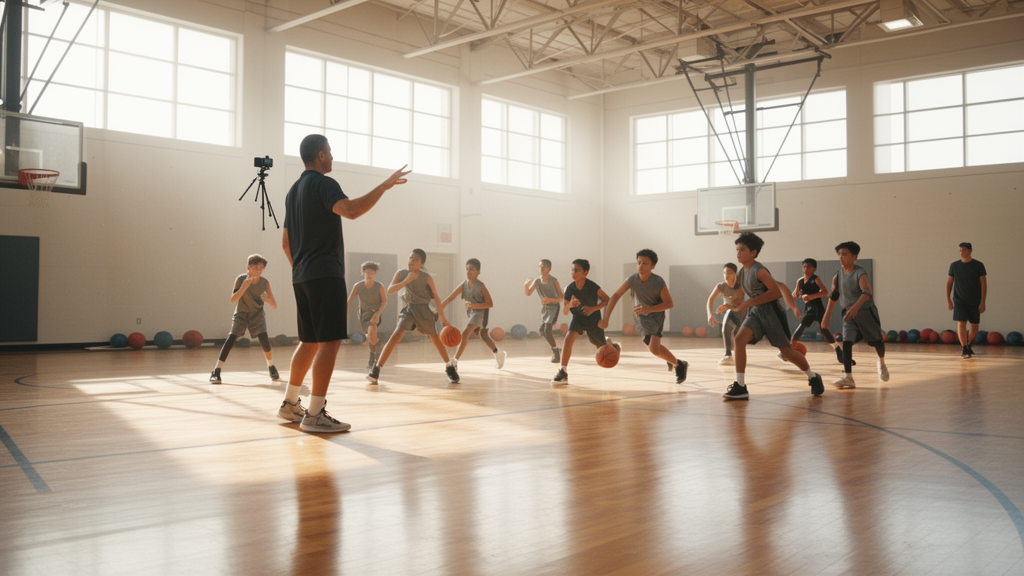
Every physical education teacher knows the moment: the demonstration ends, the practice begins, and somewhere in the crowd of moving students, attention quietly dissolves. In an indoor classroom, cameras and deep learning models have increasingly been used to spot such lapses, flagging who is listening and who is drifting. But the gymnasium, the playing field, and the outdoor practice session have remained largely invisible to this technology, even though the practice phase is where students actually convert instruction into skill. A research team at Yanshan University in Qinhuangdao, China, has now dragged computer vision into that blind spot, building a system that watches students practicing Baduanjin, a traditional Chinese qigong exercise, and translates what it sees into a quantitative score of teaching quality.
The study, published in the journal Multimedia Tools and Applications, was led by Lu Wang and Min Yang of the School of Physical Education, together with colleagues from the university’s information science and artificial intelligence schools. Their starting point was a gap in the literature: while deep learning has been successfully applied to identify students’ classroom behavior states indoors, providing an effective reflection of teaching quality, behavior recognition in outdoor settings such as physical education has been critically underexplored. That omission matters, the authors argue, because the practice stage is the phase in which students acquire knowledge and skills, and it is precisely the phase where a teacher’s organizational choices have their most visible effect on engagement.
At the heart of the system is YOLO11, the newest generation of the You Only Look Once family of object detectors, a lineage that has become one of computer vision’s workhorses since the original YOLO architecture emerged from the rich feature hierarchies pioneered by region-based detectors such as R-CNN, Fast R-CNN, and Faster R-CNN. YOLO models process an entire image in a single forward pass through a convolutional neural network, predicting bounding boxes and class probabilities simultaneously, which makes them fast enough for real-time video analysis. The Yanshan team trained YOLO11 to recognize categories of student behavior during the practice stage of Baduanjin classes in higher education institutions, constructing their dataset of student behaviors through a literature review method and direct observation of real classes.
The technical comparison at the core of the work pits YOLO11 against YOLOv8-p2, a variant of the previous YOLO generation that adds an extra small-object detection head, the P2 layer, designed to catch targets that occupy few pixels in the frame. That choice is telling: in an outdoor practice session, students spread across a wide area, bodies rotate through qigong postures, and the camera may capture them at oblique angles and distances where individual behavioral cues shrink to a handful of pixels. Small-object detection is exactly where such systems live or die, and the team evaluated both models’ detection performance to develop a recognition model for student behaviors during the practice stage.
The headline result is a model that is not only accurate but stable. Across three training runs with different random seeds, YOLO11 achieved an average mean average precision, or mAP, of 0.932 with a standard deviation of 0.016. The random-seed protocol is a quiet but important piece of rigor: deep learning training is stochastic, and a single lucky run can flatter a model that collapses on retraining. By averaging over seeds, the authors demonstrated relatively stable recognition performance, suggesting the model’s accuracy reflects genuine learning of behavioral patterns rather than an artifact of initialization. An mAP above 0.93 means the detector locates and classifies the vast majority of behavior instances correctly across the confidence thresholds used in evaluation.
But detection alone was never the destination. The team’s second act used the literature review method and the expert interview method to establish a four-level evaluation standard built on two key indicators: the proportion of problem behaviors and the proportion of ambiguous behaviors among detected instances. Problem behaviors are those that clearly signal disengagement or disruption, while ambiguous behaviors are harder to classify, the fidgets and partial postures that resist neat labels. By weighting these proportions, the researchers constructed a quantitative evaluation model for assessing teachers’ teaching effectiveness, converting a stream of bounding boxes into a graded verdict on how well a class session is going. The evaluation model proved effective in enabling precise quantification of teaching quality, the authors report.
The final act of the study is the one with the most immediate consequence for teachers. The researchers conducted interviews to analyze the causes behind the observed student behaviors and proposed countermeasures, closing the loop between what the camera sees and what the teacher can do. This contributes, they write, to optimizing teaching objectives, enhancing teaching evaluations, refining teaching organization, and ultimately promoting greater student engagement in classroom activities. In practical terms, a teaching management department no longer needs to rely on a supervisor’s subjective impression of a gymnasium session; it can receive a data-driven, quantitative assessment of teaching quality grounded in the actual behavior of every student in frame.
The context around this work is a rapidly maturing field. The bibliography traces the arc from Girshick’s 2014 rich feature hierarchies through Faster R-CNN’s real-time region proposals to a decade of classroom-focused applications: improved YOLOv8 variants for student behavior detection in Sensors, multi-view classroom behavior recognition for attention assessment in IET Computer Vision, intelligent student behavior analysis systems presented at IEEE ICASSP, and deep learning evaluations of students’ classroom behavioral states. Related Yanshan work includes E2E-MFERC, a multi-face expression recognition model for group emotion assessment, showing the group has been building a family of tools that read collective human states from video. YOLO11 itself is already spreading beyond classrooms, with recent variants detecting tomato maturity in agriculture, a reminder that the same detector family now grades both qigong postures and crop ripeness.
Why Baduanjin, of all activities? The choice is strategic. Baduanjin, the Eight Section Brocade, is a slow, structured qigong routine widely taught in Chinese higher education as part of public physical education, and it is funded here through a Yanshan University Teaching Research and Reform Project on student classroom behavior evaluation for public PE courses based on deep learning. Its postures are standardized enough that correct and incorrect practice are visually distinguishable, yet the practice stage demands sustained individual engagement, making behavioral participation a meaningful proxy for learning. A model that can score engagement in such a setting can plausibly generalize to other structured physical activities, from tai chi to drill practice, wherever students move in view of a camera.
The broader implications reach into the ethics and architecture of automated teaching evaluation. The authors are careful to position the system as support for teaching management departments rather than as a surveillance instrument over students, and the evaluation model’s four-level standard is designed to be interpretable, anchored in expert interviews rather than an opaque score. Still, the trajectory is unmistakable: the same detection pipeline that flags a distracted student in a Baduanjin session could, in principle, quantify participation in any practice-based course, from fluid mechanics experiments to flipped classrooms in medical imaging, both of which appear in the study’s cited literature as domains where teaching quality evaluation has been constructed and practiced. As computer vision’s mAP numbers climb past 0.93 and its seeds hold steady, the gymnasium joins the lecture hall as a measurable space, and the question shifts from whether machines can see classroom behavior to how teachers, administrators, and students will use what they see.
Subject of Research: Constructing the evaluation model of students’ behaviors participation and analysing the teaching strategies for physical education class based on YOLO11
Article Title: Constructing the evaluation model of students’ behaviors participation and analysing the teaching strategies for physical education class based on YOLO11
Article References: Wang, L., Yang, M., Tan, A., Kang, H., Zhang, L., & Ren, Z. (2026). Constructing the evaluation model of students’ behaviors participation and analysing the teaching strategies for physical education class based on YOLO11. Multimedia Tools and Applications, 85(11), Article 813. https://doi.org/10.1007/s11042-026-21966-4
Image Credits: AI Generated
DOI: 10.1007/s11042-026-21966-4
Keywords: Constructing, evaluation, model, students, behaviors, participation, analysing, teaching, strategies, physical, education, class
Cite Scienmag News
Courtney Benton. (October 17, 2026). Constructing the evaluation model of students’ behaviors participation and analysing the teaching strategies for physical education class based on YOLO11. Scienmag. https://scienmag.com/constructing-the-evaluation-model-of-students-behaviors-participation-and-analysing-the-teaching-strategies-for-physical-education-class-based-on-yolo11/
Courtney Benton. "Constructing the evaluation model of students’ behaviors participation and analysing the teaching strategies for physical education class based on YOLO11." Scienmag, 17 October 2026, https://scienmag.com/constructing-the-evaluation-model-of-students-behaviors-participation-and-analysing-the-teaching-strategies-for-physical-education-class-based-on-yolo11/. Accessed 17 October 2026.
Courtney Benton. "Constructing the evaluation model of students’ behaviors participation and analysing the teaching strategies for physical education class based on YOLO11." Scienmag. October 17, 2026. https://scienmag.com/constructing-the-evaluation-model-of-students-behaviors-participation-and-analysing-the-teaching-strategies-for-physical-education-class-based-on-yolo11/


