


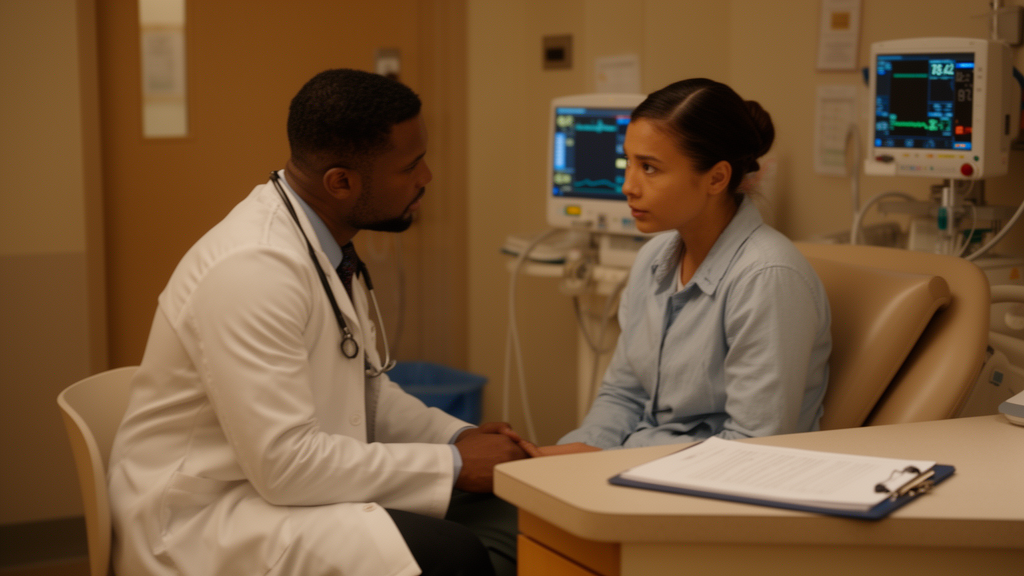
Every day, emergency departments around the world admit patients with psychiatric complaints—suicidal thoughts, agitation, psychosis, or overwhelming anxiety—and immediately face a question that has divided two medical specialties for decades: how much medical testing does this patient actually need? Emergency physicians worry about missing a hidden medical illness masquerading as a psychiatric crisis. Psychiatrists worry about unnecessary blood draws, CT scans, and hours of waiting that delay the mental health care their patients desperately need. Now, an international team of researchers has done something rarely achieved in this contested corner of medicine: they have built a consensus-based medical screening tool, agreed upon by both specialties and by patients themselves, published in BMC Medicine.
The study, led by Luca Ünlü of the University Hospital Basel and University Medical Center Freiburg, together with Christian H. Nickel and a transdisciplinary steering committee spanning emergency medicine and psychiatry on four continents, used a modified Delphi process—a structured method for building consensus among experts who rarely see eye to eye. Between May and November 2025, the team ran four rounds of online surveys and steering committee discussions. The participants were not a random sample of clinicians: they were 25 official representatives from seven emergency medicine and psychiatry societies, including the European Society for Emergency Medicine, the American Association of Emergency Psychiatry, the Australasian College for Emergency Medicine, the Brazilian Association for Emergency Medicine, the Dutch Acute Medicine Society, the German Association for Psychiatry, Psychotherapy and Psychosomatics, and the Coalition on Psychiatric Emergencies. Crucially, the panel also included six patient representatives with prior experience of emergency department medical screening, either as patients or as relatives of patients, recruited with help from the National Alliance on Mental Illness and the Italian advocacy network E.N.E.A.
The technical logic of the Delphi method is what makes this result notable. In the first round, participants freely generated candidate screening elements: 91 statements came from the society representatives and 27 from the patient representatives. In the second round, the panel rated and refined these statements, merging overlapping items and sharpening ambiguous wording. The third round applied a predefined consensus threshold: a statement would only survive if at least 80 percent of participants agreed with it. That threshold proved demanding. Only 48 of the 91 society statements—52.8 percent—reached consensus, while 21 of the 27 patient statements—77.8 percent—cleared the bar. The surviving items were then synthesized into a single instrument, the Delphi-Informed Medical Evaluation, or DIME, tool.
Retention rates across the rounds were high for a Delphi study of this scale. Of 28 invited society representatives and steering committee members, 25—89.3 percent—participated in the first round, 23 in the second, 22 in the third, and 23 in the fourth. All six patient representatives completed every round, a detail the authors highlight as evidence that the patient perspective was not a token gesture but a sustained contribution throughout the process. The study was registered with ClinicalTrials.gov under identifier NCT06936826, and the consensus process followed the ACCORD—ACcurate COnsensus Reporting Document—guidance, a framework designed to make consensus methods transparent and reproducible rather than a black box of expert opinion.
The fourth round served as the tool’s first stress test. Rather than asking participants whether they liked the DIME tool in the abstract, the researchers confronted them with 37 standardized clinical vignettes—short, structured descriptions of hypothetical emergency department patients with psychiatric complaints. Each participant independently applied the draft tool to every vignette and decided which screening elements it called for. The researchers then measured how often the raters agreed with one another using Gwet’s agreement coefficient, a statistical measure of interrater agreement that is more robust than simple percentage agreement when agreement is high, because it corrects for agreement that would occur by chance alone.
The numbers tell a striking story. Among the society representatives, applying the DIME tool to the 37 vignettes produced a Gwet agreement coefficient of 0.86, with a 95 percent confidence interval of 0.78 to 0.93 and a p-value below 0.001—a level the authors characterize as almost perfect agreement. Among the patient representatives, the coefficient was 0.76, with a confidence interval of 0.66 to 0.86 and the same p-value below 0.001, corresponding to substantial agreement. In practical terms, this means that when clinicians and patients from different countries, cultures, and professional traditions applied the same tool to the same hypothetical patient, they overwhelmingly reached the same conclusions about what medical screening was warranted. For a process that has historically generated more conflict than consensus, that level of agreement is remarkable.
The background problem the DIME tool addresses is well documented in the emergency medicine literature. Medical screening in the emergency department is performed to identify underlying medical conditions that may contribute to a patient’s psychiatric presentation or require treatment in their own right—think of delirium caused by an infection, agitation driven by intoxication, or psychosis secondary to a brain lesion. But the objectives and appropriate scope of this screening have never been standardized. Emergency physicians and psychiatrists frequently disagree about which tests are necessary, and the consequences are measurable: potentially unnecessary testing, prolonged emergency department length of stay, and increased costs. Patients with psychiatric complaints often wait longest, undergo the most redundant workups, and receive the least consistent evaluation. The DIME tool is designed to identify adult emergency department patients with psychiatric complaints who are at low risk for acute medical illness—effectively giving both specialties a shared, explicit framework for deciding when enough is enough.
The inclusion of patient voices is one of the study’s most distinctive technical features. Patient and public involvement has become an increasingly formalized element of health research, with reporting frameworks such as GRIPP2-SF—the Guidance for Reporting Involvement of Patients and the Public 2 Short Form—used to document how lay perspectives shaped the work. In this study, the patient representatives did not merely comment on a finished product; they generated their own statements in the first round, and those statements survived the 80 percent consensus threshold at a higher rate than the professional statements did. The synthesis of both streams of statements into the final tool means the DIME instrument reflects what patients consider important about being medically screened, not only what specialists consider defensible. The authors note that the patient perspective was incorporated with assistance from the National Alliance on Mental Illness and E.N.E.A., an organization of experts by experience based in Rome.
The authorship itself illustrates the transdisciplinary ambition. The panel includes figures such as Christopher R. Carpenter of the Mayo Clinic, Philipp Sterzer of the University of Basel’s Department of Psychiatry, Judith Tintinalli of the University of North Carolina, a towering name in emergency medicine education, and Michael P. Wilson of Virginia Tech-Carilion, whose work spans both emergency medicine and psychiatry. The DIME study group extends the effort to clinicians in New Zealand, Brazil, Australia, Spain, France, the Netherlands, the United Kingdom, and the United States. The work was funded by scientific funds of the Emergency Department of the University Hospital Basel, with open access funding provided by the University of Basel, and the article is published under a Creative Commons Attribution 4.0 license, making the tool freely available to any department that wants to examine it.
The authors are careful about what this study does and does not establish. The DIME tool is a consensus-based instrument, evidence-informed but not yet validated: it has not been tested against real patients, real outcomes, or real emergency department workflows. The researchers state explicitly that prospective multicenter validation studies are required before clinical implementation. That caveat matters, because a tool that performs well on paper vignettes among motivated expert raters may behave differently in a crowded department at three in the morning, applied by a tired resident to a frightened and agitated patient. Still, the study delivers something the field has lacked: a single, internationally agreed framework, endorsed by emergency physicians, psychiatrists, and patients on four continents, for deciding which adult psychiatric emergency patients need what medical evaluation. If prospective validation confirms its safety, the DIME tool could shorten waits, cut unnecessary testing, and—perhaps most importantly—end the turf war that has too often stood between psychiatric patients and the care they came for.
Subject of Research: Emergency Medicine
Article Title: International Delphi on a medical screening tool for emergency department patients with psychiatric complaints
Article References: Ünlü, L., Carpenter, C. R., Sterzer, P., Christ, M., Azad, N., Griese, J. A., Nordstrom, K., Skinner, C., Alsma, J., Stiebel, V., Kurzhals, S., Pascoe, E., Brister, T., van der Eycken, E., Maia, I. W. A., Tintinalli, J., Bingisser, R., Wilson, M. P., Nickel, C. H., … Zun, L. S. (2026). International Delphi on a medical screening tool for emergency department patients with psychiatric complaints. BMC Medicine. https://doi.org/10.1186/s12916-026-05324-7
Image Credits: AI Generated
DOI: 10.1186/s12916-026-05324-7
Keywords: emergency department, medical screening, psychiatric complaints, Delphi study, consensus, DIME tool, emergency medicine, psychiatry, patient involvement, BMC Medicine, International, Delphi
Cite Scienmag News
Glenn Wilkins. (October 17, 2026). Doctors and Patients Reach Rare Consensus on Screening Psychiatric Emergency Patients. Scienmag. https://scienmag.com/doctors-and-patients-reach-rare-consensus-on-screening-psychiatric-emergency-patients/
Glenn Wilkins. "Doctors and Patients Reach Rare Consensus on Screening Psychiatric Emergency Patients." Scienmag, 17 October 2026, https://scienmag.com/doctors-and-patients-reach-rare-consensus-on-screening-psychiatric-emergency-patients/. Accessed 17 October 2026.
Glenn Wilkins. "Doctors and Patients Reach Rare Consensus on Screening Psychiatric Emergency Patients." Scienmag. October 17, 2026. https://scienmag.com/doctors-and-patients-reach-rare-consensus-on-screening-psychiatric-emergency-patients/


