


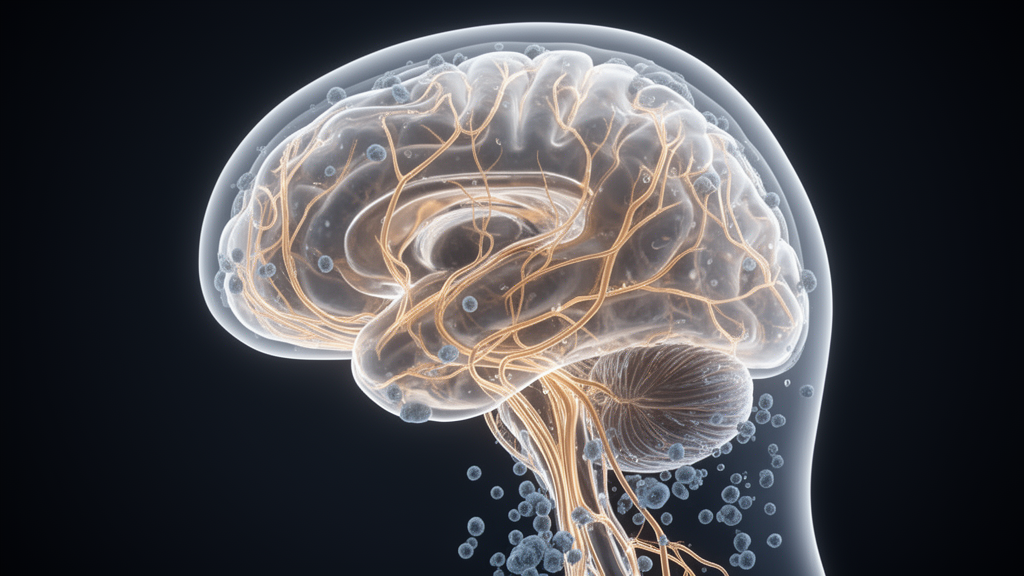
Scientists have long known that people with internet gaming disorder often sleep badly, but the biological reason why has remained murky. Now a team of researchers in China has uncovered a striking clue: young people with the condition show measurable weakening of the brain’s waste-clearance plumbing, along with a less efficient wiring of the neural networks that carry information across the cortex. The findings, published in Frontiers in Psychiatry, connect three threads that had never been woven together before — sleep quality, the brain’s glymphatic system, and the global efficiency of functional brain networks.
The study, led by Longyao Ma and colleagues at the First Affiliated Hospital of Zhengzhou University, recruited 66 adolescents and young adults diagnosed with internet gaming disorder according to DSM-5 criteria, together with 35 age-, sex-, and education-matched healthy controls. Every participant underwent magnetic resonance imaging on a 3-Tesla scanner and completed a battery of clinical assessments, including the Pittsburgh Sleep Quality Index, the Hamilton Anxiety Scale, and the Hamilton Depression Scale. The researchers then split the patient group into those with elevated sleep-disturbance symptoms and those without, using a PSQI cutoff of 7.
The centerpiece of the imaging work was a relatively new technique called diffusion tensor image analysis along the perivascular space, or DTI-ALPS. The method quantifies how freely water molecules diffuse along the perivascular channels that run alongside projection and association fiber tracts near the lateral ventricles — channels thought to carry cerebrospinal fluid deep into brain tissue and flush metabolic waste back out. Because this exchange, mediated by the aquaporin-4 water channels on astrocytes, ramps up dramatically during sleep, the ALPS index has become a popular indirect window onto glymphatic function in living humans.
In this study, an experienced neuroradiologist placed four small 5-millimeter regions of interest on color-coded fractional anisotropy maps at the level of the lateral ventricle, extracting diffusivity along the x, y, and z axes to compute the index for each hemisphere. The result was unambiguous: patients with internet gaming disorder had a mean ALPS index of 1.305, compared with 1.565 in healthy controls — a difference so large it accounted for roughly 64 percent of the variance between groups, and it held for both hemispheres independently.
The researchers also turned to resting-state functional MRI and graph theory, a branch of mathematics that treats the brain as a network of 246 nodes connected by edges of varying strength. Using the Brainnetome atlas and a range of network thresholds, they computed global efficiency, a measure of how quickly information can travel between any two regions, as well as local efficiency and small-world organization. Once again the patient group fell short: global efficiency was significantly reduced, while local efficiency and small-worldness were preserved, suggesting a selective rather than wholesale breakdown of network architecture.
The correlations with clinical symptoms were equally telling. Within the patient group, lower ALPS index values tracked with worse sleep quality, higher anxiety scores, and higher depression scores, with the strongest link to the sleep measure. Global efficiency also correlated negatively with sleep quality. Because depression, anxiety, and sleep problems are so tightly intertwined, the team checked for statistical collinearity and then reran the analyses after excluding participants with clinically meaningful depressive or anxious symptoms — the group differences in both the ALPS index and global efficiency survived intact.
Perhaps the most intriguing result came from a mediation analysis, an exploratory statistical test of whether one variable helps explain the relationship between two others. The analysis suggested that the ALPS index partially mediated the association between reduced global network efficiency and poor sleep quality, accounting for roughly 39 percent of the indirect effect. In other words, the data are consistent with a pathway in which impaired brain networks relate to weakened glymphatic diffusivity, which in turn relates to worse sleep — though the authors are careful to stress that the cross-sectional design forbids any causal reading.
The team also explored whether the ALPS index could distinguish patients with sleep disturbance from those without. In a receiver operating characteristic analysis, the index achieved an area under the curve of 0.89, with a cutoff of 1.32 yielding 80 percent sensitivity and 91 percent specificity. That is respectable discrimination, but the authors caution that the cutoff was derived and tested in the same sample, so its diagnostic value and generalizability remain unproven.
What might drive the reduced ALPS index in the first place? The researchers point to a plausible but still untested chain: chronic stress in gaming disorder can dysregulate the hypothalamic-pituitary-adrenal axis, raising inflammatory signals such as interleukin-6, which animal work has shown can disrupt aquaporin-4 expression and polarization in astrocytes. Damaged aquaporin-4, in turn, would slow the fluid exchange the glymphatic system depends on. The authors emphasize that they did not directly measure cortisol, inflammatory markers, or aquaporin-4, so this hypothesis remains speculative pending future biomarker studies.
There are important caveats. The DTI-ALPS index is an indirect measure, and its leading developers have recently urged that it be treated as a composite biomarker reflecting white-matter microstructure, extracellular environment, and vascular geometry rather than a direct gauge of glymphatic clearance. Sleep quality was assessed by self-report rather than polysomnography, the sample was modest, and the manual placement of regions of interest limits reproducibility estimates. Still, the study opens a genuinely new line of investigation: if future longitudinal work confirms that improving sleep restores glymphatic diffusivity and network efficiency in gaming disorder, sleep could become a therapeutic target rather than a mere symptom — a possibility the authors say now deserves rigorous testing.
Subject of Research: Glymphatic system dysfunction and brain network efficiency in internet gaming disorder
Article Title: Sleep disturbance is associated with reduced DTI-ALPS index and altered functional-network efficiency in internet gaming disorder
Article References: Ma, L., Mei, B., Zhang, M., Li, W., Wang, X., Tian, J., Zhang, H., Lang, Y., Lv, Q., Wei, Y., Han, S., & Zhang, Y. (2026). Sleep disturbance is associated with reduced DTI-ALPS index and altered functional-network efficiency in internet gaming disorder. Frontiers in Psychiatry, 17, Article 1892235. https://doi.org/10.3389/fpsyt.2026.1892235
Image Credits: AI Generated
DOI: 10.3389/fpsyt.2026.1892235
Keywords: internet gaming disorder, glymphatic system, DTI-ALPS, sleep disturbance, graph theory, resting-state fMRI, brain network efficiency, aquaporin-4, mediation analysis, adolescents, Frontiers in Psychiatry, Sleep
Cite Scienmag News
Cassandra Pierce. (October 17, 2026). Gaming Disorder Linked to Weakened Brain Waste Clearance and Slower Neural Networks. Scienmag. https://scienmag.com/gaming-disorder-linked-to-weakened-brain-waste-clearance-and-slower-neural-networks/
Cassandra Pierce. "Gaming Disorder Linked to Weakened Brain Waste Clearance and Slower Neural Networks." Scienmag, 17 October 2026, https://scienmag.com/gaming-disorder-linked-to-weakened-brain-waste-clearance-and-slower-neural-networks/. Accessed 17 October 2026.
Cassandra Pierce. "Gaming Disorder Linked to Weakened Brain Waste Clearance and Slower Neural Networks." Scienmag. October 17, 2026. https://scienmag.com/gaming-disorder-linked-to-weakened-brain-waste-clearance-and-slower-neural-networks/


