


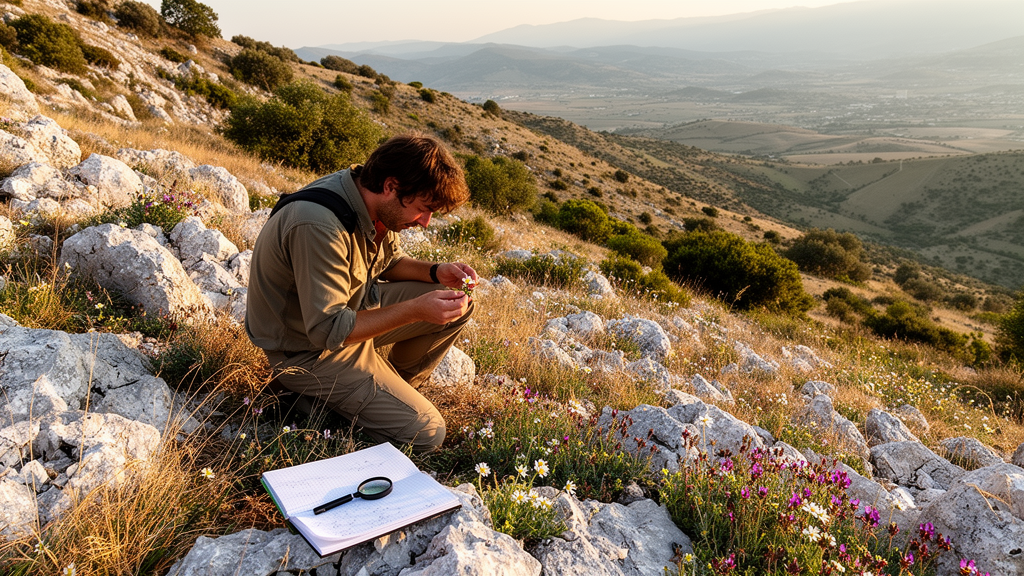
Two modest limestone hill systems north of Naples, largely ignored by botanists for more than a century, have turned out to harbor a surprisingly rich vascular flora, including 18 species found nowhere else in the world outside Italy, six species never before recorded in the region of Campania, and 47 species assessed for the IUCN Red List of the Italian flora. The findings come from an intensive collaborative survey of the Tifatini and Trebulani Mountains, published in Italian Botanist, and they underline how much plant diversity can still hide in landscapes that most researchers consider too ordinary to study.
The vascular flora of the two hill systems was essentially unknown before this project. Most of the available records dated back to the nineteenth-century work of Michele Tenore and Nicola Terracciano, with a handful of early twentieth-century contributions by Loreto Grande. For a country that ranks second only to Turkey in native plant diversity in the Mediterranean Basin, such gaps at the subregional scale are striking. Italy’s native vascular flora currently comprises 8,241 species and subspecies in 1,111 genera and 153 families, to which another 1,782 alien taxa must be added. Yet local floristic studies, which provide the essential data for tracking diversity, detecting change over time, and identifying species worth protecting, remain scarce in many areas.
The survey was organized within the framework of the Working Group for Floristics, Systematics and Evolution of the Italian Botanical Society, which has conducted annual collaborative botanical explorations since 2003. For this study, the team focused on two hilly-mountain systems in the Campanian Anti-Apennines: the Tifatini, covering roughly 80 square kilometers with peaks at Mt. Virgo (620 meters) and Mt. Tifata (603 meters), and the larger Trebulani, spanning about 180 square kilometers and culminating at Mt. Maggiore with Pizzo San Salvatore (1,037 meters). Both complexes consist of Cretaceous limestones and are separated by the Volturno River. The Tifatini are famous among geologists for their karst collapse sinkholes, locally called Comole, including the Comola grande near Castel Morrone, considered one of the largest in Italy.
The climate of the study area is temperate oceanic sub-Mediterranean, with a Mediterranean-type rainfall pattern: mean annual precipitation of 1,038 millimeters concentrated in autumn and winter, an annual average temperature of 15.6 degrees Celsius, and a two-month summer drought. The soils are dominated by Andisols derived from pyroclastic deposits linked to the volcanic activity of the Phlegraean Fields and Vesuvius, which cover the limestone reliefs in shallow, skeleton-rich profiles. Inceptisols occur only along the Volturno River. Vegetation ranges from holm oak and thermophilous downy oak forests to hop-hornbeam submontane mixed woods, with extensive secondary grasslands, scrub communities, and steppe-like grasslands shaped by deforestation and traditional land use. Four Special Areas of Conservation fall within the study area, protecting sites such as Monte Tifata, Bosco di S. Silvestro, and the Catena di Monte Maggiore.
Field sampling adopted an opportunistic approach based on the so-called botanist’s algorithm, pre-selecting 22 sites considered representative of the local environmental diversity in terms of physiography, climate, soil, elevation, and land use. Eleven sites were chosen on each hill system, covering 6.91 square kilometers in the Tifatini and 7.56 square kilometers in the Trebulani. The sites were intensively surveyed between 3 and 6 May 2017 by a team of 31 botanists, each collecting independently with the aim of obtaining at least one specimen of every taxonomically identifiable species in each system. Additional surveys were carried out by one of the organizers between 2015 and 2023. The result was a dataset of 4,123 herbarium specimens, of which 3,987, about 96 percent, could be identified: 2,623 from the Tifatini and 1,364 from the Trebulani.
The workflow involved a technically rigorous review process. Each participant first identified their specimens using standard floras and taxonomic references, then compiled a partial floristic list in a pre-established format. Merging all partial lists produced a provisional total of 4,123 specimens, and critical analysis flagged 1,705 specimens whose identification was uncertain or required verification. These critical specimens were revised during a dedicated workshop held in Caserta in March 2018, and 103 specimens belonging to notoriously difficult groups, including Asplenium, Polypodium, Myosotis, Orobanche, Phelipanche, and Ornithogalum, were sent to specialists for further revision. All identified exsiccata were deposited in public and private herbaria across Italy, with more than 25 percent in the Herbarium Austroitalicum in Caserta.
The final list documented 706 species and subspecies, including five hybrids, belonging to 121 families: 14 ferns and fern allies, one gymnosperm, and 691 angiosperms. The Tifatini yielded 591 species, while 369 were recorded in the Trebulani. The team suggests that the difference in species richness may partly reflect unequal sampling effort, since the 2017 excursion devoted only its last two days to the Trebulani, consistent with species accumulation theory and the natural saturation of species detection during surveys. The recorded flora includes 18 Italian endemics, 42 alien species, three cryptogenic species for Campania, and 47 species on the IUCN Red List, all assessed as least concern except five data-deficient taxa.
Among the most significant discoveries are six species new to the regional flora of Campania, five of them found only on the Tifatini: Lysimachia loeflingii, Nassella neesiana, Phelipanche schultzii, Poa angustifolia, Valerianella pumila, and Ulmus minor subsp. canescens, the last also confirmed on the Trebulani. Five further taxa were confirmed for Campania, including Allium guttatum subsp. sardoum, Carex praecox, and Lathyrus inconspicuus. One record carries a remarkable historical echo: the Gastridium phleoides specimen collected on the Tifatini confirms a collection made by Loreto Grande almost a century earlier, in July 1927. The phytogeographically most significant native find is Cymbalaria glutinosa subsp. brevicalcarata, a rare endemic subspecies restricted to Campania, whose confirmation on the Trebulani and new record on the Tifatini extend its known range. Also noteworthy is Globularia cordifolia subsp. neapolitana, whose global distribution is limited to a few localities in the Lattari Mountains, Capri, the Picentini Mountains, and Mt. Camposauro.
The non-native flora tells a story of human pressure. Of the 42 alien species documented, 26 are neophytes and nine are considered invasive in the study area and in Campania, including Ailanthus altissima, Robinia pseudoacacia, Oxalis pes-caprae, and Veronica persica. Only two, Ailanthus altissima and Broussonetia papyrifera, are on the European Union list of invasive alien species of Union concern. The higher number of aliens on the Tifatini, 40 versus 8 on the Trebulani, reflects the intensity of anthropogenic disturbance there: the Tifatini are embedded in a highly urbanized landscape of agricultural land use, infrastructure, and fire disturbance, consistent with the documented urban sprawl of the province of Caserta. Interestingly, two Mediterranean natives, the European fan palm Chamaerops humilis and Sulla coronaria, are cultivated in the area, so their recorded populations likely spread from nearby gardens and count as non-native.
The survey also exposed taxonomic puzzles that will keep botanists busy. Four putative hybrids within the Quercus pubescens complex showed morphological characteristics intermediate between downy oak and other white oak species, suggesting introgressive hybridization. Several other groups, including the Bromus hordeaceus, Cerastium brachypetalum, Carex flacca, Micromeria graeca, and Pilosella piloselloides complexes, revealed that current taxonomic treatments allow different subspecies to coexist in the same habitats, suggesting the framework does not reflect the modern concept of subspecies. The authors emphasize that the data provide an essential baseline for conservation and sustainable management of these landscapes, and that collaborative botany, bringing dozens of specialists together for a few intense days of fieldwork, is a powerful model for closing the knowledge gaps that still persist across the Mediterranean biodiversity hotspot.
Subject of Research: A floristic survey of the Tifatini and Trebulani Mountains, southern Italy
Article Title: A floristic survey of the Tifatini and Trebulani Mountains, southern Italy
Article References: Stinca, A., Banfi, E., Bartolucci, F., Bonari, G., Cancellieri, L., Caruso, G., Cennamo, G. D., Conti, F., D'Auria, G., Di Pietro, R., Fascetti, S., Fortini, P., Galasso, G., Iberite, M., Lattanzi, E., Lucchese, F., Montepaone, G., Musarella, C. M., Pennesi, R., … Esposito, A. (2026). A floristic survey of the Tifatini and Trebulani Mountains, southern Italy. Italian Botanist, 22, 17-49. https://doi.org/10.3897/italianbotanist.22.189945
Image Credits: AI Generated
DOI: 10.3897/italianbotanist.22.189945
Keywords: floristic, survey, Tifatini, Trebulani, Mountains, southern, Italy, scientific research
Cite Scienmag News
Margaret Porter. (October 17, 2026). Forgotten limestone hills of southern Italy yield 706 plant species and six regional firsts. Scienmag. https://scienmag.com/forgotten-limestone-hills-of-southern-italy-yield-706-plant-species-and-six-regional-firsts/
Margaret Porter. "Forgotten limestone hills of southern Italy yield 706 plant species and six regional firsts." Scienmag, 17 October 2026, https://scienmag.com/forgotten-limestone-hills-of-southern-italy-yield-706-plant-species-and-six-regional-firsts/. Accessed 17 October 2026.
Margaret Porter. "Forgotten limestone hills of southern Italy yield 706 plant species and six regional firsts." Scienmag. October 17, 2026. https://scienmag.com/forgotten-limestone-hills-of-southern-italy-yield-706-plant-species-and-six-regional-firsts/


