


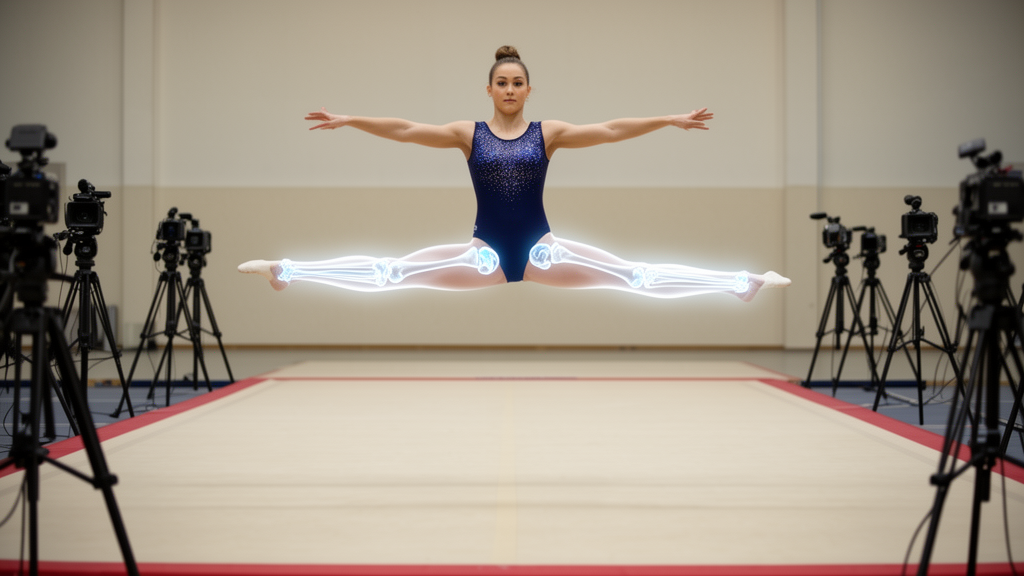
Artistic gymnastics has long lived with a paradox at the heart of its scoring. The sport rewards extraordinary flexibility and split positions executed at speed, yet the judges who assign those scores must assess them with the naked eye, in real time, from a fixed vantage point. A new validation study published in Scientific Reports offers the strongest quantitative answer yet to a question that has quietly shaped the sport’s technological future: can a camera-based, markerless judging support system measure a gymnast’s body positions as accurately as the laboratory-grade 3D motion analysis systems that researchers consider the gold standard?
The research, led by Misato Ishikawa of Juntendo University’s Graduate School of Health and Sports Science together with colleagues from Juntendo University, International Pacific University, Kobe Shinwa University and Fujitsu, evaluated the Judging Support System, or JSS, a markerless motion analysis system developed for use in artistic gymnastics. Rather than relying on reflective markers attached to an athlete’s body, the JSS derives joint positions directly from video imagery, a crucial advantage in a competition environment where attaching hardware to athletes is impractical and intrusive. The team benchmarked the system against VICON, an optical motion capture platform widely regarded in biomechanics as the reference standard for three-dimensional kinematic measurement.
The experimental design was elegantly direct. Nine female collegiate artistic gymnasts performed split leap trials, and their movements were recorded simultaneously by both systems. The researchers focused on a single, well-defined kinematic quantity: the split angle, calculated as the angle between the left and right leg vectors, each vector extending from the hip joint center to the toe center. This definition matters because it anchors the comparison to an anatomically meaningful measure that maps closely onto what judges evaluate when scoring split positions on the balance beam and floor exercise.
To assess agreement between the two systems, the team deployed a battery of statistical techniques drawn from measurement agreement analysis. Maximum split angles were compared using Bland–Altman analysis, which plots the difference between two measurement methods against their average to reveal systematic bias, and using the concordance correlation coefficient, which quantifies how closely measurements from the two systems fall along the line of perfect agreement. Similarity in the time-series movement patterns was evaluated using dynamic time warping, an algorithm that aligns two temporal waveforms even when they are slightly shifted or stretched in time, making it well suited to comparing rapid athletic movements captured by different systems.
The headline result was strikingly close. The JSS showed slightly larger maximum split angles than VICON, with a mean difference of just 1.1 degrees, and no significant proportional bias was detected. In practical terms, this means the markerless system neither systematically overestimated small angles and underestimated large ones, nor drifted in a way that would distort scores across the range of athlete ability. A discrepancy of roughly one degree in a sport where split positions are judged on visual approximation is well within the tolerance that matters for scoring support.
Beyond the peak values, the time-series waveforms told an equally important story. The JSS captured movement patterns broadly similar to those from VICON during the aerial phase of the leap, including the moment of maximum split angle. This is the phase that carries the greatest scoring weight, when the gymnast is airborne and the judges assess the extension and symmetry of the split. The concordance correlation coefficient was high across trials, indicating that the two systems tracked the same underlying movement with strong agreement trial after trial.
The discrepancies that did emerge were concentrated at specific moments rather than spread throughout the movement. Temporal differences between the systems appeared mainly during take-off and landing, the phases when the gymnast’s limbs move fastest and when body segments may be partially occluded or blurred in video imagery. These are precisely the instants where markerless systems face their greatest technical challenge, since rapid joint rotation and brief visual ambiguity can shift the estimated timing of joint positions. The authors’ finding that agreement remained strong during the aerial phase, while discrepancies clustered at the transitions, gives a technically precise picture of where the system excels and where caution is warranted.
The implications reach beyond the balance beam. Aesthetic sports such as gymnastics, figure skating and diving have all grappled with the tension between subjective visual judging and the objective measurement that modern technology makes possible. The International Gymnastics Federation has explored video review and judging support tools, and markerless systems promise to bring laboratory-quality kinematics into training halls and competition venues without markers, wires or dedicated capture volumes. If a camera-based system can reproduce gold-standard measurements to within about a degree, coaches gain a practical biomechanical tool for daily training feedback, and federations gain a defensible technological basis for judging support.
The study also demonstrates a methodological template for validating markerless systems in sport. By combining Bland–Altman analysis, which tests for systematic bias, with the concordance correlation coefficient, which tests overall agreement, and dynamic time warping, which tests waveform similarity across the entire movement, the researchers built a multi-layered evidence structure rather than relying on a single statistic. This matters because two systems can agree on peak values yet diverge in how they track the movement leading up to that peak, and only time-series comparison can reveal such differences.
Limitations remain, as the authors acknowledge in framing their conclusions. The sample comprised nine collegiate gymnasts performing split leaps, and the JSS’s agreement was demonstrated for one well-defined angle rather than the full repertoire of gymnastic skills. The system’s performance during the fastest phases of movement, take-off and landing, showed temporal discrepancies that future work will need to address. Nevertheless, the findings support the JSS’s potential use as a practical biomechanical measurement tool in gymnastics, capable of capturing the main time-series kinematic characteristics of the split angle in a way broadly comparable to VICON. For a sport deciding how much of its judging future to entrust to algorithms, that degree of validated accuracy is a meaningful milestone.
Subject of Research: Biomechanics and sports technology validation
Article Title: Evaluating the accuracy of the judging support system in artistic gymnastics compared to the 3D motion analysis system
Article References: Ishikawa, M., Koizumi, K., Hata, K., Oda, T., Yasu, Y., Harada, M., Tomita, H., Hisanaga, S., Nonomura, S., Kozachenko, O., Yanagiya, T., Sun, Z., Noro, H., Yamazaki, Y., & Waki, H. (2026). Evaluating the accuracy of the judging support system in artistic gymnastics compared to the 3D motion analysis system. Scientific Reports. https://doi.org/10.1038/s41598-026-73534-3
Image Credits: AI Generated
DOI: 10.1038/s41598-026-73534-3
Keywords: artistic gymnastics, markerless motion analysis, judging support system, 3D motion capture, biomechanics, split leap, sports technology, Bland-Altman analysis, Evaluating, accuracy, judging, support
Cite Scienmag News
Denise Maddox. (October 17, 2026). Markerless Judging Support System Matches Gold-Standard 3D Motion Capture in Gymnastics Split Angles. Scienmag. https://scienmag.com/markerless-judging-support-system-matches-gold-standard-3d-motion-capture-in-gymnastics-split-angles/
Denise Maddox. "Markerless Judging Support System Matches Gold-Standard 3D Motion Capture in Gymnastics Split Angles." Scienmag, 17 October 2026, https://scienmag.com/markerless-judging-support-system-matches-gold-standard-3d-motion-capture-in-gymnastics-split-angles/. Accessed 17 October 2026.
Denise Maddox. "Markerless Judging Support System Matches Gold-Standard 3D Motion Capture in Gymnastics Split Angles." Scienmag. October 17, 2026. https://scienmag.com/markerless-judging-support-system-matches-gold-standard-3d-motion-capture-in-gymnastics-split-angles/


