


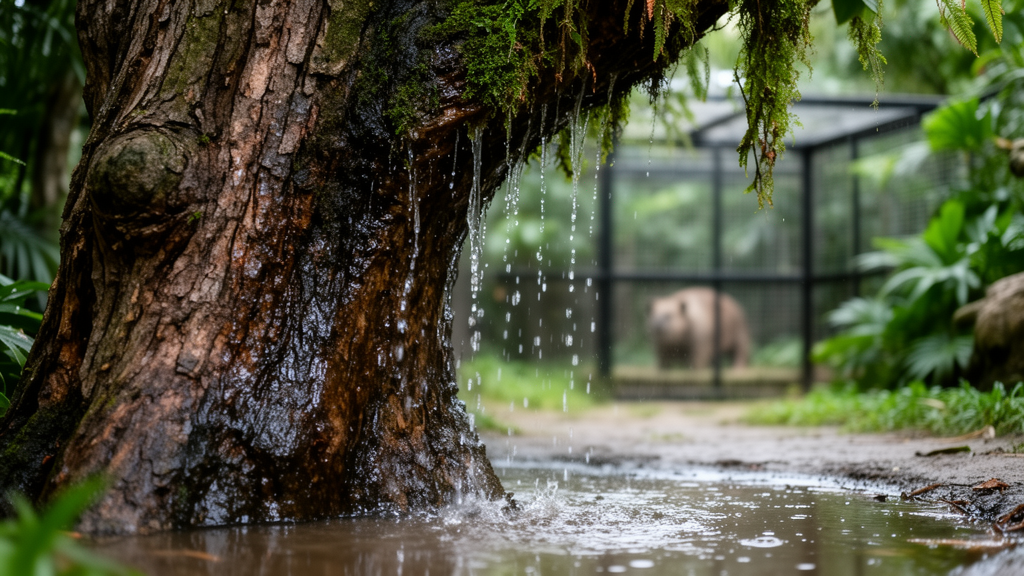
Every time rain falls on a tree, some of the water trickles down the trunk, washing over the bark and carrying with it whatever genetic traces cling to the surface. For the first time, researchers have shown that this trickle — known to ecologists as stemflow — can be collected and analyzed to reveal the DNA of mammals, opening an unexpectedly simple window onto animal communities that has so far gone unexploited. In a study conducted at Oji Zoo in Kobe, Japan, scientists collected stemflow from 11 trees over eight months and recovered environmental DNA from 22 mammal species, demonstrating that rainwater running down tree trunks can serve as a practical sampling medium for mammal monitoring.
Environmental DNA, or eDNA, has transformed biodiversity monitoring over the past decade. The technique rests on a straightforward premise: animals constantly shed genetic material through feces, urine, saliva, skin cells, and hair, and this DNA persists in environmental media such as water, soil, and air. By extracting and sequencing DNA from these substrates, researchers can identify which species are present without ever seeing the animals themselves. The approach requires no specialized taxonomic expertise, is non-invasive, and has proven more cost-efficient than traditional mammal surveys based on visual observation, camera traps, or pitfall traps. Yet despite its promise, no standardized and widely accepted eDNA monitoring method for mammals has been established, largely because detection probability varies enormously between substrates and sampling designs.
Each existing eDNA substrate carries its own constraints. Soil eDNA may reflect past rather than current animal presence, since genetic material can persist long after an animal has moved on. Air eDNA is at the mercy of the wind, making it difficult to attribute detections to particular habitats. Aquatic surveys can miss species that camera traps readily record and are limited by the availability of water bodies. Fly sampling is biased by the feeding preferences of the insects themselves. On trees, researchers have experimented with rubbing bark surfaces with rollers to collect eDNA from arboreal mammals, and a recently developed rainwash method collects rainwater dripping from the canopy to characterize biodiversity living among the branches. The stemflow approach, in which rainwater flowing over the trunk itself is captured, had previously been used to sample eDNA on tree surfaces, but no one had ever reported detecting mammalian DNA with it.
To test whether stemflow could recover mammalian eDNA, the research team turned to a setting where ground truth was known with certainty: a zoo. Oji Zoo houses 263 mammal individuals of 51 species, and the location of every enclosure is precisely documented. Between June 2024 and January 2025, the researchers installed stemflow samplers on 11 trees and collected samples six times, with two additional sampling sessions added when water could not be recovered from some trees, yielding 62 samples in total. One tree stood inside the squirrel enclosure, where Japanese squirrels could rub directly against its trunk; the other ten stood outside the cages, beyond the reach of any captive animal’s physical contact.
The samplers themselves are elegantly simple. A rubber rope wrapped around each trunk at a height of 80 centimeters channels rainwater flowing down the stem into a silicone funnel lined with gauze, which connects through a hose and a backflow prevention unit to a water collection bag. Benzalkonium chloride was added to each bag beforehand to inhibit DNA degradation, and field blanks containing distilled water were placed near sampling trees to control for contamination. After rainfall events, the bags were retrieved and taken to the laboratory, where the water was gravity-filtered through Sterivex filters with a pore size of 0.45 micrometers. DNA was extracted from the filters, purified to remove PCR inhibitors, and then amplified using MiMammal primers targeting the mitochondrial 12S rRNA gene — a primer mix designed for mammals in general, supplemented with dedicated primers for bears and elephants, whose DNA is difficult to amplify with the standard set. The resulting sequencing libraries were run on an Illumina iSeq100 platform with paired-end sequencing.
The bioinformatic pipeline processed more than 6.6 million raw reads, which were filtered down to roughly 1.18 million high-quality reads. Sequences were merged, quality-checked, denoised into amplicon sequence variants, and assigned to species by comparison against NCBI reference sequences, with strict thresholds of over 99 percent query coverage and over 98.5 percent identity. The team applied conservative contamination controls, excluding house mouse reads that appeared consistently in negative controls and unrelated samples, and filtering out any taxon whose read count fell at or below the level implied by reads observed across all negative controls. Humans and non-mammalian species were removed as non-targets. What remained was a clear signal: eDNA from 22 mammal species, 14 of them zoo residents and eight of them not.
The spatial pattern of detections was striking. All captive species kept in cages within 50 meters of a sampled tree were detected at least once, and 12 of the 14 detected zoo species were recorded at the tree closest to their enclosure. Statistical modeling with a generalized linear mixed model revealed a significant negative relationship between eDNA detection and the distance from each mammal cage to each tree — the closer the animal, the higher the probability of detection. This pattern held across multiple contamination-control thresholds in sensitivity analyses. The one tree inside the squirrel enclosure told an even stronger story: Japanese squirrel eDNA was detected in all six sampling sessions, with a maximum of 203,049 reads, dwarfing the counts of other species at that tree. Notably, squirrel DNA also appeared in some field blanks and PCR negative controls at low levels, a reminder of how abundant this species’ genetic material was in the immediate environment.
Perhaps most intriguingly, mammalian eDNA was also recovered from trees that no captive animal could touch. The researchers attribute this to airborne transport: genetic material or the residues from which it derives can drift through the air and settle on bark surfaces. Supporting this interpretation, no species kept in enclosed spaces separated by walls or glass was ever detected. The eight non-zoo species told their own stories. Siberian weasels, raccoons, masked palm civets, Japanese martens, and domestic cats inhabit the surroundings of the zoo and plausibly wander onto its grounds. Domestic cattle DNA may have arrived in food items carried in by visitors, while dog DNA likely hitched a ride on owners’ clothing. Sika deer detections were harder to interpret — the species is uncommon around the zoo, but a few individuals may occur nearby, and the zoo itself kept sika deer until 2018, leaving either explanation open.
The study also probed whether the physical character of the trees influenced recovery. Bark was classified visually into smooth, shallowly fissured, and fissured categories, and the number of species detected was compared across three pairs of adjacent trees of different species. No significant difference emerged among bark categories, although trees with fissured bark tended to yield fewer detections — a trend that was not statistically supported and warrants caution. Canopy structure may matter too, since the density and arrangement of branches determine how much rainfall is intercepted before reaching the stem, affecting the volume of stemflow available for collection. Filtration volume, by contrast, did matter: mammalian eDNA was more likely to be detected as the volume of filtered water increased, mirroring findings from riverine fish studies. Remarkably, mammals were detectable with as little as 30 milliliters of stemflow, though detections were inconsistent across volumes, and the researchers emphasize that identifying a robust filtration volume remains an open question.
The authors are careful to frame this as a pioneering proof of concept rather than a finished monitoring tool. Rainfall introduces inherent uncertainty, since sampling timing, water volume, and filtration capacity all depend on the weather; in dry regions or seasons, the researchers suggest that spraying water over trees could enable a pseudo-rainfall survey. Detection also depends on stochastic processes — whether animals contact trees and whether their DNA reaches bark through the air — so increasing the number of trees sampled would improve stability. The maximum distance between cages and sampled trees in this study was 347 meters, and the true detectable distance limit remains unknown; a Japanese squirrel was detected from a tree 314 meters from its cage, hinting at considerable reach. The decisive next step is validation in natural settings, where the number and location of mammal species are not known in advance. If stemflow eDNA metabarcoding performs there as it did in the zoo, monitoring mammals could become as simple as attaching a water sampler to a tree and waiting for the rain.
Subject of Research: Detection of mammalian environmental DNA from stemflow rainwater collected from trees using eDNA metabarcoding in a zoo
Article Title: Stemflow for detecting mammalian environmental DNA: a case study in a zoo
Article References: Ishihara, Y., Aoki, K., Sakata, A., Sakata, M. K., Hamano, K., Wu, Q., Miya, M., & Minamoto, T. (2026). Stemflow for detecting mammalian environmental DNA: a case study in a zoo. Metabarcoding and Metagenomics, 10, Article e176285. https://doi.org/10.3897/mbmg.10.176285
Image Credits: AI Generated
Keywords: environmental DNA, eDNA metabarcoding, stemflow, mammal monitoring, biodiversity conservation, zoo, Japanese squirrel, 12S rRNA, tree bark, airborne DNA, Oji Zoo, Kobe
Cite Scienmag News
Margaret Porter. (October 17, 2026). Rainwater flowing down trees reveals mammal DNA in pioneering zoo study. Scienmag. https://scienmag.com/rainwater-flowing-down-trees-reveals-mammal-dna-in-pioneering-zoo-study/
Margaret Porter. "Rainwater flowing down trees reveals mammal DNA in pioneering zoo study." Scienmag, 17 October 2026, https://scienmag.com/rainwater-flowing-down-trees-reveals-mammal-dna-in-pioneering-zoo-study/. Accessed 17 October 2026.
Margaret Porter. "Rainwater flowing down trees reveals mammal DNA in pioneering zoo study." Scienmag. October 17, 2026. https://scienmag.com/rainwater-flowing-down-trees-reveals-mammal-dna-in-pioneering-zoo-study/


