


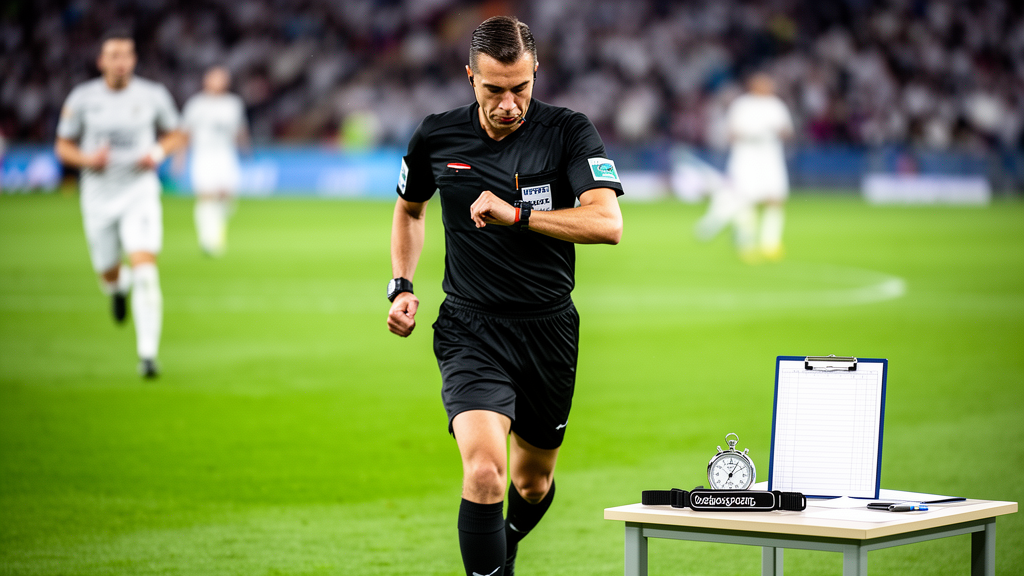
Every elite football referee knows the feeling: the ball switches ends in a blink, play accelerates toward a penalty area, and the official must sprint into position while simultaneously processing whether a foul occurred. A new study from Croatia now suggests that the laboratory-measured aerobic engine behind that sprint may matter far less to a referee’s season-long performance grade than researchers expected. In research published in Frontiers in Sports and Active Living, a team from the University of Zagreb and the Croatian Football Federation put the entire referee list of the country’s highest competition through treadmill-based spiroergometric testing and then compared the physiological results with the official quality grades each referee accumulated across the 2022/2023 season. The hypothesis was straightforward: referees with better functional abilities would earn better refereeing quality scores. The data did not support it.
The analytical sample consisted of 16 referees, drawn from an initial group of 17 who represented 100 percent of the officials eligible to work the top Croatian league that season. One referee sustained an injury during sprint testing and did not complete the physiological assessment. These were not casual officials. Ten of the referees were listed by UEFA or FIFA, meaning they operated at international as well as national level, and their median experience in the highest Croatian league was six years, with a range spanning one to 23 years. Laboratory testing took place in January 2023, between the first and second parts of the competitive season, and every referee was tested at least three days after an officiated match to avoid residual fatigue contaminating the results.
The testing protocol itself was rigorous. Referees ran on a Technogym Run Race Competition treadmill under a progressive spiroergometric procedure that began with two minutes of walking at 3 km/h and then increased speed by 0.5 km/h every 30 seconds until volitional exhaustion, with the incline fixed at one percent. Breath-by-breath gas analysis was performed with a Cosmed Quark b system, heart rate was monitored through Polar RS800 telemetry, and the gas analysers were calibrated before each test with a known mixture of 16 percent oxygen and 5.20 percent carbon dioxide. The ventilatory threshold, the point at which carbon dioxide output begins to rise disproportionately relative to oxygen uptake, was identified using the V-slope method. From this battery, the researchers extracted seven variables: maximal treadmill speed, speed at the ventilatory threshold, maximal heart rate, heart rate at the ventilatory threshold, absolute and relative maximal oxygen uptake, and relative oxygen uptake at the ventilatory threshold.
The physiological numbers confirm that this group was exactly as fit as elite football referees should be. Mean relative maximal oxygen uptake was 51.71 ± 4.28 mL/kg/min, almost identical to the 51.9 mL/kg/min reported for elite male football referees in a recent systematic review. Absolute maximal oxygen uptake averaged 4.38 L/min, exceeding the roughly 3.98 L/min reported for elite male referees in the same review. Maximal treadmill speed reached 18.50 ± 1.03 km/h, and maximal heart rate averaged 184.19 beats/min. Heart rate at the ventilatory threshold corresponded to 91.54 percent of maximal heart rate, while oxygen uptake at the ventilatory threshold corresponded to 87.80 percent of maximal oxygen uptake, indicating that these officials were operating at high percentages of their maximal capacities during sustained work.
Refereeing quality was measured differently from most previous studies. Rather than counting the success of individual decisions in a single match, the researchers used the official season-long grade, calculated as the average of all final refereeing grades received across the entire competitive season. During each match, a supervisor records situations requiring referee decisions, starting from a baseline grade of 8.4, with correct or incorrect decisions typically moving the grade by 0.1 to 0.5 points. After each round, seven members of the Croatian Football Federation Referees Committee independently reviewed the match video and reached a joint decision on the final grade, a procedure designed to reduce the influence of any single observer. The mean season-long refereeing quality grade was 8.21 ± 0.26 points, with values ranging from 7.30 to 8.40.
When the researchers ran the statistical analysis, the pattern was unambiguous. Spearman rank correlations between each functional ability variable and refereeing quality ranged from -0.372 to 0.386, with all p-values at or above 0.140, and every 95 percent bootstrap confidence interval, estimated from 100,000 resamples, included zero. Simple linear regression analyses showed the same result, with no statistically significant predictors and low explained variance, with R² values between 0.001 and 0.090. In plain terms, knowing a referee’s maximal oxygen uptake, treadmill speed, or heart rate profile told you essentially nothing about how well that referee was graded across the season.
One sensitivity analysis did produce an intriguing result. When the researchers excluded the single lowest refereeing quality value of 7.30, leaving 15 referees, absolute maximal oxygen uptake showed a statistically significant positive correlation with refereeing quality, with a Spearman coefficient of 0.532 and a p-value of 0.041. However, the corresponding linear regression remained non-significant, with an R² of 0.157 and a p-value of 0.143. The authors interpret this cautiously, noting that the association was sensitive to a single observation and should not be overinterpreted. The full-sample analysis, which is the more robust result given the small sample, showed no significant relationship for any variable.
Why does fitness fail to separate good referees from excellent ones at this level? The authors point to the homogeneity created by selection. Referees who reach the highest national competition have already passed years of selection, physical testing, and performance evaluation, including the official fitness tests required by UEFA and FIFA norms. Physical fitness may act mainly as a prerequisite for reaching and remaining at this competition level, rather than as a differentiator among those already selected. A similar result has been reported in elite handball referees, where functional abilities also failed to predict refereeing quality among 31 top-level officials. There is also a statistical dimension: with only 16 referees, a sensitivity power analysis showed the study could detect mainly large associations, with a minimum detectable correlation of approximately 0.63, so weak or moderate relationships may have gone undetected.
The mismatch between laboratory capacity and match performance has deeper roots. Recent high-level data show that main referees cover approximately 9.4 to 11.6 km per match and perform repeated high-intensity actions, while heart rate can reach very high relative values during specific periods of play. A laboratory treadmill test describes the referee’s available physiological capacity on a single day, but it does not directly represent the short match periods in which the most difficult decisions are made. Research by McEwan and colleagues found that decision errors were more frequent when referees had a heart rate of at least 90 percent of maximal heart rate, a respiratory rate of at least 80 percent of peak respiratory rate, or very high running speeds immediately before a decision. This suggests that the acute load in the seconds preceding a decision may be more relevant to decision accuracy than a general measure of aerobic capacity recorded on a separate day.
Refereeing quality also depends on cognitive and psychological characteristics that no treadmill can measure. Expert and novice referees differ in decision-making strategy, accuracy, and confidence during disciplinary decisions, while anxiety and pressure can change the cognitive processing used during football decisions. Response-suppression ability has recently been associated with more accurate disciplinary decision-making, and mental fatigue increases perceived effort during a football-referee match simulation without necessarily compromising inhibitory control. Variability in judgment is also present when referees evaluate comparable football situations, adding another source of variation to season-long performance grades. These findings support the view that final refereeing quality is produced by several interacting components and cannot be reduced to one physiological characteristic.
The practical implications are clear. Physical preparation remains an essential component of high-level refereeing, and training programmes should maintain high aerobic and repeated high-intensity capacity, since repeated-sprint training can improve high-intensity physical performance. But physical training alone is not enough for the complete refereeing task. Referees should also practise decision-making while physically loaded and use football-specific perceptual-cognitive training, and a recent systematic review and meta-analysis found a large positive effect of video-based training on football referees’ decision-making skills. Combining physical and decision training is a practical way to prepare referees for the periods when high running demands and important decisions occur at the same time.
The study has clear strengths, including the completeness of the initial sample, with all 17 eligible referees entering the testing procedures, and the use of an official quality measure based on an entire season and reviewed by seven experts rather than a single isolated decision task. But the same characteristics create limitations. The analytical sample of 16 referees is small, refereeing quality had a restricted and markedly non-normal distribution, and the grading system may create a ceiling effect around the standard starting grade of 8.4, since the highest season-long mean in the sample was exactly 8.40. Individual ratings of the seven committee members were not available, so inter-rater reliability could not be calculated, and no formal classification of match difficulty or importance was available. Functional abilities were assessed only once, in January, so possible changes in physical condition across the season were not measured. Future studies should include repeated physiological assessments across the competitive season and direct match-based measures of physical load, such as GPS-derived running performance, heart rate, sprint ability, and change-of-direction capacity, to examine this relationship more precisely.
Subject of Research: Laboratory-measured functional abilities and refereeing quality in elite football referees
Article Title: Laboratory-measured functional abilities and refereeing quality in elite football referees
Article References: Krakan, I., Tomasko, J., Belcic, I., & Novak, D. (2026). Laboratory-measured functional abilities and refereeing quality in elite football referees. Frontiers in Sports and Active Living, 8, Article 1987062. https://doi.org/10.3389/fspor.2026.1987062
Image Credits: AI Generated
DOI: 10.3389/fspor.2026.1987062
Keywords: Laboratory-measured, functional, abilities, refereeing, quality, elite, football, referees, scientific research
Cite Scienmag News
Faith Mcneil. (October 17, 2026). Why Elite Referees’ Fitness Doesn’t Predict Their Match Grades. Scienmag. https://scienmag.com/why-elite-referees-fitness-doesnt-predict-their-match-grades/
Faith Mcneil. "Why Elite Referees’ Fitness Doesn’t Predict Their Match Grades." Scienmag, 17 October 2026, https://scienmag.com/why-elite-referees-fitness-doesnt-predict-their-match-grades/. Accessed 17 October 2026.
Faith Mcneil. "Why Elite Referees’ Fitness Doesn’t Predict Their Match Grades." Scienmag. October 17, 2026. https://scienmag.com/why-elite-referees-fitness-doesnt-predict-their-match-grades/


