


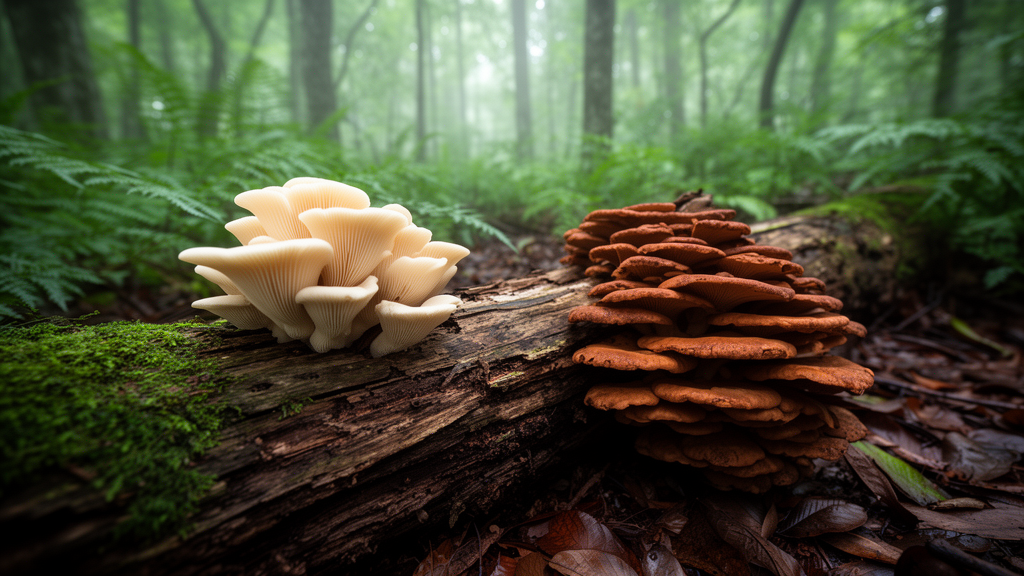
Deep in the forests of Laoshan National Forest Park near Nanjing, two previously unknown wood-decaying fungi have been formally described as new species, adding fresh branches to the fungal tree of life. The discoveries, published in the journal MycoKeys, belong to the family Polyporaceae, a group of bracket fungi that serves as the forest’s primary demolition crew. One specimen, Coriolopsis albescens, clings flatly to fallen branches like a pale crust, while the other, Polyporus laoshanensis, rises on a striking black stalk beneath a pale yellow cap. Both were identified through a combination of painstaking morphological examination and molecular phylogenetic analyses, the modern gold standard for confirming that a fungus is genuinely new to science rather than a mere variant of something already catalogued.
The significance of these finds extends well beyond the novelty of two new names. Polypores are fundamental agents of wood decomposition in forest ecosystems worldwide, enzymatically degrading the major structural components of wood, including lignin, cellulose, and hemicellulose. This decay process is essential for material decomposition and nutrient cycling, allowing carbon and minerals locked inside dead timber to re-enter the biosphere’s circulation. Without these fungi, forests would be buried under their own deadwood, and the nutrients bound within fallen trunks would remain inaccessible to living trees. Some polypores also carry economic weight, occasionally acting as pathogens of standing timber and, in some cases, being prized for supposed medicinal properties, which makes accurate taxonomy a matter of practical as well as scientific importance.
The genus Coriolopsis, to which the first new species belongs, has long been a taxonomic headache for mycologists. Index Fungorum holds more than 80 historical records of Coriolopsis, but most have been synonymized or transferred to closely related genera such as Funalia, Lenzites, Pycnoporus, and Trametes because of overlapping morphological features. Only about 20 species are currently accepted, and molecular sequence data are available for merely four of these. The genus is polyphyletic within Polyporaceae, meaning its members do not all descend from a single common ancestor, so its precise circumscription remains in doubt. Nevertheless, molecular phylogenetics has demonstrated that most Coriolopsis species form a well-supported clade distinct from the main Trametes clade, offering a more natural classification than morphology alone ever could.
Coriolopsis albescens stands out immediately from its brown-toned relatives. Its fruiting bodies, technically called basidiomata, are annual and resupinate, spreading flat against the substrate without a cap or stalk, and they possess a soft, sponge-like texture when dry. The pore surface is white to pale brown, glabrous, and without concentric zones, with round to angular pores measuring 0.5 to 2 per millimetre. Microscopically, the species exhibits a trimitic hyphal system, meaning its tissues contain three distinct hyphal types: thin-walled generative hyphae bearing clamp connections, dominant thick-walled skeletal hyphae, and frequently branched binding hyphae. The basidiospores are mostly oblong-ellipsoid, sometimes slightly curved, hyaline, thin-walled, and smooth, measuring 8 to 12 micrometres long by 3.2 to 4 micrometres wide. The species name albescens refers to the basidiomata being white when juvenile and becoming pale brown at maturity.
Phylogenetically, Coriolopsis albescens forms a monophyletic and highly supported clade, with bootstrap support of 100 percent and Bayesian posterior probability of 1.00, closely related to Coriolopsis trogii, an important model organism for investigating white rot fungi. Sequences of C. trogii collected from Asia, Europe, and the Americas all separate cleanly from the new species. Morphologically, C. trogii differs by having an ochraceous buff pore surface and thinner basidiospores. The new species also forms a joint subclade with Coriolopsis gallica, but C. gallica differs by its thick basidiomata with a hispid to villose, brown to gray pore surface, and longer basidiospores reaching 16 micrometres in length. Most known congeners range from brown to dark brown in color, making the pale, crust-like C. albescens a clear morphological outlier within the genus.
The second discovery, Polyporus laoshanensis, belongs to one of the oldest and most intensively studied genera of polypores, characterized by stipitate fruiting bodies that rise on a stalk. This new species produces annual, solitary, elliptical basidiomata with an obvious black stipe, a pale yellow pileal surface with dark brown margins, and a glabrous texture occasionally marked with distinct concentric zones and radial stripes. Its angular pores number 3 to 6 per millimetre, and its cylindrical basidiospores measure 8 to 12 by 3 to 5 micrometres. Microscopically, it possesses a dimitic hyphal system, with generative hyphae bearing clamp connections and dominant skeleto-binding hyphae that are thick-walled with arboriform branches. The species name laoshanensis honors Laoshan National Forest Park, the locality where the type specimen was collected.
Molecular phylogenetics placed Polyporus laoshanensis with high support, again 100 percent bootstrap and 1.00 posterior probability, within the squamosus clade of Polyporus, where it nests closely with P. hemicapnodes, P. miscanthi, and P. minutissimus. The squamosus species have been consistently confirmed as monophyletic in previous multi-locus investigations, yet the taxa within this clade exhibit such diverse morphology that they cannot be combined into a single monophyletic genus. Each close relative is readily distinguishable from the new species: P. hemicapnodes has smaller pores and smaller basidiospores, P. miscanthi grows on miscanthus with a much longer stipe and a pale, applanate pileus margin, and P. minutissimus has smaller pores, a cream to buff pileal surface, and smaller spores. Polyporus varius shares similar spore and basidia sizes but produces much larger basidiomata and is widespread across temperate Europe, North America, and Asia.
The research team constructed phylogenetic trees using two concatenated nuclear ribosomal markers, the internal transcribed spacer region and the nuclear large subunit gene, analyzed with Maximum Likelihood and Bayesian Inference methods. The Coriolopsis dataset included sequences from 113 specimens representing 58 species, with an aligned length of 2,012 characters, while the Polyporus dataset covered 87 specimens representing 48 species across 1,799 aligned characters. Alignments were generated with MAFFT and refined manually, then concatenated using PhyloSuite. BLAST searches of the holotype specimens against the NCBI nucleotide database returned closest matches with roughly 97 percent sequence identity, confirming that neither new species corresponds to any previously sequenced taxon. All newly generated sequences were deposited in GenBank, and voucher specimens are preserved at the Forest Pathology Laboratory of Nanjing Forestry University.
Polyporus itself is a notoriously complicated genus, with more than 3,000 records in Index Fungorum, though many species have subsequently been transferred to other genera. Phylogenetic studies have revealed that Polyporus is polyphyletic, with its members distributed across several well-supported clades that do not fully correspond to the six traditional morphological groups into which the genus was once divided. Approximately 19 Polyporus species have been documented from China, and novel species within this genus continue to be published as Chinese mycologists intensively survey the country’s forests. The traditional classification, based on features such as the form of the basidiomata, pileal surface, pore size, stipe characteristics, and basidiospore morphology, has proven an unreliable guide to evolutionary relationships, which is why modern species delimitation increasingly depends on integrating morphology with multi-locus phylogenetic inference.
Nanjing lies in the transition zone between subtropical and temperate climates, a biogeographic position that harbours great potential for undiscovered fungal resources. The two new species were collected on fallen angiosperm branches within Laoshan National Forest Park, and their discovery during a systematic survey of polypores in Jiangsu Province suggests that even well-studied regions of eastern China still conceal hidden fungal diversity. Although Polyporaceae has a long history of study and many species have been described from China, numerous undescribed species remain within this fungal family. Further large-scale field surveys, combined with morphological observation and molecular phylogenetic analyses, will surely uncover more unrecorded fungal species across China, and each new species documented brings science closer to a complete inventory of the wood-decaying fungi that quietly sustain forest ecosystem stability.
Subject of Research: Mycology
Article Title: Two new polypore species Coriolopsis albescens and Polyporus laoshanensis ( Basidiomycota , Polyporales ) from Jiangsu Province, China
Article References: Zhang, Q.-Y., Cao, Y.-H., Chen, X.-X., Huang, M.-H., Wang, Z., Shi, F.-M., Lv, S., & Li, H.-D. (2026). Two new polypore species Coriolopsis albescens and Polyporus laoshanensis (Basidiomycota, Polyporales) from Jiangsu Province, China. MycoKeys, 139, 341-362. https://doi.org/10.3897/mycokeys.139.209057
Image Credits: AI Generated
DOI: 10.3897/mycokeys.139.209057
Keywords: Polyporaceae, Coriolopsis albescens, Polyporus laoshanensis, Jiangsu Province, wood-decaying fungi, phylogenetics, new species, China, polypore, species, Coriolopsis, albescens
Cite Scienmag News
Roger Howard. (October 17, 2026). Two New Wood-Rotting Fungi Unearthed in Eastern China’s Forest Park. Scienmag. https://scienmag.com/two-new-wood-rotting-fungi-unearthed-in-eastern-chinas-forest-park/
Roger Howard. "Two New Wood-Rotting Fungi Unearthed in Eastern China’s Forest Park." Scienmag, 17 October 2026, https://scienmag.com/two-new-wood-rotting-fungi-unearthed-in-eastern-chinas-forest-park/. Accessed 17 October 2026.
Roger Howard. "Two New Wood-Rotting Fungi Unearthed in Eastern China’s Forest Park." Scienmag. October 17, 2026. https://scienmag.com/two-new-wood-rotting-fungi-unearthed-in-eastern-chinas-forest-park/


