


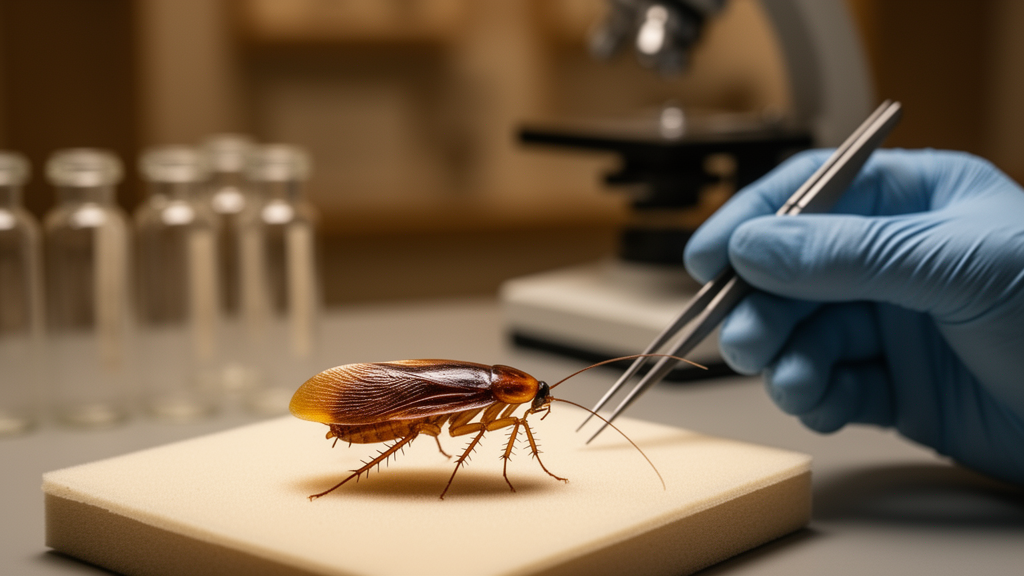
For more than a hundred years, a small neotropical cockroach named Antitheton iniquiungues existed in the scientific literature as little more than a pair of pinned specimens and a taxonomic puzzle. Described in 1919 by the American entomologist Morgan Hebard from a male collected in Guatemala and a female from Veracruz, Mexico, the species was so rarely encountered that generations of researchers knew it only from its type material. Now, a new study published in the Journal of Orthoptera Research has finally confirmed where this enigmatic insect belongs on the cockroach family tree, using freshly collected specimens and a close examination of male genitalia that settles a classification dispute stretching back decades.
The genus Antitheton is monotypic, meaning it contains only one species, A. iniquiungues. Its specific epithet, which literally alludes to the unequal tarsal claws of the insect, reflects the very trait that led Hebard to place it in the subfamily Pseudomopinae alongside the genus Latiblattella, which shares the same asymmetrical claw characteristic. That classification was later adopted by the Swedish cockroach specialist Karl Princis in his 1969 catalogue. But taxonomy is not static. In 1996, Philippe Grandcolas transferred the genus to the family Ectobiidae, a placement followed by the Cockroach Species File as recently as 2024, though without assigning it to any subfamily. Then, in 2021, Mexican researchers Alejandro Estrada-Álvarez and Riccardo Sormani moved it to the family Pseudophyllodromiidae without presenting supporting evidence, leaving the genus in a state of taxonomic limbo that only fresh material could resolve.
The breakthrough came through a combination of museum work and field collecting. During a visit in June 2023 to the Colección Nacional de Insectos at the Universidad Nacional Autónoma de México, the authors examined the cockroach holdings of the collection and received a male specimen of A. iniquiungues donated by the second author. This individual had been collected on 25 July 2022 by Manuel de Luna at the Estación de Biología Tropical Los Tuxtlas in San Andrés Tuxtla, Veracruz, and preserved in 70 percent ethanol. It represented only the second male of the species ever available to science, alongside the holotype pinned at the Academy of Natural Sciences of Drexel University in Philadelphia, which was collected on 19 April 1906 at Cacao, Trece Aguas, in the Guatemalan department of Alta Verapaz.
To reveal the hidden structures of the male genitalia, the researchers followed a standard but delicate preparation protocol. The abdomen was dissected and cleared by submerging it for 15 minutes in a 10 percent potassium hydroxide solution held at 70 degrees Celsius in a bain-marie, a water bath that gently heats the tissue without boiling it. The potassium hydroxide dissolves the soft internal tissues and muscle attachments that obscure the sclerotized genital sclerites, leaving the diagnostic hard parts intact. The cleared structures were then photographed with a USB microscope while submerged in 70 percent ethanol, and all images were edited using Photoshop. This method allowed the team to illustrate the genital complex in unprecedented detail for a genus whose internal anatomy had never been figured before.
The results confirm that the genital hook, designated R2 in the standard nomenclature of cockroach genitalia established by Margaret McKittrick in 1964, sits on the right side of the genital complex. That single character is decisive. Because the hook is right-sided, the genus belongs firmly in the family Pseudophyllodromiidae, vindicating the 2021 transfer by Estrada-Álvarez and Sormani. The genital hook of A. iniquiungues is thin and long, with a preapical incision and an apical keel, features that are now illustrated for the first time. The confirmation matters because cockroach family-level classification has been reshuffled repeatedly over the past decades, and genera known only from type material often linger unplaced, distorting our understanding of neotropical blattodean diversity.
Beyond the family placement, the study goes further and assigns Antitheton to the subfamily Plectopterinae. This decision rests on the morphology of the subgenital plate and, above all, on the extreme modification of the styli, the small paired appendages at the tip of the subgenital plate. In A. iniquiungues, the styli bear lateral keels and the interstylar space is projected, an arrangement so distinctive that the authors place the genus comfortably alongside Aglaopteryx, Chorisoneura, Dendroblatta, Euphyllodromia, Macrophyllodromia, Riatia, and Plectoptera. The subgenital plate itself carries dissimilar apodemes, the internal apodemal supports that anchor the genital musculature, adding another layer of diagnostic detail.
The redescription also documents the external anatomy of the species in full color for the first time. The freshly collected Los Tuxtlas male is a medium-sized cockroach with a total length of 21 to 23 millimeters. Its head is reddish brown and concolorous, while the oval pronotum is bicolor, with hyaline lateral margins and an opaque reddish brown center. The tegmina and wings are reddish brown, the wings with a grayish anal area and an intercalar triangle, a wing venation feature relevant to blaberoid classification. Strikingly, the mesonotum, metanotum, and abdominal terga are bright orange, and the legs are bicolor, with black distal portions of the femora, tibiae, and tarsi contrasting against reddish brown. The fore femora carry spination of type B3, the tarsi bear asymmetrical claws with well-developed arolia, and the seventh abdominal tergite of the male houses a tergal gland, a structure associated with courtship in many blaberoid cockroaches.
The male genital sclerites themselves reveal a complex architecture. The first left sclerite, L1, carries three subsclerites: a dorsal L1d with a multi-spined apex, a medial L1m that is bulbose with minute projections and keels, and a ventral L1v with a bulbose apex covered in pilose structures. The second left sclerite, L2, has two subsclerites, with the medioventral L2vm wider proximally and the curved dorsal L2d narrowing distally. The third left sclerite, L3, bears two projections designated a and b, with the b projection carrying a spinose apex on its retrolateral margin. Together with the right-sided R2 hook, this suite of characters provides the differential diagnosis that separates Antitheton from every other genus in the subfamily, based on the body size, the presence of the male tergal gland, the morphology of the styli, and the form of L2.
The study also expands the known distribution of this elusive insect. Previously, A. iniquiungues was recorded only from Alta Verapaz in Guatemala and from Santa Lucrecia and Jesús Carranza in Veracruz, Mexico. The new Los Tuxtlas record adds a fresh locality in Veracruz, and the authors document photographic records from Catemaco, San Andrés Tuxtla, and Ixtaczoquitlán, all in Veracruz, contributed by citizen scientists on the platform iNaturalist. One of these photographs, taken in Catemaco in May 2022 by Jorge Rojas S., shows a male attracted to light, hinting that the species may be phototactic like many forest cockroaches. Most tantalizing of all is a photographic record from Costa Rica of a cockroach that clearly belongs to this genus, which would represent the southernmost record of Antitheton by a wide margin. The authors caution that specimens must be collected in Costa Rica before the presence of the species in that country can be confirmed.
Why should anyone care about a 23-millimeter cockroach known from a handful of individuals? Because Antitheton iniquiungues exemplifies a broader pattern in tropical insect conservation: countless species are described from type material and then vanish from the scientific record, sometimes for a century, while their habitats are transformed by deforestation and climate change. The Los Tuxtlas tropical biology station sits in one of the last substantial remnants of humid lowland forest in Veracruz, a region whose original vegetation has been largely cleared for pasture and agriculture. That a species described in 1919 from Veracruz could go undocumented there for so long suggests both how scarce it is and how little collecting effort has targeted its microhabitats. Every confirmed placement, redescription, and new locality record converts a taxonomic ghost into a testable entity, one that can be monitored, mapped, and ultimately protected. The study of Antitheton is a reminder that even the smallest and least glamorous insects carry stories of biogeography, morphology, and survival worth telling, and that the tools of modern taxonomy, from potassium hydroxide clearing to citizen science photography, can resurrect them from the drawers of history.
Subject of Research: Contributions to the cockroach genus Antitheton Hebard (Insecta, Blattodea), with confirmation of its familial placement in Pseudophyllodromiidae
Article Title: Contributions to the cockroach genus Antitheton Hebard ( Insecta , Blattodea ), with confirmation of its familial placement in Pseudophyllodromiidae
Article References: Estrada-Álvarez, J. C., de Luna, M., & Núñez-Bazán, R. (2026). Contributions to the cockroach genus Antitheton Hebard (Insecta, Blattodea), with confirmation of its familial placement in Pseudophyllodromiidae. Journal of Orthoptera Research, 35(1), 49-52. https://doi.org/10.3897/jor.35.145107
Image Credits: AI Generated
Keywords: cockroaches, Blattodea, taxonomy, male genitalia, Pseudophyllodromiidae, Plectopterinae, Antitheton iniquiungues, Veracruz, Guatemala, iNaturalist, neotropical insects, redescription
Cite Scienmag News
Gavin Prescott. (October 17, 2026). Mystery Cockroach Finally Placed on the Cockroach Family Tree After a Century. Scienmag. https://scienmag.com/mystery-cockroach-finally-placed-on-the-cockroach-family-tree-after-a-century/
Gavin Prescott. "Mystery Cockroach Finally Placed on the Cockroach Family Tree After a Century." Scienmag, 17 October 2026, https://scienmag.com/mystery-cockroach-finally-placed-on-the-cockroach-family-tree-after-a-century/. Accessed 17 October 2026.
Gavin Prescott. "Mystery Cockroach Finally Placed on the Cockroach Family Tree After a Century." Scienmag. October 17, 2026. https://scienmag.com/mystery-cockroach-finally-placed-on-the-cockroach-family-tree-after-a-century/


