


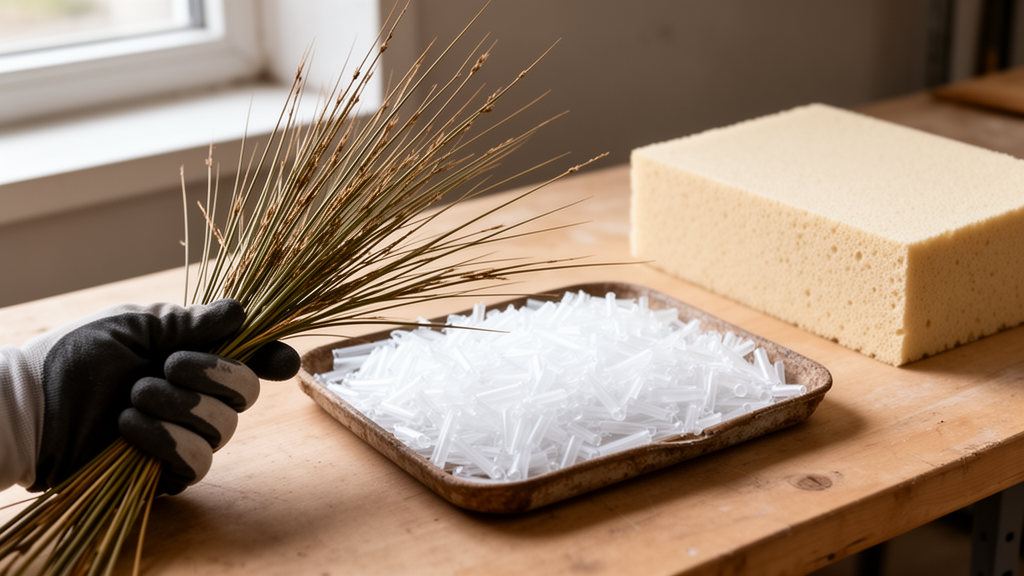
Building insulation is one of the quiet giants of global carbon emissions, and a new study from Morocco suggests a way to shrink its footprint using two waste streams at once. Researchers at Mohammed First University in Oujda have combined fibers from Juncus Acutus, a sharp-leaved rush common in the Mediterranean region, with recycled expanded polystyrene to create composite insulation panels. The work, published in Environmental Science and Pollution Research, reports experimental characterization, a cradle-to-gate life-cycle assessment, and transient numerical thermal simulations for three fiber-to-polymer formulations, and it identifies a 70 percent fiber blend as the most promising candidate for non-structural building insulation.
The appeal of the approach lies in its double valorization strategy. Juncus Acutus is a fast-growing biomass resource that requires little agricultural input, while expanded polystyrene is a notoriously persistent plastic waste that is difficult to recycle economically. By dissolving recycled EPS and using it as a binder for JA fibers, the team effectively locks polymeric waste into a useful product rather than sending it to landfill or incineration. The researchers prepared three composites with fiber-to-EPS ratios of 70:30, 60:40, and 50:50 by weight, designated JA70, JA60, and JA50 respectively, and measured their density, thermal properties, and compressive strength in the laboratory.
The experimental results reveal a clear trend with increasing fiber content. Raising the JA fraction from 50 to 70 percent reduced the bulk density of the composites from 371.6 to 289.9 kilograms per cubic meter, a drop of roughly 22 percent. Thermal conductivity fell in parallel, from 0.117 to 0.096 watts per meter-kelvin, meaning the fiber-rich panels conduct less heat and insulate better. Thermal diffusivity, which describes how quickly heat propagates through a material, decreased by approximately 15 percent across the same range, while specific heat capacity increased by about 10 percent. Together, these changes indicate that fiber-rich composites store more thermal energy per unit mass and release it more slowly, a combination that improves thermal inertia and helps regulate indoor temperatures.
Mechanical performance moved in the opposite direction, as expected for a polymer-bonded fiber composite. Compressive strength declined as the proportion of EPS binder decreased, since the polymer matrix is what holds the fibrous network together under load. Nevertheless, the JA70 formulation still reached 0.16 megapascals, which the authors describe as adequate mechanical integrity for handling and for use in non-structural insulation applications. The JA70 blend also provided the most favorable balance between thermal and mechanical properties among the three formulations tested, making it the leading candidate for practical development.
To quantify the environmental benefits, the team conducted a cradle-to-gate life-cycle assessment covering raw material acquisition through manufacturing. The global warming potential of the JA70 composite was estimated at 1.1 kilograms of CO2-equivalent per kilogram of material. While this figure is not zero, the authors note that it reflects the impacts of the recycled polymer content and the processing route, and they highlight that further work is needed to address solvent-related impacts associated with dissolving the EPS. The assessment demonstrates the potential of the composites as lower-impact insulation materials while also identifying specific environmental hotspots that future optimization should target.
The numerical analysis adds a dynamic dimension to the static laboratory measurements. Using the experimentally derived thermal properties as inputs, the researchers performed transient simulations under representative climatic conditions to model how the composites behave in real building walls over time. The simulations showed that the fiber-rich panels demonstrate improved thermal inertia and indoor temperature regulation compared with the other formulations. In practical terms, this means buildings insulated with the JA70 composite would heat up and cool down more slowly, smoothing indoor temperature swings and potentially reducing the energy demand for heating and cooling in hot climates.
The choice of Juncus Acutus as the fiber source is significant for the regional context. The plant is abundant in the Mediterranean basin and has previously been investigated as a reinforcement for unfired clay bricks, but this study is among the first to combine it with recycled polystyrene specifically for insulation panels. Using locally available biomass reduces transport emissions and supports rural economies, while the recycled EPS content diverts a problematic plastic waste stream from landfill. The authors frame the work as a response to the growing demand for lower-impact building insulation materials, a sector where conventional products such as virgin polystyrene and mineral wool carry substantial embodied carbon.
Despite the promising results, the study is candid about its limitations. The authors highlight the need to further address solvent-related impacts, moisture resistance, fire performance, and long-term durability before practical building application. The solvent used to dissolve the recycled EPS is an environmental concern that the life-cycle assessment identifies as a hotspot, and the hygrothermal and fire behaviour of the composites remain to be fully characterized. Long-term durability under real building conditions, including exposure to moisture, temperature cycling, and biological attack, is another area that requires investigation before the material can be deployed at scale.
The research was supported by the PhD-ASsociate Scholarship program funded by the CNRST, Morocco, and was conducted at the Mechanics and Energy Laboratory of Mohammed First University in Oujda. The team, led by Jinane Mejdoubi, included Othmane Horma, Boutahar Laaouar, Ahmed Mezrhab, and Mohammed Amine Moussaoui. Their work contributes to a growing body of research on bio-based insulation composites, a field where researchers worldwide are exploring fibers from hemp, date palm, wheat straw, eucalyptus bark, and other biomass sources as alternatives to conventional insulation products.
The study demonstrates that combining Juncus Acutus fibers with recycled expanded polystyrene can produce insulation composites with competitive thermal performance, adequate mechanical integrity for non-structural applications, and a quantifiable lower-impact profile compared with conventional alternatives. The 70 percent fiber blend emerges as the leading formulation, offering the lowest thermal conductivity, the highest specific heat capacity, and improved thermal inertia in transient simulations. While challenges related to solvents, moisture, fire, and durability remain, the research provides a technical foundation for developing lower-impact insulation materials that valorize both biomass and polymeric waste streams simultaneously.
,
Subject of Research: Juncus Acutus fiber–recycled expanded polystyrene composites for lower-impact insulation: experimental characterization and numerical thermal analysis
Article Title: Juncus Acutus fiber–recycled expanded polystyrene composites for lower-impact insulation: experimental characterization and numerical thermal analysis
Article References: Mejdoubi, J., Horma, O., Laaouar, B., Mezrhab, A., & Moussaoui, M. A. (2026). Juncus Acutus fiber–recycled expanded polystyrene composites for lower-impact insulation: experimental characterization and numerical thermal analysis. Environmental Science and Pollution Research. https://doi.org/10.1007/s11356-026-38313-7
Image Credits: AI Generated
DOI: 10.1007/s11356-026-38313-7
Keywords: Juncus, Acutus, fiber, recycled, expanded, polystyrene, composites, lower-impact, insulation, experimental, characterization, numerical
Cite Scienmag News
Violet Maxwell. (October 17, 2026). Sharp Juncus Acutus fibers turn recycled polystyrene waste into low-carbon building insulation. Scienmag. https://scienmag.com/sharp-juncus-acutus-fibers-turn-recycled-polystyrene-waste-into-low-carbon-building-insulation/
Violet Maxwell. "Sharp Juncus Acutus fibers turn recycled polystyrene waste into low-carbon building insulation." Scienmag, 17 October 2026, https://scienmag.com/sharp-juncus-acutus-fibers-turn-recycled-polystyrene-waste-into-low-carbon-building-insulation/. Accessed 17 October 2026.
Violet Maxwell. "Sharp Juncus Acutus fibers turn recycled polystyrene waste into low-carbon building insulation." Scienmag. October 17, 2026. https://scienmag.com/sharp-juncus-acutus-fibers-turn-recycled-polystyrene-waste-into-low-carbon-building-insulation/


