


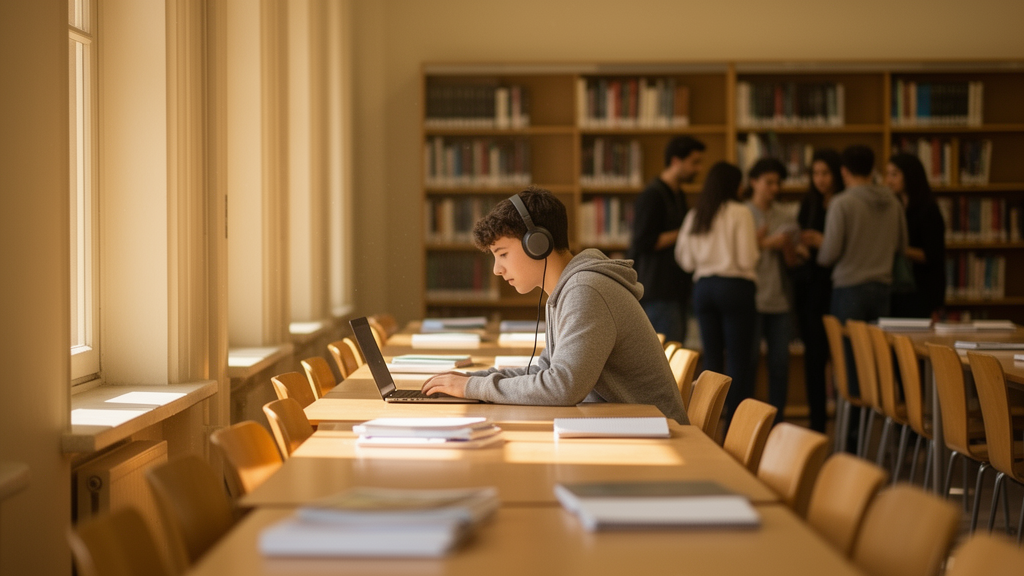
Higher education presents itself as a system of supports, yet for neurodivergent students those supports often arrive only after individuals have fought for them. A qualitative study published in SN Social Sciences examined how neurodivergent students navigate universities that expect them to secure their own accommodations while offering little help with the social isolation that shadows their academic lives. Drawing on interviews with 64 neurodivergent students across institutions, researchers Emre Dinç and colleagues identified three interlocking patterns: systemic barriers to accommodations, the heavy expectation of self-advocacy, and pervasive social disconnection. Together, these findings sketch a portrait of universities that shift the labor of access onto the very students least positioned to carry it.
The first pattern concerns how accommodation systems operate in practice. Students described processes riddled with documentation requirements, waiting periods, and gatekeeping that made even well-established supports difficult to obtain. Many reported that accommodations they were legally entitled to required repeated requests, follow-up emails, and sometimes appeals before materializing. The burden of proof fell on students themselves, who had to disclose sensitive diagnostic information to multiple offices, often without clear guidance about what information was needed or how it would be used. For students with limited financial resources or without family support, the process could be especially punishing, since obtaining documentation often required costly evaluations that insurance did not cover.
These barriers were not experienced as isolated technical failures but as reflections of deeper institutional attitudes. Students perceived that universities operated from a deficit model, treating neurodivergence as a problem to be managed rather than a form of diversity to be embraced. Office staff sometimes displayed skepticism about accommodation requests, and faculty occasionally questioned whether supports were necessary at all. Such skepticism communicated that students had to justify their needs repeatedly, a dynamic that many found exhausting and, at times, humiliating. The result was a system that promised access but delivered it conditionally, only after students had demonstrated persistence that many neurodivergent students found difficult to sustain.
The second pattern, the expectation of self-advocacy, compounds these barriers. Universities routinely frame self-advocacy as a skill students should develop, positioning it as preparation for adult life. Yet the study found that this framing shifts responsibility for access onto individuals while leaving institutional structures unchanged. Students described having to initiate every conversation about their needs, from requesting extended test time to asking professors for flexibility with deadlines. Each interaction required disclosure, explanation, and sometimes negotiation, and the emotional labor involved was substantial. Many students reported that the cumulative effect of repeated self-advocacy was burnout, with some choosing to forgo accommodations altogether rather than continue fighting for them.
The researchers note that this dynamic is particularly problematic for neurodivergent students, for whom initiating conversations, reading social cues, and managing disclosure can be especially challenging. Self-advocacy, in other words, demands exactly the skills that many neurodivergent students find most difficult, creating a paradox in which the system requires individuals to perform neurotypical social behavior in order to obtain supports designed for those who do not behave neurotypically. Students who could mask effectively fared better in these interactions, but masking carried its own costs, including exhaustion and identity strain. Those who could not or would not mask often found their needs dismissed or minimized.
The third pattern, social disconnection, proved to be the least addressed of the three. Students described profound isolation, reporting few meaningful friendships and little sense of belonging on campus. Many attributed this to social environments structured around neurotypical norms, including unstructured social events, group work that relied on implicit coordination, and campus cultures that rewarded masking. Some students reported that their isolation deepened over time, as repeated social failures eroded confidence and motivation. Others described turning to online communities, where they found connection with others who shared their experiences, but these virtual spaces rarely translated into in-person belonging.
What makes this isolation particularly troubling is how little institutional attention it receives. Universities offer accommodations for academic tasks, such as extended test time or note-taking support, but few provide structured support for social connection. The study found that students who sought help with isolation often encountered counselors unfamiliar with neurodivergence or peer programs designed without neurodivergent input. The result was a system that addressed academic barriers while leaving social ones untouched, a division that many students found arbitrary given how intertwined academic and social life are. Group work, class participation, and office hours all carry social dimensions, and students who struggled with these dimensions often found their academic performance suffering as a consequence.
The researchers argue that these three patterns reinforce one another in ways that make individual coping strategies insufficient. Students who face barriers to accommodations must self-advocate, and self-advocacy requires social skills that many find difficult, while the isolation that results from social disconnection makes it harder to find peers who can offer advice or solidarity. The system, in other words, creates a feedback loop in which each barrier deepens the others, and students who lack external resources, such as supportive families or financial means, are left to navigate this loop alone. The researchers contend that addressing any one barrier in isolation is unlikely to succeed, since the barriers are structurally intertwined.
The study’s implications point toward institutional rather than individual solutions. The researchers suggest that universities should adopt proactive accommodation systems that reduce the burden of self-advocacy, such as universal design for learning that builds flexibility into courses from the start. They also recommend that institutions provide structured support for social connection, including peer programs designed with neurodivergent input and campus cultures that embrace rather than penalize difference. Faculty training emerged as another key recommendation, since skeptical or uninformed professors can undermine even well-designed accommodation systems. The researchers emphasize that such changes require more than policy updates, demanding a shift in institutional culture from a deficit model to one that embraces neurodiversity as a form of diversity.
For the 64 students whose experiences anchor this study, the findings validate what many have long known: that universities promise access but deliver it conditionally, only after individuals have fought for it. The researchers hope that by documenting these patterns, they can help institutions understand that the labor of access must be shared, not shifted onto students. Until universities embrace that responsibility, neurodivergent students will continue to navigate systems that demand self-advocacy while delivering isolation, a burden that many have carried for far too long.
Subject of Research: Qualitative research on neurodivergent students' experiences with accommodation barriers, self-advocacy expectations, and social disconnection in higher education
Article Title: Neurodivergent students’ experiences with systemic inequities, self-advocacy pressures, and social disconnection
Article References: Dinç, E., & Kohler, M. (2026). Neurodivergent students’ experiences with systemic inequities, self-advocacy pressures, and social disconnection. SN Social Sciences, 6(9), Article 358. https://doi.org/10.1007/s43545-026-01655-7
Image Credits: AI Generated
DOI: 10.1007/s43545-026-01655-7
Keywords: Neurodivergent, students, experiences, systemic, inequities, self-advocacy, pressures, social, disconnection, scientific research
Cite Scienmag News
Courtney Benton. (October 17, 2026). Neurodivergent Students Face Systems That Demand Self-Advocacy While Delivering Isolation. Scienmag. https://scienmag.com/neurodivergent-students-face-systems-that-demand-self-advocacy-while-delivering-isolation/
Courtney Benton. "Neurodivergent Students Face Systems That Demand Self-Advocacy While Delivering Isolation." Scienmag, 17 October 2026, https://scienmag.com/neurodivergent-students-face-systems-that-demand-self-advocacy-while-delivering-isolation/. Accessed 17 October 2026.
Courtney Benton. "Neurodivergent Students Face Systems That Demand Self-Advocacy While Delivering Isolation." Scienmag. October 17, 2026. https://scienmag.com/neurodivergent-students-face-systems-that-demand-self-advocacy-while-delivering-isolation/


