


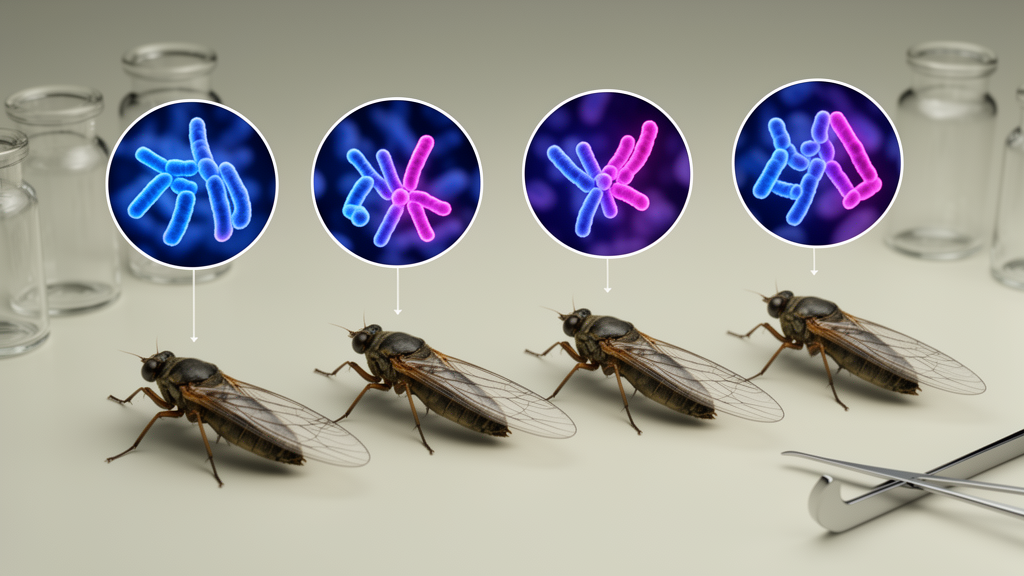
Deep in the creeks of Oregon and California, and in the Red Cedar River of Michigan, live some of the most dramatic insects in North America: fishflies, the aquatic larvae of which prowl the shallows of rivers and streams before transforming into winged adults with striking antennae. Now, a study published in the journal Comparative Cytogenetics has for the first time characterized the chromosomes of three western North American fishfly species, Dysmicohermes disjunctus, Dysmicohermes ingens, and Orohermes crepusculus, and one eastern species, Nigronia serricornis. The findings reveal a surprisingly deep evolutionary story, one that connects these insects to dobsonflies on both sides of the Pacific and, remarkably, to beetles, the most species-rich order of animals on Earth.
The research team, working with final-instar larvae collected along the banks of creeks and rivers in Oregon and California during August 1997 and in Michigan during August 2002, prepared chromosome spreads from larval gonads using a lactic acid dissociation and drying method. The larvae were transported alive to Japan, fed with aquatic insects, and dissected to obtain spermatogonial and spermatocyte preparations. Ten nuclei from spermatogonia of two males were examined for each of the three western species, and ten spermatocytes from two males were examined for the eastern species. The chromosomes were stained with Giemsa solution and photographed using an optical microscope with a 100× oil immersion objective.
The results show that the three western species all share a diploid chromosome number of 2n = 22, consisting of ten pairs of autosomes plus XY sex chromosomes in males. In Orohermes crepusculus, the autosomes include four pairs of metacentric, five pairs of submetacentric, and a single pair of small subtelocentric chromosomes, with secondary constrictions near the center of the long arm in chromosomes no. 4 and no. 6. Dysmicohermes disjunctus has six pairs of metacentric, three pairs of submetacentric, and one pair of small subtelocentric autosomes, while Dysmicohermes ingens has three pairs of metacentric, four pairs of submetacentric, and three pairs of subtelocentric autosomes, the last pair being relatively small. In all three species, the X chromosome is subtelocentric and the Y chromosome is small and dot-like.
The eastern species, Nigronia serricornis from Michigan, presents a different picture. At the first meiotic metaphase in spermatocytes, the chromosome number was n = 10, comprising nine autosomal bivalents plus a parachute-type sex bivalent designated Xy(p). During this division, the sex chromosomes invariably formed parachute-type bivalents synchronously with the autosomes. This configuration, in which the dot-like Y chromosome approaches the X chromosome as autosomal pairs do, creating a parachute-shaped structure, is a hallmark of meiosis in these insects and has now been documented in fishflies and dobsonflies from both East Asia and North America.
Comparing the new data with previous studies reveals a striking pattern. Four Japanese fishfly species of the genera Parachauliodes and Neochauliodes all have a chromosome number of 2n = 20, with nine autosomal pairs plus XY, and lack the single pair of small autosomes seen in the three western North American species. By contrast, Hughes-Schrader’s earlier work on the western fishfly Neohermes fillicornis, and the present study on three western species, all show one pair of small autosomes and a chromosome number of 2n = 22. In dobsonflies, five species from East Asia and the United States all have 2n = 24 and all possess a single pair of dot-like autosomes. These findings indicate that the chromosome number and karyotype structure are more variable in fishflies than in dobsonflies, and that the presence or absence of a characteristic small chromosome pair might play an important role in karyotype evolution within the family Corydalidae.
The secondary constrictions observed in chromosomes no. 4 and no. 6 of Orohermes crepusculus suggest that they may be the sites of rDNA clusters, often located at nucleolus organizer regions. The authors note that future verification using techniques such as fluorescence in situ hybridization (FISH) or silver staining of nucleolus organizer regions (AgNOR) will be required to confirm this interpretation. Such methods would allow researchers to map the precise locations of ribosomal DNA clusters and better understand the structural evolution of chromosomes in these insects.
The parachute-type bivalent Xy(p) is a shared feature of both subfamilies of Corydalidae, the Corydalinae (dobsonflies) and the Chauliodinae (fishflies). It has been found in four fishfly and four dobsonfly species from East Asia, as well as in the North American dobsonfly Corydalus cornutus and the fishfly Neohermes fillicornis. The present study adds Nigronia serricornis to this list, confirming that species of both subfamilies share a common sex-bivalent mechanism. This consistency across continents and subfamilies suggests that the mechanism is ancient, predating the divergence of the two lineages.
Remarkably, the parachute-type bivalent Xy(p) is not unique to Megaloptera. It is found in many beetle families, the order Coleoptera. Recent phylogenetic analyses of DNA sequence data recognize Coleoptera as the sister group of Megaloptera, and the presence of the parachute-type bivalent in both orders further corroborates this close evolutionary relationship. By contrast, the Xy(p) configuration has not been found in current members of the order Neuroptera, which includes antlions and owlflies, where the sex chromosomes are of the XY type. Megaloptera was once included in Neuroptera but is today considered an independent order, and the new cytogenetic evidence adds an independent line of support to this modern classification.
The larvae of all Megaloptera are aquatic and predaceous, performing important functions in aquatic food webs. Corydalinae larvae inhabit deeper waters in streams and rivers and absorb oxygen through tracheal gills on the ventral surface of their abdomens, whereas Chauliodinae larvae live near the banks of rivers and are primarily air breathers, using a pair of respiratory tubes on the dorsal surface of the abdomen. In North America, 49 species of Megaloptera are recognized, including 24 alderflies, 6 dobsonflies, and 19 fishflies. According to the Lacewing Digital Library, there is only one species in the genus Orohermes in the world fauna, and each of the genera Dysmicohermes and Nigronia harbors two species, making the present study a rare opportunity to sample nearly the full cytogenetic diversity of these narrowly distributed lineages.
This study offers a vivid example of how classical cytogenetics, using nothing more sophisticated than larval gonads, Giemsa stain, and optical microscopy, can still illuminate grand evolutionary questions. By comparing karyotypes across continents and subfamilies, the researchers have traced a chromosome signature that links fishflies of western North America to their East Asian relatives, dobsonflies to fishflies, and Megaloptera to beetles. The work underscores that even the smallest dot-like chromosomes can carry the imprint of hundreds of millions of years of evolution, and that the humble fishfly, so often overlooked along the banks of quiet creeks, is a living archive of insect evolutionary history.
Subject of Research: Chromosome analysis of four North American fishfly species (Megaloptera, Corydalidae, Chauliodinae)
Article Title: Chromosomes of four fishfly species ( Megaloptera , Corydalidae , Chauliodinae ) from North America
Article References: Takeuchi, Y., Iizuka, K., Nakazato, T., Koishi, H., & Hoshiba, H. (2025). Chromosomes of four fishfly species (Megaloptera, Corydalidae, Chauliodinae) from North America. Comparative Cytogenetics, 19, 83-90. https://doi.org/10.3897/compcytogen.19.146136
Image Credits: AI Generated
DOI: 10.3897/compcytogen.19.146136
Keywords: Chromosomes, four, fishfly, species, Megaloptera, Corydalidae, Chauliodinae, North, America, scientific research
Cite Scienmag News
Gavin Prescott. (October 17, 2026). Chromosomes of Four North American Fishfly Species Reveal Ancient Insect Sex Mechanism. Scienmag. https://scienmag.com/chromosomes-of-four-north-american-fishfly-species-reveal-ancient-insect-sex-mechanism/
Gavin Prescott. "Chromosomes of Four North American Fishfly Species Reveal Ancient Insect Sex Mechanism." Scienmag, 17 October 2026, https://scienmag.com/chromosomes-of-four-north-american-fishfly-species-reveal-ancient-insect-sex-mechanism/. Accessed 17 October 2026.
Gavin Prescott. "Chromosomes of Four North American Fishfly Species Reveal Ancient Insect Sex Mechanism." Scienmag. October 17, 2026. https://scienmag.com/chromosomes-of-four-north-american-fishfly-species-reveal-ancient-insect-sex-mechanism/


