


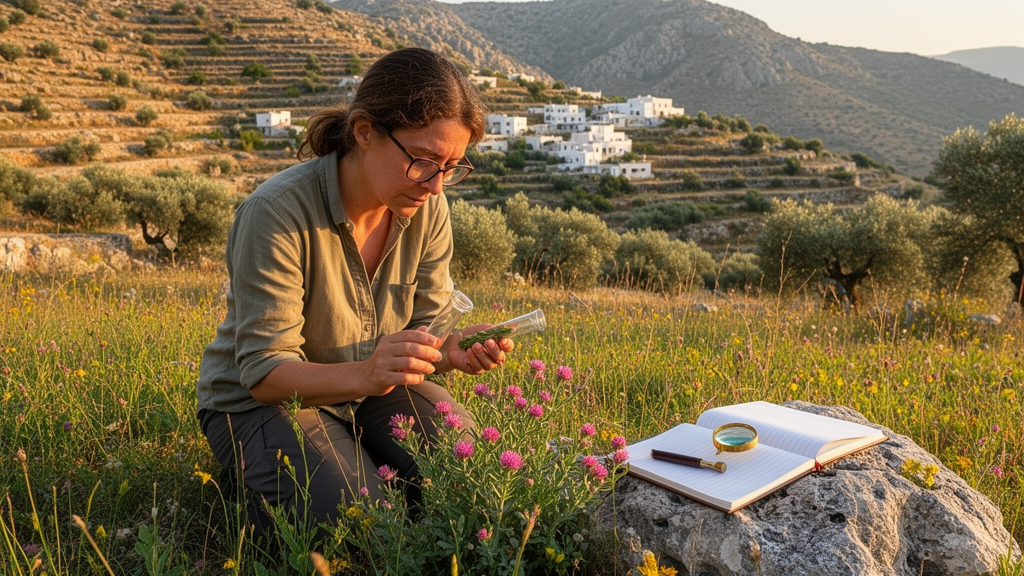
Deep in the mountains and coastlines of the Peloponnese, the southern peninsula of Greece, hundreds of plant species grow nowhere else on Earth. Many of them have never been tested for medicinal value, yet their close relatives are used in approved herbal medicines or cultivated as food crops. A new study published in the journal One Ecosystem has now built a systematic, literature-based method to identify which of these overlooked endemics might hold the next generation of natural remedies, and the results suggest that far more of Greece’s unique flora deserves scientific attention than previously assumed.
The research team, working with the endemic flora of the Peloponnese, faced a familiar problem in natural product science: there are simply too many poorly studied plants to investigate them all. Traditional approaches rely on expert intuition, on genera already known for their benefits, or on the sheer number of use reports from ethnobotanical surveys. While these strategies have produced results, they are subjective, slow, and prone to overlooking species that lack a reputation or a documented history of folk use. The researchers set out to replace that intuition with a transparent, repeatable set of numerical indicators that could be applied to any flora, anywhere.
The core idea behind the method is deceptively simple: a plant is more likely to possess medicinal or aromatic properties if its close relatives already do. Closely related taxa tend to share biosynthetic pathways, the biochemical machinery that produces secondary metabolites such as alkaloids, terpenes, and phenolic compounds. This principle, supported by studies linking phylogeny to metabolite evolution, means that the chemistry of a well-documented species can hint at the hidden potential of its poorly known cousins. The team formalised this concept as the Related Taxa Network, a web of relatives surrounding each target plant that includes phylogenetic neighbours, subspecies of the same species, other endemics of the same genus, and so-called outstanding relatives: plants of the same genus approved as herbal medicines by bodies such as the European Medicines Agency or cultivated as food crops.
From this framework, the researchers formulated four indicators. The first, the MAP Potential Index, estimates the probability that a taxon possesses medicinal, aromatic, or edible properties by averaging the number of documented property categories across its entire Related Taxa Network. The second, the Study Interest Index, grades how worthwhile it would be to study a given taxon next, balancing its potential against how thoroughly it has already been investigated, the volume of literature on its relatives, the chemical interest of its documented compounds, and its extinction risk under the IUCN system. Two supporting indicators, the Literature Volume Index and the Chemical Interest Index, quantify respectively how much has been published on a network and how many groups of pharmacologically interesting metabolites its members contain.
Building the dataset was a monumental literature exercise. The team compiled records for 494 endemic taxa of the Peloponnese, drawn from the Flora of Greece Project’s database, and enriched them with 113 non-endemic species-level relatives, 171 phylogenetic relatives, and 59 outstanding relatives, including 57 approved herbal medicinal products and three crop plants. Properties were classified into 25 categories following the Economic Botany Data Standards, ranging from food and food additives to medicines and vertebrate poisons, and each record was weighted according to the strength of its evidence: experimentally proven properties counted fully, traditional uses counted fully, promising indications counted half, and documented toxicity or lack of benefit subtracted from the score. Chemical compositions were sorted into 18 groups of secondary metabolites of pharmacological interest.
Before applying the indicators to the Peloponnese, the team validated them against human expertise. One hundred Greek endemic taxa absent from the Peloponnese were scored by the indicators and independently assessed by Professor Gregoris Iatrou, Emeritus Professor at the University of Patras and one of the rare specialists in both the endemic plants of the region and their uses. The comparison showed that both main indicators predicted expert judgements correctly in about 70 percent of cases. The MAP Potential Index achieved a sensitivity of 67.9 percent and a specificity of 75.0 percent, while the Study Interest Index reached a specificity of 88.9 percent, meaning it correctly identified low-priority taxa almost nine times out of ten. Notably, in a handful of cases the indicators flagged taxa the expert had dismissed, drawing on references or relatives the expert had not considered, which is precisely the kind of blind-spot correction the method was designed to deliver.
Applied to the Peloponnese endemics, the indicators transformed the picture of the region’s botanical wealth. Only 12.5 percent of the endemic taxa had previously been documented as medicinal or aromatic plants, yet the MAP Potential Index returned non-null values for 58.3 percent of the flora, and the Study Interest Index scored 74.1 percent of taxa above zero. The families Asteraceae, Lamiaceae, Caryophyllaceae, and Boraginaceae dominated the rankings, reflecting both their species richness and the documentation available for their relatives. Twenty-five taxa emerged with high medicinal and aromatic potential, and 24 were flagged as top priorities for further study, with Lamiaceae species particularly prominent among the highest ranks.
Among the standouts, the mountain tea relative Sideritis clandestina earned the highest Study Interest Index grade of 1.70 out of a possible 5, and subsequent laboratory work has already vindicated the prediction: the species has shown antioxidant and aromatic properties, a rich chemistry of iridoids, phenols, and diterpenes, and beneficial effects of its sideridiol and verbascoside ingredients against mechanisms of Alzheimer’s disease. Other high-ranking taxa include Origanum lirium, Melilotus graecus, Satureja hellenica, Thymus laconicus, and Cruciata taurica subsp. euboea. The method also delivered negative verdicts: eight taxa received negative MAP scores, some because toxicity was proven within their networks, as in several Teucrium species, and others because the only property investigated, antiviral activity, proved absent.
Perhaps the most sobering result concerns Isoetes heldreichii, a quillwort flagged as extinct by the IUCN. The species scored above one on the Study Interest Index based on the chemistry of a phylogenetic relative and its extinction status, meaning that a plant with probable scientific value vanished before anyone could investigate it. The researchers cite this case as a direct argument for embedding such indicators in conservation policy: when a region is degraded, humanity loses not only biodiversity in the abstract but also concrete, unexplored benefits for medicine, nutrition, and cosmetics. The indicators could, the authors suggest, be applied to areas proposed for national parks, regions facing construction, or entire countries, providing numerical evidence that habitat protection safeguards a documented portion of natural capital.
The method has clear limits, which the authors acknowledge candidly. Because it is built entirely from published literature, it inherits the gaps and biases of that literature: a genuinely remarkable plant with no studied relatives will score low, and the indicators represent only a snapshot that shifts as new knowledge accumulates. The team argues that the ideal implementation would be automated, with artificial intelligence tools assisting the literature extraction and a relational database coupled to a web portal handling the calculations. For now, the study offers the first systematic, literature-based framework for assessing the edible, medicinal, and aromatic potential of poorly studied endemic plants, and it hands researchers a prioritised shortlist of 24 Peloponnesian species whose chemistry, until now, has remained an untold story waiting in the hills of southern Greece.
Subject of Research: A literature-based indicator method for assessing the medicinal and aromatic potential of endemic plants in the Peloponnese, Greece
Article Title: Indicators for the medicinal and aromatic potential of endemic plants in the Peloponnese (Greece)
Article References: Cheminal, A., Lamari, F., Kokkoris, I., Kallimanis, A., & Dimopoulos, P. (2026). Indicators for the medicinal and aromatic potential of endemic plants in the Peloponnese (Greece). One Ecosystem, 11, Article e162336. https://doi.org/10.3897/oneeco.11.e162336
Image Credits: AI Generated
DOI: 10.3897/oneeco.11.e162336
Keywords: medicinal plants, aromatic plants, endemic flora, Peloponnese, Greece, ecosystem services, phylogeny, secondary metabolites, plant conservation, ethnobotany, natural products, biodiversity
Cite Scienmag News
Margaret Porter. (October 17, 2026). Hidden Healers: New Indicators Reveal the Medicinal Secrets of Greece’s Endemic Plants. Scienmag. https://scienmag.com/hidden-healers-new-indicators-reveal-the-medicinal-secrets-of-greeces-endemic-plants/
Margaret Porter. "Hidden Healers: New Indicators Reveal the Medicinal Secrets of Greece’s Endemic Plants." Scienmag, 17 October 2026, https://scienmag.com/hidden-healers-new-indicators-reveal-the-medicinal-secrets-of-greeces-endemic-plants/. Accessed 17 October 2026.
Margaret Porter. "Hidden Healers: New Indicators Reveal the Medicinal Secrets of Greece’s Endemic Plants." Scienmag. October 17, 2026. https://scienmag.com/hidden-healers-new-indicators-reveal-the-medicinal-secrets-of-greeces-endemic-plants/


