


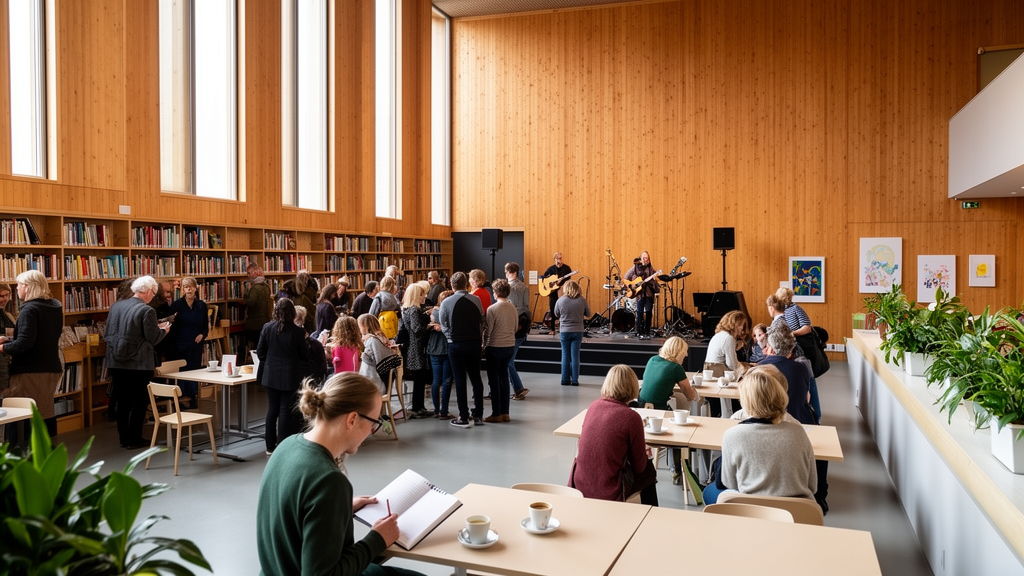
Cultural centers are everywhere in Europe—thousands of them, from converted warehouses in Berlin to purpose-built halls in Helsinki suburbs—yet science has struggled to say what one actually is. A new study from Åbo Akademi University in Vaasa, Finland, published in the European Journal of Cultural Management and Policy, takes on this definitional vacuum with unusual methodological rigor. Researcher Dorothee Schulte-Basta applied a structured concept analysis method borrowed from nursing science to distill the essence of the cultural center into four defining attributes, then tested those attributes against 259 real facilities across Finland. The results are striking: only about one in five facilities operating under the label cultural center actually embodies the full concept, while more than a third embody none of its defining characteristics at all.
The definitional problem is not merely academic. Because cultural centers lack a clear, shared definition, they slip through statistical categorization, funding allocations, and cultural policy frameworks. Museums, libraries, theaters, concert halls, and galleries are readily identifiable by their specific activities and functions. Cultural centers, by contrast, encompass a broad and varied range of activities that resists confinement to a single enduring definition. This ambiguity means cultural centers struggle to secure funding, and underserved communities risk losing access to vital cultural and social resources. The stakes are highest in rural and sparsely populated areas, where cultural centers often serve as key cultural infrastructure supporting social cohesion, cultural participation, and regional equity.
Schulte-Basta chose Finland as her case study for reasons both practical and theoretical. Finland is a Nordic welfare state with a strong municipal role in cultural provision, balancing state-led and community-based approaches to cultural infrastructure. Its institutional landscape is transparent, and the relatively limited number of institutions labeled as cultural centers provides a coherent setting for developing and testing a typology. Yet Finland also exemplifies the data problem: the national statistics agency’s dataset on cultural halls and centers by region 2023 is gathered informally, through a two-step verification of checking existing entries for online activity and searching for new establishments using the terms culture center and culture house alongside the names of all Finnish municipalities. The result, the study notes, resembles a long list more than a table of data, and it systematically overlooks institutions that do not include the word culture in their titles.
The methodological heart of the study is the Walker and Avant concept analysis method, originally developed for nursing science but designed for a fundamental scientific concern: the precise clarification and contextual embedding of theoretical concepts. Where cultural policy research typically adopts interpretive and historical approaches tracing the evolving meanings of culture, this study needed something measurable and operational. The method defines core attributes and empirical referents, allowing researchers to identify, measure, and apply a concept consistently. It is ideal when a concept requires standardization for practical use, such as in creating assessments or research measures. The study deliberately refrains from defining culture itself—often called one of the most complicated words in the English language, with 160 different definitions compiled as early as 1952—and focuses instead on the composite term cultural center, the actual object of policy, practice, and institutional labeling.
From the literature, the analysis distilled four defining attributes. The first is provider and creator: a cultural center is both a venue for and a producer of culture, offering cultural programming that includes at least some internally produced content, not merely renting space for external events. The second is experience and active participation: cultural centers offer learning experiences, cultural education, and activating formats such as workshops, open-stage events, and lectures, with openness for audiences to take part in shaping the program itself. The third is diversity and multidisciplinary: the program addresses a diverse audience, combines professional and amateur engagement, and spans more than two cultural disciplines. The fourth is interaction and community orientation: the facility provides physical space for meeting, upholds partnerships, involves the local community in program planning, and participates in local civic initiatives.
These attributes were operationalized through a detailed checklist of empirical referents and indicators, applied systematically to official websites and Facebook pages of facilities in the Statistics Finland dataset. After duplicate checks and filtering—removing halls, children and youth facilities, and student houses to reduce variability—the original 315 entries were reduced to 266, and seven more were dropped for lacking recent or accessible information, leaving 259 facilities analyzed over a week in March 2024. Only if both components of a defining attribute were traced—for example, provider AND creator—was the attribute considered confirmed. The analysis period proved its own point about the dynamic nature of the field: based on the study’s results, Statistics Finland added four facilities to its table in May 2024.
The empirical findings reveal a landscape far more heterogeneous than the label suggests. Just 50 entries, or 19.31 percent, fully embody all four attributes. Thirty-one entries fulfill three attributes, 37 fulfill two, and 45 fulfill only one. The largest group—95 entries, or 36.68 percent—fulfills none at all. Within this zero-attribute group, the study found 37 places to rent for public or private events with no cultural program, seven restaurants, three education centers, three concert halls, two leisure parks, a shopping mall with a library and rentable space, and a youth center. The term cultural center, the findings suggest, is sometimes applied loosely or even inflatedly, perhaps to confer prestige or attract attention. Patterns in attribute absence were also revealing: diversity and multidisciplinarity was the most commonly missing attribute, while provider and creator was the most consistently present, suggesting many facilities function as producers of cultural activity even when they lack participatory or community dimensions.
From these patterns, the study clusters facilities into a refined typology of seven types. Facilities embodying all four attributes are termed socio-cultural centers, a nod to the German tradition of socioculture with its 50-year history, while six centers that fulfill all attributes but focus on specific groups—children, youth, or Sámi culture—are specialized socio-cultural centers. Facilities missing only the diversity attribute, 29 of the 31 in that group, are focused cultural centers with narrower disciplinary or demographic scope. Two entries excelling in broad programming but lacking participation or community dimensions are cultural anchors. The zero-attribute group divides into venues, places to rent with no program; satellite venues, components of a larger cultural program managed by a central provider such as a city or theater; and creative production spaces, ateliers and showrooms showcasing artistic output without offering actual programming.
The typology is designed as a practical tool, not just a conceptual framework. Cultural practitioners can use it for self-assessment and strategic positioning, reflecting on which attributes they already fulfill and where development is possible. Researchers may employ the framework to structure comparative analyses across regions or countries. Policymakers can apply it to design differentiated funding strategies, distinguishing between facilities aligned with sociocultural objectives and those primarily serving as rental venues. In the Finnish context, systematic application would be particularly valuable for capturing the needs of the Swedish-speaking minority and the Sámi community, and for mapping cultural facilities in rural and sparsely populated areas where access to cultural services is limited but vital for social cohesion.
The research arrives at a politically charged moment: Finland’s cultural funding and the scope of statistical data collection face potential cuts that would leave Finland the only Nordic country without a systematic cultural data infrastructure. The study argues that rather than justifying reductions, the priority should be strengthening data collection and evaluation methods to support cultural centers as key pillars of civil society. Although focused on Finland, the developed typology may offer a useful framework for cross-country comparisons and could support policy alignment within the EU cultural sector, provided local adaptations are made. The author also points toward the concept of Third Places—accessible spaces beyond home and work that foster informal social interaction and democratic engagement—noting that sociocultural centers often exceed Third Place characteristics by enabling users to actively shape the space itself, both physically and socially. As community needs, policy landscapes, and cultural trends shift, cultural centers continuously adapt, and longitudinal studies tracking their development over time could further validate the typology and offer broader insights into cultural policy and community engagement across Europe.
Subject of Research: A structured concept analysis of Finnish cultural centers identifying four defining attributes and a seven-type typology.
Article Title: Definition and distinction of the concept cultural center using the example of Finland
Article References: Schulte-Basta, D. (2025). Definition and distinction of the concept cultural center using the example of Finland. European Journal of Cultural Management and Policy, 15, Article 14704. https://doi.org/10.3389/ejcmp.2025.14704
Image Credits: AI Generated
Keywords: cultural centers, Finland, concept analysis, cultural policy, typology, socioculture, Definition, distinction, concept, cultural, center, example
Cite Scienmag News
Courtney Benton. (October 17, 2026). What Makes a Cultural Center? Finland Study Cracks a Slippery Concept. Scienmag. https://scienmag.com/what-makes-a-cultural-center-finland-study-cracks-a-slippery-concept/
Courtney Benton. "What Makes a Cultural Center? Finland Study Cracks a Slippery Concept." Scienmag, 17 October 2026, https://scienmag.com/what-makes-a-cultural-center-finland-study-cracks-a-slippery-concept/. Accessed 17 October 2026.
Courtney Benton. "What Makes a Cultural Center? Finland Study Cracks a Slippery Concept." Scienmag. October 17, 2026. https://scienmag.com/what-makes-a-cultural-center-finland-study-cracks-a-slippery-concept/


